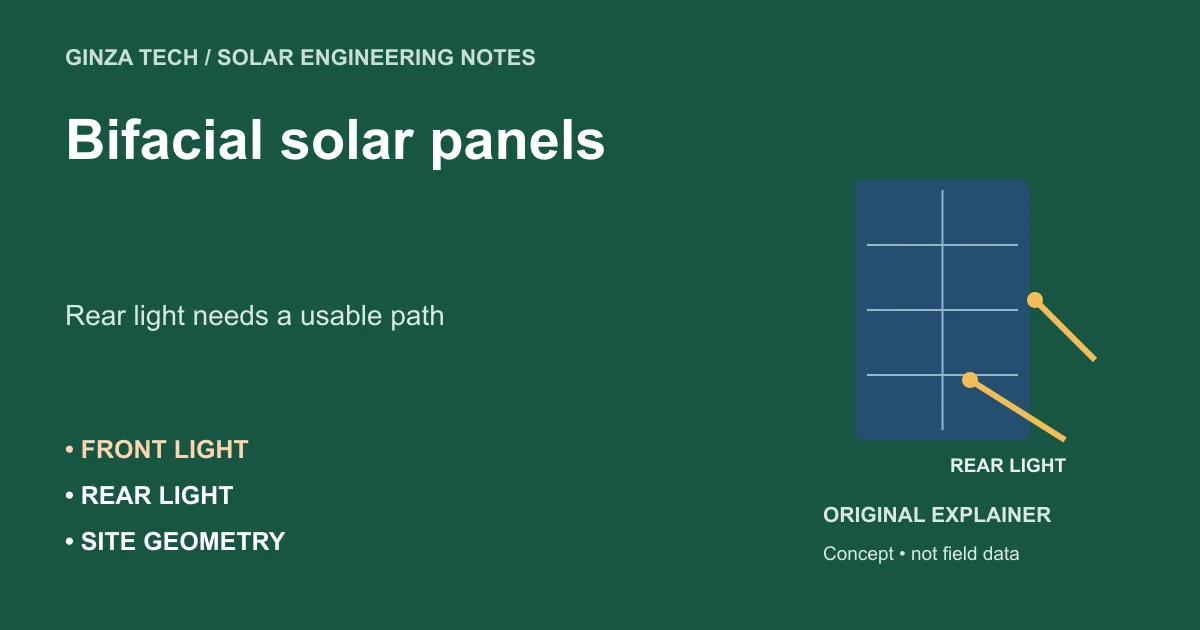
Bifacial solar panels generate electricity from light reaching the front and rear of the module. Their value depends on whether the installation gives the rear surface useful light. A bifacial label describes a capability; it does not establish a fixed percentage increase in annual production.
For a Philippine roof, a commercial canopy or a distributor quotation, begin with the mounting arrangement and the surface behind the panels. Then compare the proposed energy estimate with a clearly defined reference. This guide explains what to record before paying for an assumed rear-side benefit.
Quick answer: bifaciality and energy gain measure different things
Bifaciality describes the rear response relative to the front under defined measurement conditions. Bifacial energy gain compares energy from a particular bifacial installation with a defined reference over a stated period. A module with an 80 percent bifaciality factor does not automatically generate 80 percent more electricity on a roof.
The NREL System Advisor Model documentation treats bifaciality and rear irradiance as separate model inputs. It also considers array geometry and rear-side mismatch. That separation is useful when reading a sales proposal: ask which value describes the module and which value comes from a site model.
Why an 80 percent bifaciality factor is not an 80 percent site gain
A simplified instantaneous comparison weights rear irradiance by the module bifaciality factor: effective irradiance ≈ front irradiance + bifaciality × rear irradiance. With invented inputs of 1,000 W/m² at the front, 100 W/m² at the rear and a factor of 0.8, this gives 1,080 W/m² of equivalent irradiance, or 8 percent above the front-only reference.
That is not 1,080 W of electrical output from one module. It is a teaching comparison at fixed conditions before the other model effects. Geometry, nonuniformity, temperature and conversion constraints still matter, and annual gain requires a time-based comparison. The NLR PVWatts V8 documentation also identifies bifaciality as a separate module-response input. Keep the reference conditions visible whenever that percentage enters a proposal.
Check the rear light path before comparing wattage
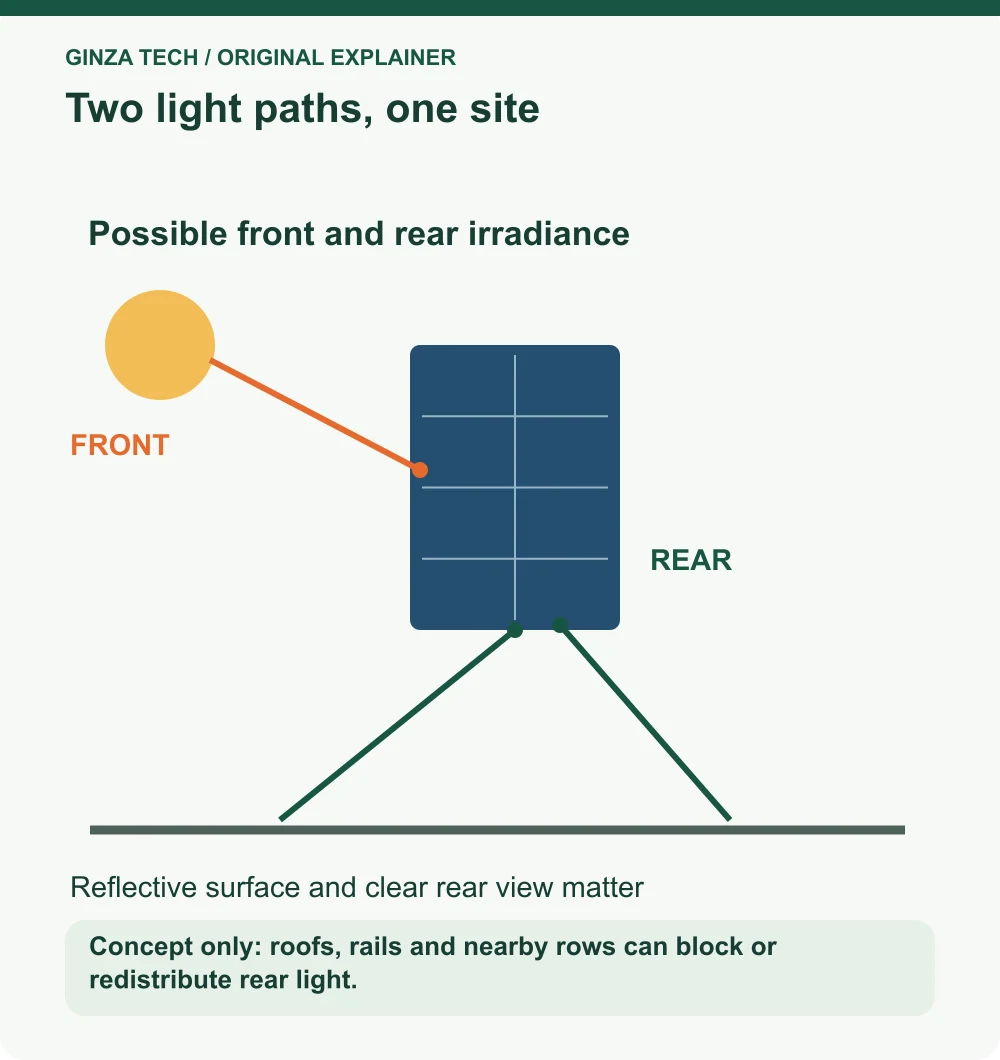
A close-mounted opaque roof can block much of the view behind a module. A raised structure may expose more of the ground or roof surface, but its actual contribution still depends on orientation, spacing, obstructions and reflectivity. Look at the complete rear field of view rather than one bright patch photographed at noon.
Albedo is the proportion of incident light a surface reflects. A surface described as white can become dirty or wet, and its condition can change during the project life. Record the material, condition and area that the modules actually see. Avoid applying a reflectivity number from a different site without explaining why it represents this one.
Mounting rails, junction boxes and nearby rows can make rear illumination uneven. The NREL rear-side mismatch study discusses this additional electrical effect. A design review should therefore consider both the amount and distribution of rear light. Raising an array is also a structural and wind-design decision for the responsible professional.
| Site feature | Evidence to request | Question it answers |
|---|---|---|
| Rear clearance | Section drawing and mounting dimensions | Can useful light reach the rear? |
| Surface behind panels | Material, condition and reflectivity assumption | What reflection enters the model? |
| Rows and rails | Layout with rear obstructions | Is illumination uneven? |
| Yield estimate | Reference system and annual simulation | What benefit is actually being compared? |
Use an annual comparison with the same reference
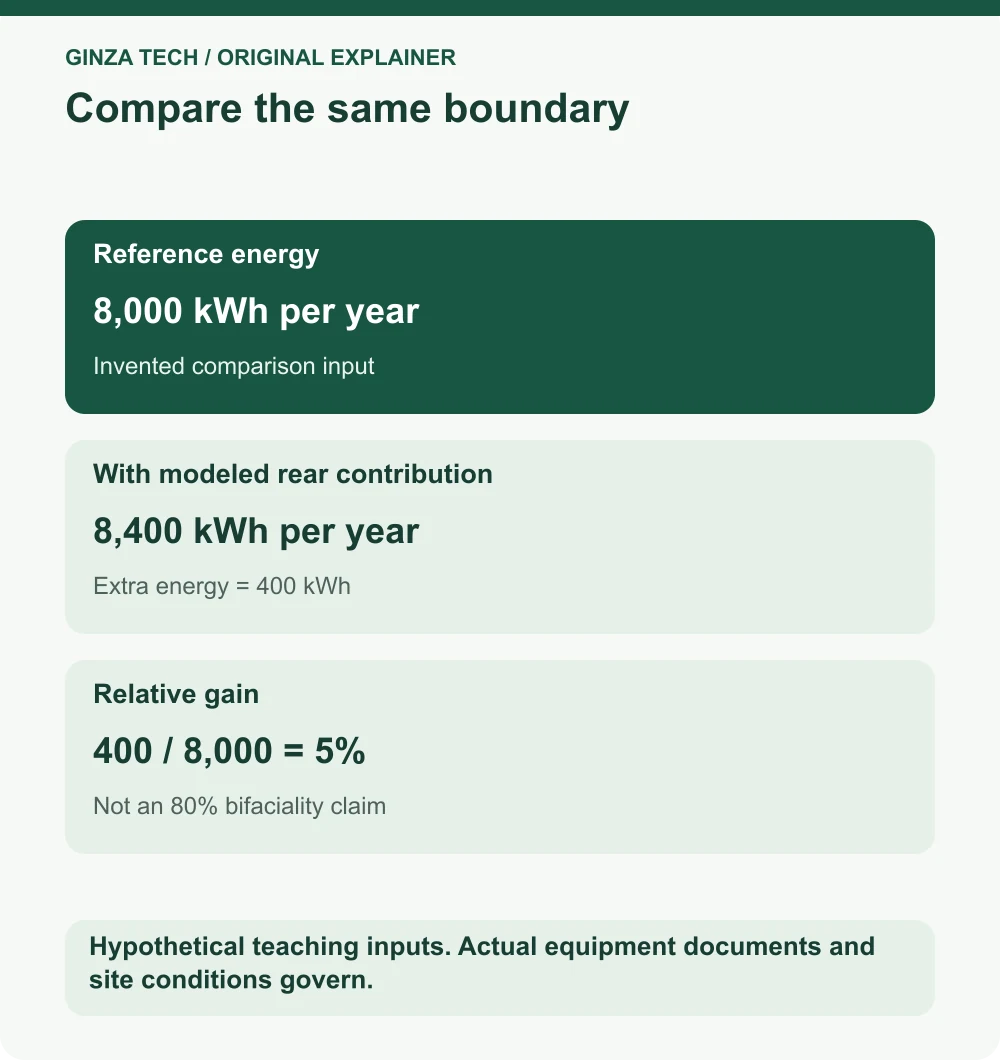
Suppose an illustrative reference system produces 8,000 kWh in a year and a comparable model predicts 8,400 kWh with rear contribution. The modeled gain is (8,400 − 8,000) ÷ 8,000 = 5 percent, or 400 kWh. These are invented comparison inputs, not a GINZA production forecast.
Check whether both cases have the same front-side rated capacity, roof area, location, weather file and loss assumptions. If one case also adds modules or changes the orientation, the entire difference cannot be attributed to bifacial operation. Ask the designer to identify each change separately.
A useful quotation shows at least a conservative and a proposed rear-light case. If the commercial decision changes when the assumed gain moves from 5 percent to 2 percent, the uncertainty deserves attention. Keep the assumed surface condition visible in both cases instead of concealing it inside one annual output number.
Translate extra energy into a project benefit
Extra generation has value when the site can use, store or export it under the applicable arrangement. Its financial value depends on timing and the marginal value of that energy. A commercial property with daytime demand can have a different result from a home whose solar production already exceeds midday use.
For example, assigning an invented value of 4 currency units per additional useful kWh gives 400 × 4 = 1,600 currency units per year before extra costs. If only 250 kWh has that use and the remainder has a different export value, calculate the two parts separately. The example supplies a comparison method, not a tariff or payback claim.
Where storage is proposed, connect the generation estimate to the PV recharge budget. Extra modeled production does not automatically become battery charging: daytime loads, charge limits and battery headroom still determine what can be stored.
Keep bifacial design separate from shade mitigation
Front-side shadows and rear-side obstruction are related layout issues, but they require distinct records. A nearby water tank may shade the front at a particular hour while rails obstruct the rear throughout the day. Neither problem is resolved by changing the marketing description of the module.
Use the shading and bypass-diode guide to record moving shadows and electrical grouping. Compare a revised layout before assuming optimizers or a bifacial module can recover missing sunlight. Keep the proposed hardware and its service requirements in the same comparison.
Build a procurement file that survives handover
Request the exact module datasheet, front-side rating, bifaciality definition, relevant rear-irradiance test conditions and installation instructions. Include the mounting drawing, model assumptions and the party responsible for maintaining the reflective surface. The installed serial numbers should match the order documents.
A distributor can keep one technical comparison sheet for each confirmed model rather than copying a rear-gain percentage across an entire product family. If a quotation changes glass, dimensions or electrical current, revisit mechanical and inverter compatibility. Similar front-side wattage does not establish interchangeable modules.

Check who will maintain the rear-light assumption
If the energy case depends on a clean reflective surface, name the party responsible for keeping it in that condition. Include access, drainage and the cost of the proposed care. A roof coating or a reflective ground treatment should be reviewed for its own material, building and maintenance implications before it enters a solar proposal.
Record later changes to the space under the array. Stored equipment, new pipes or vegetation can alter the rear view without changing the module count. Keep dated photographs from repeatable positions and compare the observed site with the model assumptions. A production change should lead to a review of weather, availability and electrical records as well as rear obstruction; a photograph alone cannot allocate the entire energy difference.
Sources and interpretation
The references explain bifacial modeling and rear-side mismatch. The annual energy and currency examples are invented comparisons, not measured GINZA output. Site geometry, exact module documents and a qualified structural and electrical design determine the real installation.
- NREL SAM detailed PV model: bifacial inputs
- NREL: bifacial rear-side mismatch research
- Trinasolar: bifaciality and system-level comparison
Frequently asked questions
Are bifacial panels always better on a rooftop?
The answer depends on the roof arrangement, usable rear light, purchase scope and modeled benefit. A low-clearance opaque roof may offer limited rear opportunity. Compare the complete installation rather than assuming a premium label guarantees extra useful energy.
Does a 600 W bifacial panel have two separate 600 W outputs?
No. Read the front rating and any specified bifacial test condition on the exact datasheet. Rear contribution changes the module’s combined electrical behavior; it is not a second independent nameplate output that can simply be added to every design.
What should I send GINZA for a comparison?
Send the country, roof or canopy drawing, approximate module area, inverter model, demand profile and quantity through the project enquiry. Review the GINZA solar module range against the current order datasheet and a site-specific design.