
A useful solar panel to battery ratio comes from an energy budget. Estimate how much solar the site can produce during the relevant season, subtract daytime loads and other commitments, then check whether the remaining energy can refill the intended battery window. A fixed number of panel watts for every battery kWh cannot capture those conditions.
This guide answers the recharging question after you have chosen the loads and useful storage target. It uses hypothetical solar yields and efficiencies to show the method. For the amount of storage the household needs, start with the home battery capacity worksheet, then use this page to check how it will be replenished.
Keep array power and battery energy in their own units
An array rated at 5 kWp has a nominal peak DC power rating under specified test conditions. A battery rated at 10 kWh describes nominal stored energy. Comparing the two labels gives a ratio, but it does not give daily generation or a recharge time. The array’s location, orientation, losses and weather affect its daily output.
Use an appropriate site model or measured production history. The National Laboratory of the Rockies’ PVWatts calculator estimates grid-connected PV production using system and location inputs and offers monthly or hourly results. Record the yield boundary. If the model already gives AC output after system losses, avoid applying the same losses again. The panel cleaning review helps investigate soiling alongside other changes in production.
Calculate the battery energy you need to replace
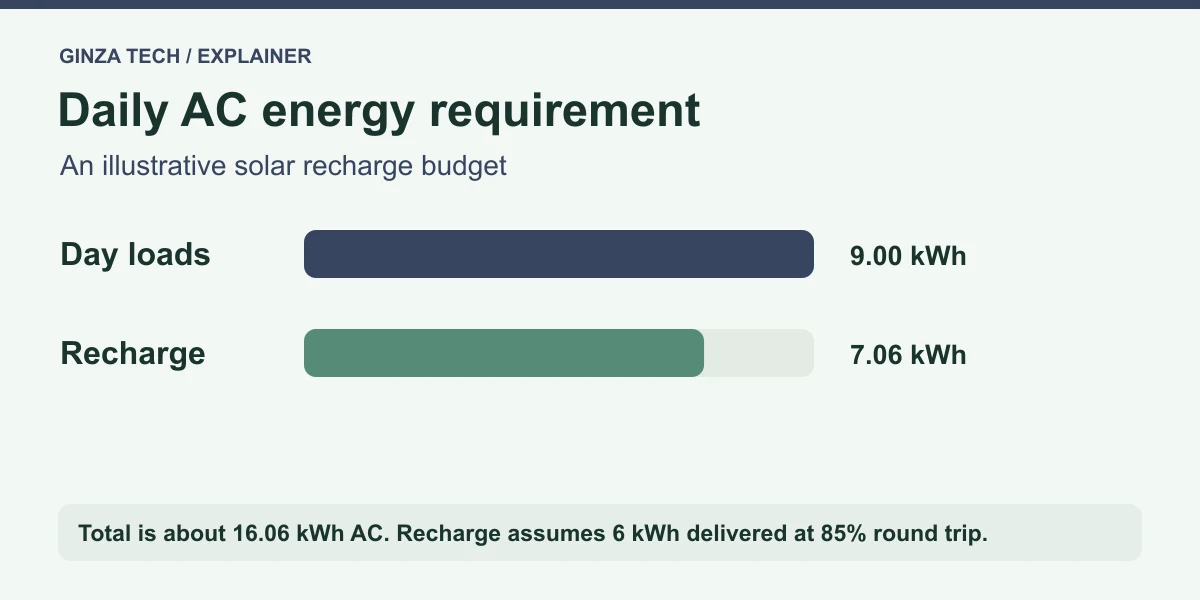
Suppose the planned evening loads use 6 kWh AC. For an illustrative complete AC-to-AC storage efficiency of 85 percent, replacing that delivered energy would need about 7.06 kWh of charging input at the same AC boundary. The result changes with the actual equipment, operating point and hold period. Use the round-trip efficiency guide to obtain a suitable input.
Alternatively, if you start from a battery-side energy change, apply the charging-path efficiency appropriate to that DC target. Keep the two methods distinct in the calculation sheet. Using an AC round-trip figure and then subtracting the same inverter losses again would overstate the required source energy.
Subtract daytime demand before allocating energy to storage
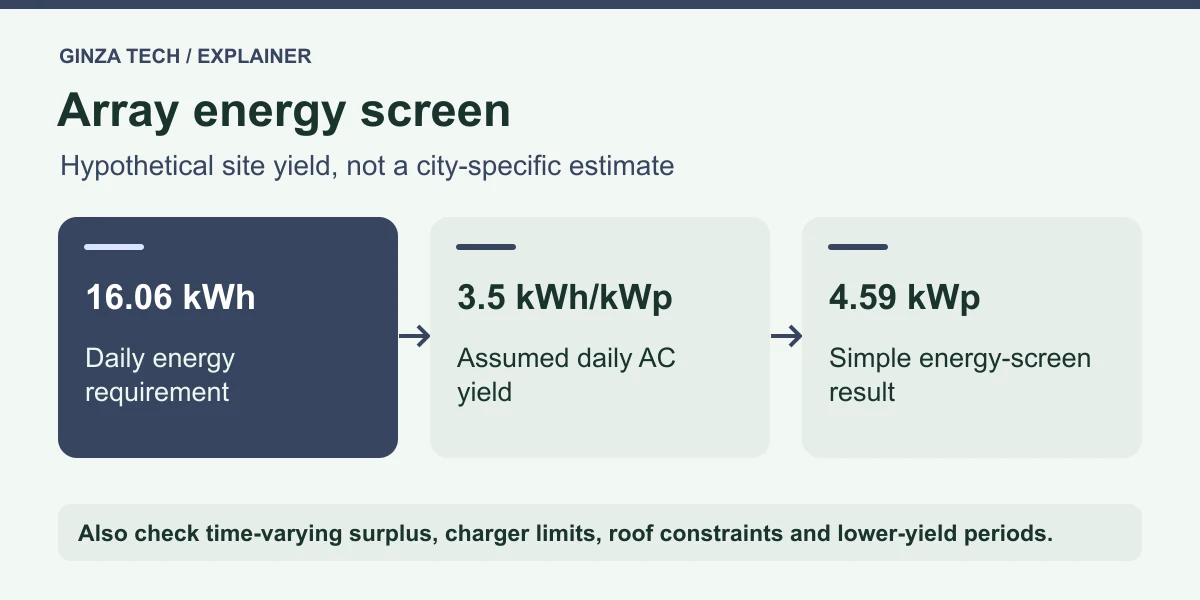
Assume daytime loads require 9 kWh AC and the storage recharge requirement is 7.06 kWh AC. Together they require about 16.06 kWh of usable PV output at that boundary. If a hypothetical site’s daily yield is 3.5 kWh AC per installed kWp, the simple energy screen suggests about 4.59 kWp. This is a worked calculation, not a yield estimate for a Philippine or Malaysian city.
| Budget line | Illustrative daily amount | Where it comes from |
|---|---|---|
| Daytime loads | 9.00 kWh AC | Measured demand during PV hours |
| Charging input | 7.06 kWh AC | 6 kWh delivered later at 85 percent round trip |
| Total PV requirement | 16.06 kWh AC | Daytime demand plus charging input |
| Array energy screen | About 4.59 kWp | Total divided by 3.5 kWh AC per kWp |
The screen also assumes the energy is available when the system can use it. A short midday surplus may exceed the permitted battery charge power, while morning or late-afternoon loads can consume most available PV. Ask for an interval review of the charging opportunity as well as the daily sum.
Translate the energy screen into a panel-count discussion
Array screen in kWp = (daytime AC demand + required AC charging input) ÷ site-specific daily AC yield per kWp. Keep all energy quantities at the stated AC boundary. The result is a screening input for the designer, not a PV-string specification.
For an illustrative panel-count calculation, the published GINZA 580 W module rating is 0.58 kWp per module. Rounding 4.59 ÷ 0.58 upward gives eight modules, or 4.64 kWp. The lower-yield 6.42 kWp screen would round to twelve modules, or 6.96 kWp; eleven modules provide only 6.38 kWp.
Neither count establishes an acceptable string layout. The designer must still check roof geometry, module voltage and current, temperature corrections, inverter MPPT limits and the approved electrical configuration. A larger count also does not guarantee enough surplus at the hours when charging is possible.
Repeat the screen for a lower-yield period
If the same site’s illustrative yield falls to 2.5 kWh AC per kWp per day, the 16.06 kWh budget would correspond to about 6.42 kWp before other design decisions. A larger array may be constrained by roof area, inverter inputs or the approved installation. The useful result is a visible energy shortfall and an operating plan to address it.
Compare monthly production and a low-generation scenario with the loads you must maintain. The DOE solar and storage overview describes how weather and other factors change solar output. Storage shifts available energy across time. It needs an approved recharge source when generation is insufficient.

Check charge power and the available hours
A 7.06 kWh input spread evenly over four hours averages about 1.77 kW. In reality, solar and household loads vary, so ask the installer to compare the time series against the charger’s permitted power. A battery may accept a lower current as it approaches the target, and controls may deliberately hold a backup reserve. The LiFePO4 charging-time guide covers this separate time-and-current constraint.
For a retrofit, check the original inverter and approved storage route before increasing the array. The AC and DC coupling guide explains why retained equipment matters. The PV string voltage, current, MPPT limits and system approvals need an engineering review for any proposed change.
Model the value of unused energy
If the battery is full and daytime loads are low, the remaining PV may be exported under the approved arrangement or curtailed by the system. Record which outcome applies. The Philippine zero-export guide addresses an own-use arrangement. For a Malaysian home, the Solar ATAP storage review discusses the export alternative.
Do not assume all annual generation can be used simply because annual consumption is larger. A useful quote shows the timing of generation, charging, direct demand and any constrained surplus. That supports both an energy plan and the incremental-cost calculation.
Check whether the surplus lasts long enough
Consider three illustrative two-hour periods. After daytime demand, the available surplus is 0.5 kW, 3 kW and 1 kW. That represents 9 kWh of potential charging energy. If the supported charger can accept only 2 kW during the middle period, the maximum accepted energy in this simplified example is 1 + 4 + 2, or 7 kWh. The daily surplus total alone would overstate what reaches storage.
The actual result also depends on the battery’s charge state during those periods and any taper or control limit. Ask for an interval model or a representative measured record. If the system reaches its upper target early, record what happens to later PV production. If it finishes the day below target, record whether source energy, charging power or the selected schedule caused the gap.
For a roof-space decision, compare the benefit of additional supported PV with a change in daytime demand. Moving a flexible task into a period that would otherwise be curtailed can change the budget without changing battery capacity. Have the provider evaluate the actual equipment limits and the household’s ability to follow that schedule before counting the change in the proposal.
For a new array, assess whether the mounting actually supports bifacial rear gain and use the module temperature-coefficient examples to distinguish a nameplate rating from a hot-cell planning input. Keep those generation assumptions separate from the energy required to refill the battery.
If the charging estimate depends on a separate controller, use the MPPT and PWM selection guide to check the battery-side power and controller limits.
Sources and example boundaries
The 3.5 and 2.5 kWh-per-kWp yields are invented daily inputs, not local climate predictions. The module count uses a published nameplate rating. A site model and interval review are required before choosing the final array.
Frequently asked questions
Does a 10 kWh battery need a 10 kW array?
Calculate the chosen recharge window, daytime loads and site yield. The battery’s nominal energy alone does not determine the required array power or the maximum supported PV configuration.
Can more panels solve a battery that is not charging?
First establish that source availability is the limiting issue. The charging diagnostic guide helps distinguish source, mode and battery limits before planning an upgrade.
What do I send for a recharge review?
Provide monthly or interval generation, daytime demand, evening energy, array and inverter details and the intended charge window through the project enquiry form.