Solar panel warranties usually separate product defects from a defined power-retention promise. Installation work, access, testing and logistics may be governed by additional terms. A long power-warranty headline does not by itself promise that the entire solar installation will deliver a fixed number of kWh or be serviced without cost.
For a module purchase, request the written terms for the exact model, destination market and order. This guide provides a document comparison and an invented retention calculation. Contract scope and applicable rights require the actual documents and, where needed, appropriate local advice.
Read product and performance cover as separate obligations
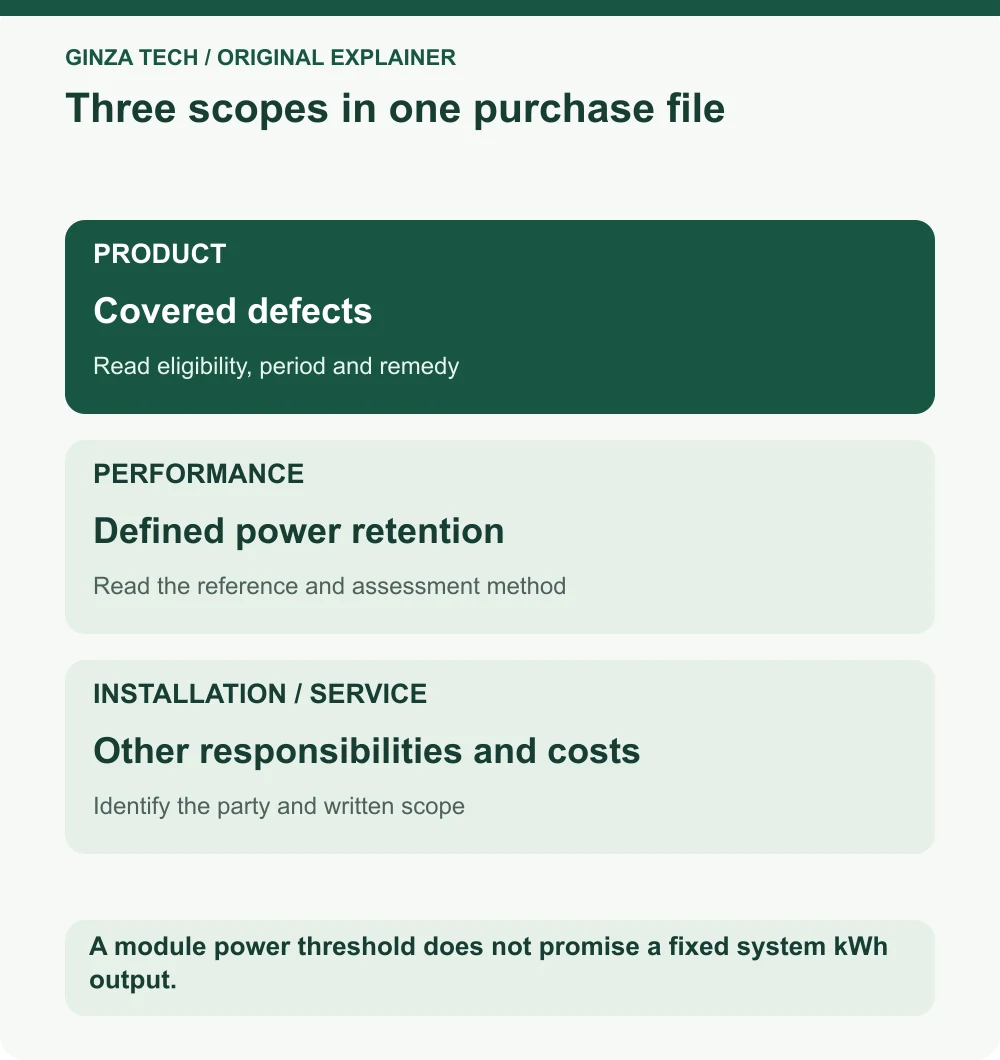
A product warranty addresses covered defects in materials or workmanship under its stated conditions. A performance warranty sets a retained module-power threshold under a defined assessment method. Their periods, eligibility, exclusions and remedies can differ.
REC’s warranty overview illustrates separately described product and performance cover. Canadian Solar’s customer-support resources point buyers toward its own product and warranty documentation. These references demonstrate how manufacturers organize their terms; they do not supply GINZA’s contractual warranty.
Also identify the installer or contractor’s obligations for workmanship, roof interfaces and system service. Those responsibilities may come from a different party and document. Keep the legal entity, contact route and applicable revision with each obligation in the purchase file.
Build a comparable warranty table
| Field | What to establish |
|---|---|
| Covered product | Exact model, power bin, serial records and market |
| Starting date | How each period begins under the terms |
| Power threshold | Reference rating, year convention and retention formula |
| Assessment | Required test conditions, evidence and acceptance method |
| Remedy | Available response and who chooses it under the terms |
| Costs and procedure | Testing, removal, freight, reinstallation and notification duties |
Leave an unclear field marked as unresolved rather than filling it with a competitor’s practice. Two warranties described as 25-year cover can have different starting dates, power curves and remedies. A side-by-side table is useful only when it reflects the actual documents offered.
Work a hypothetical linear retention example
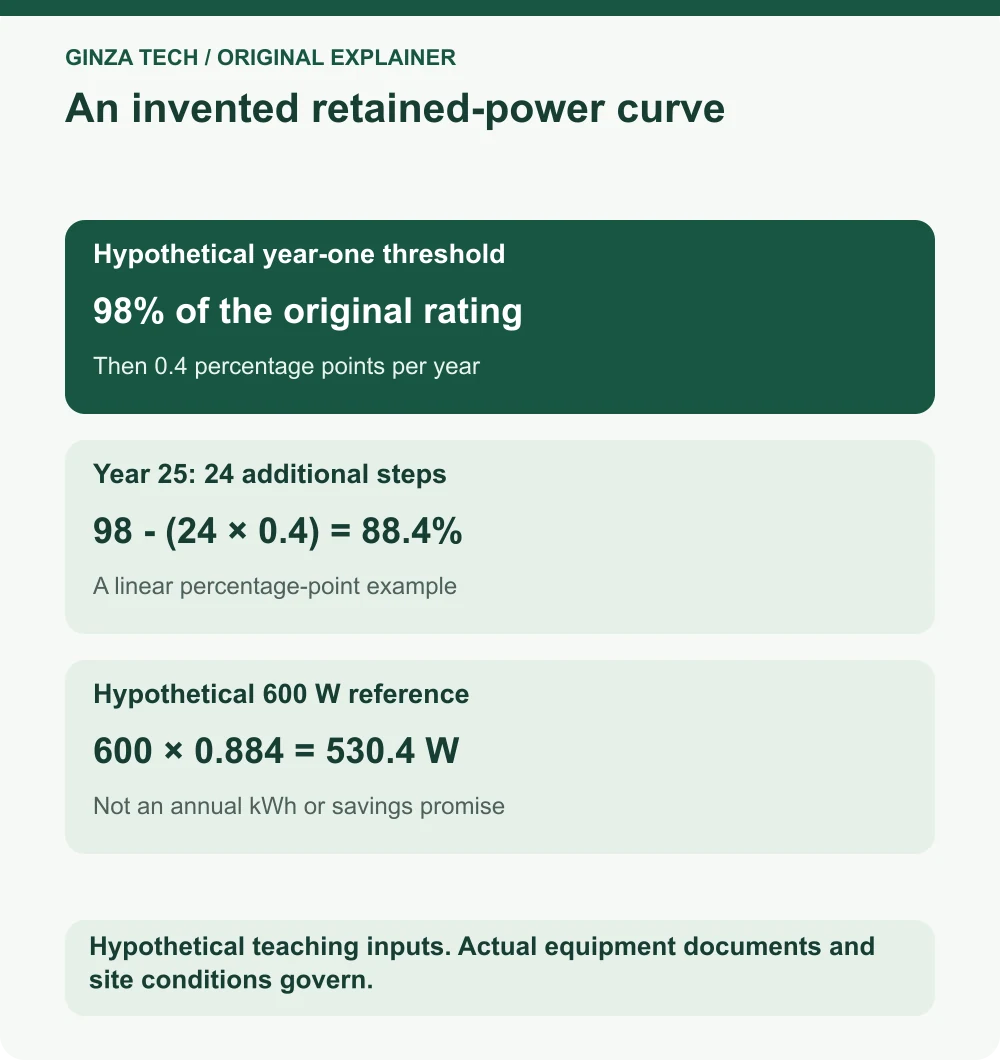
Imagine a 600 W module with an invented retained-power threshold of 98 percent at the end of year one, followed by a decline of 0.4 percentage points of the original rating for each additional year. At year 25, there are 24 such additional steps.
The threshold is 98 − (24 × 0.4) = 88.4 percent. Applied to the original 600 W rating, that is 530.4 W under the hypothetical assessment conditions. It is not an 88.4 percent daily yield promise or a guarantee that an inverter will show 530.4 W on a particular afternoon.
The exact formula matters. Subtracting percentage points of the original rating differs from multiplying the remaining value by a percentage each year. Count the years according to the actual terms and confirm how the first period is treated. The numbers here do not describe any named manufacturer’s warranty.
Separate retained module power from system production
A system’s annual kWh depends on sunlight, temperature, shading, availability, conversion, curtailment and other conditions. A low-production month therefore does not, by itself, establish that a module has fallen below a warranty threshold. The claim assessment may require a different measurement boundary and specified test method.
Begin with the provider’s diagnostic process and retain the relevant operating records. Use the shading guide and the clipping explanation to understand common production constraints. These observations support investigation; they should not replace the warranty’s agreed assessment.
Identify service costs before they become a dispute
Ask who arranges testing, safe access, removal, freight, storage, replacement installation and commissioning. Read which costs are included, excluded or conditional. A replacement module remedy may leave other project work to a separate service agreement.
REC’s installer-program page provides an example where additional warranty benefits depend on stated installer and registration conditions. Do not assume those terms apply to a different installer, country or brand. Obtain the named supplier’s written service scope.
For a commercial roof, access permissions, shutdown coordination and the availability of a compatible replacement can also affect practical resolution. Ask the responsible contractor how these steps are managed and keep that response with the order, without presenting an assumed resolution time as guaranteed.
Keep a traceable file from delivery onward
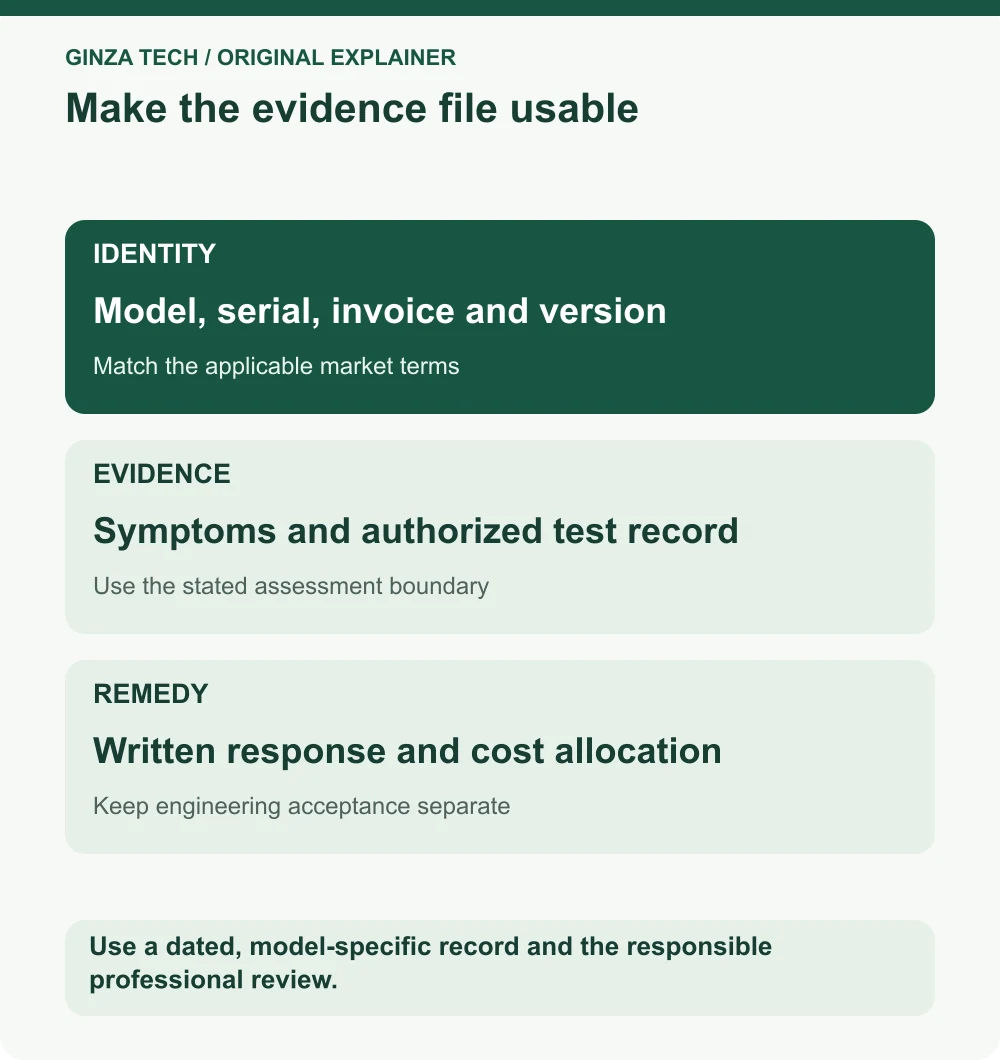
Retain the invoice, purchase specification, serial list, applicable warranty version, installation record and any required registration confirmation. Link modules to their array positions where the service arrangement requires it. Preserve accepted substitutions and the documents governing them.
If the site changes ownership or the installer changes, check how the actual terms address transfer and service contacts. Do not assume that a warranty automatically moves with every commercial arrangement. For a distributor, distinguish obligations owed by the manufacturer from the promises made in your own customer contract.
Raise a production concern with useful evidence
Describe the symptom, when it began, recent site changes and the affected equipment. Include the available production, alarm and weather context requested by the provider. Keep photographs safe and external; electrical inspection and module testing should follow the authorized professional procedure.
A consistent report helps the supplier decide what evidence is needed next. It also prevents an unrelated inverter limit, new shadow or communication gap from being presented as a module-power test. Keep the final findings and the accepted action with the original case.
Use warranty quality in the whole purchasing decision
A complete module comparison includes physical fit, electrical compatibility, energy assumptions, support and contract scope. The TOPCon-versus-PERC worksheet keeps those fields separate. A long warranty period cannot resolve missing engineering documents or an incompatible module substitution.
When considering the GINZA solar module range, request the current warranty statement for the exact offered model and destination. A product-family page or another manufacturer’s example should not be used to fill a missing contract term.
Review the engineering implications of a replacement
If a claim is resolved with another module model, have the responsible team confirm the accepted replacement arrangement. Dimensions, mounting, current, voltage and connector requirements can differ even when the proposed replacement has a similar power rating. Retain the supplier’s authorization and the revised installation record.
The warranty remedy and the engineering acceptance are connected records, but they answer different questions. A written offer of replacement does not itself demonstrate that the new equipment fits the existing string and mounting design.
If the suspected problem is a hidden cell fracture, the module microcrack inspection guide explains how to collect serial-level evidence before assessing coverage.
Sources and interpretation
Manufacturer pages illustrate how warranty scopes and conditional benefits can be presented. They do not establish a GINZA contract. The 600 W retention curve is invented and is separate from annual energy, savings and any assessment under actual market-specific terms.
- REC: product and performance warranty distinction
- Canadian Solar: customer support and warranty documentation
- REC: conditional installer-linked labour coverage example
Frequently asked questions
Does a power warranty guarantee my electricity savings?
Its scope follows the written retained-power terms. Energy yield and financial savings involve additional site, operating and tariff assumptions. Read any separate performance or service agreement on its own terms.
Is the longest warranty automatically the strongest offer?
Compare eligibility, evidence, remedies, costs, responsible parties and product fit alongside the period. A single year count cannot express the complete offer.
Which documents should I request from GINZA?
Send the exact module model, destination market, quantity and proposed installation through the GINZA enquiry form. Ask for the current datasheet, installation instructions and written warranty statement for that order.