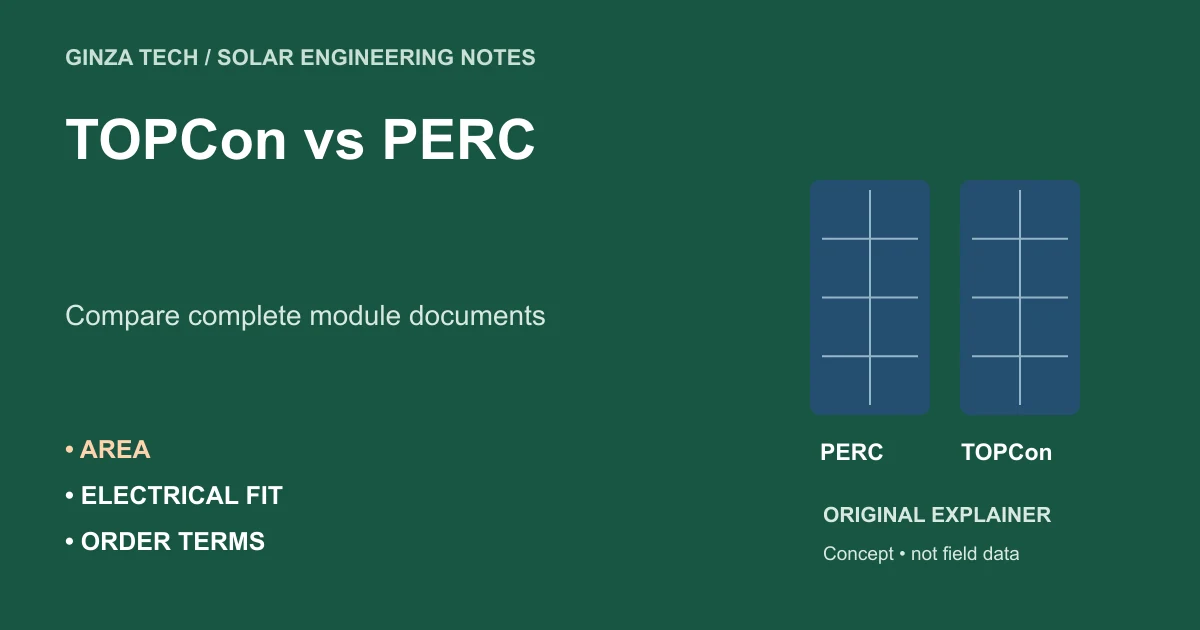
TOPCon and PERC describe solar-cell design approaches. They help identify how a module is made, but a buyer still needs the complete module datasheet to compare roof space, electrical compatibility, energy assumptions and warranty terms. A technology name alone cannot decide which quotation fits a project.
For installers and distributors, the practical task is to make two offers comparable. Use the same roof boundary and electrical requirements, then document what changes. This guide concentrates on that procurement decision rather than promising that one cell label produces a fixed gain on every site.
What TOPCon and PERC mean
PERC commonly expands to Passivated Emitter and Rear Cell. TOPCon means Tunnel Oxide Passivated Contact. Both concern the treatment of the cell and its contacts. Fraunhofer ISE’s passivated-contact research explains the relationship between surface passivation, contact losses and charge-carrier transport.
N-type and p-type describe the semiconductor base. TOPCon products are commonly offered on n-type wafers, while many established PERC modules use p-type wafers. These are useful categories, not a substitute for identifying the exact product. Bifacial construction, glass format and cell cutting are additional characteristics that should appear in their own fields.
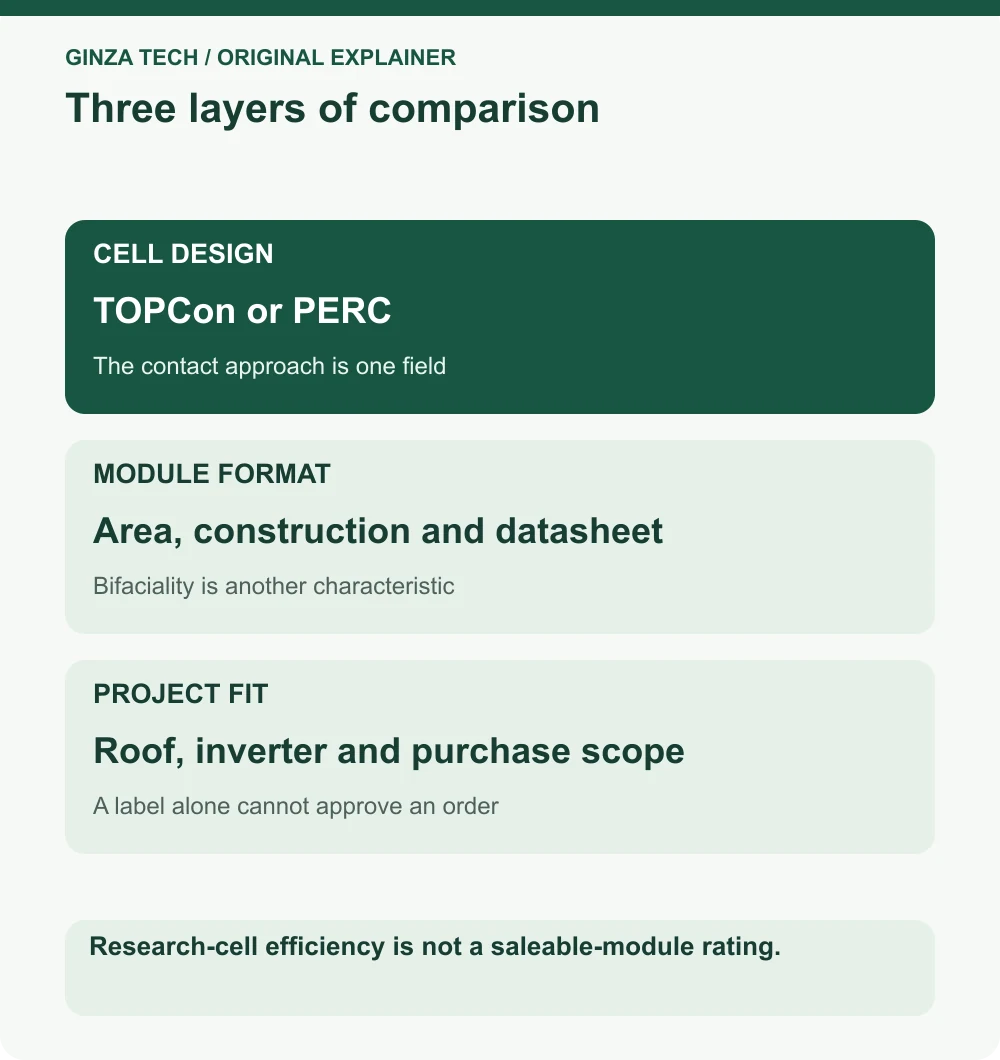
The Fraunhofer TOPCon project describes the selective-contact concept. Its research-cell efficiency results are not saleable-module ratings. Likewise, a manufacturer’s technology white paper explains its own platform; it does not establish the electrical or warranty values of a different supplier’s module.
Compare module efficiency on the same area basis
Module efficiency relates electrical output to incident light over the module area under specified test conditions. Higher nameplate wattage can come from a larger module, a higher efficiency or both. Measure usable roof space and obtain external module dimensions before concluding that a higher-wattage offer needs less space.
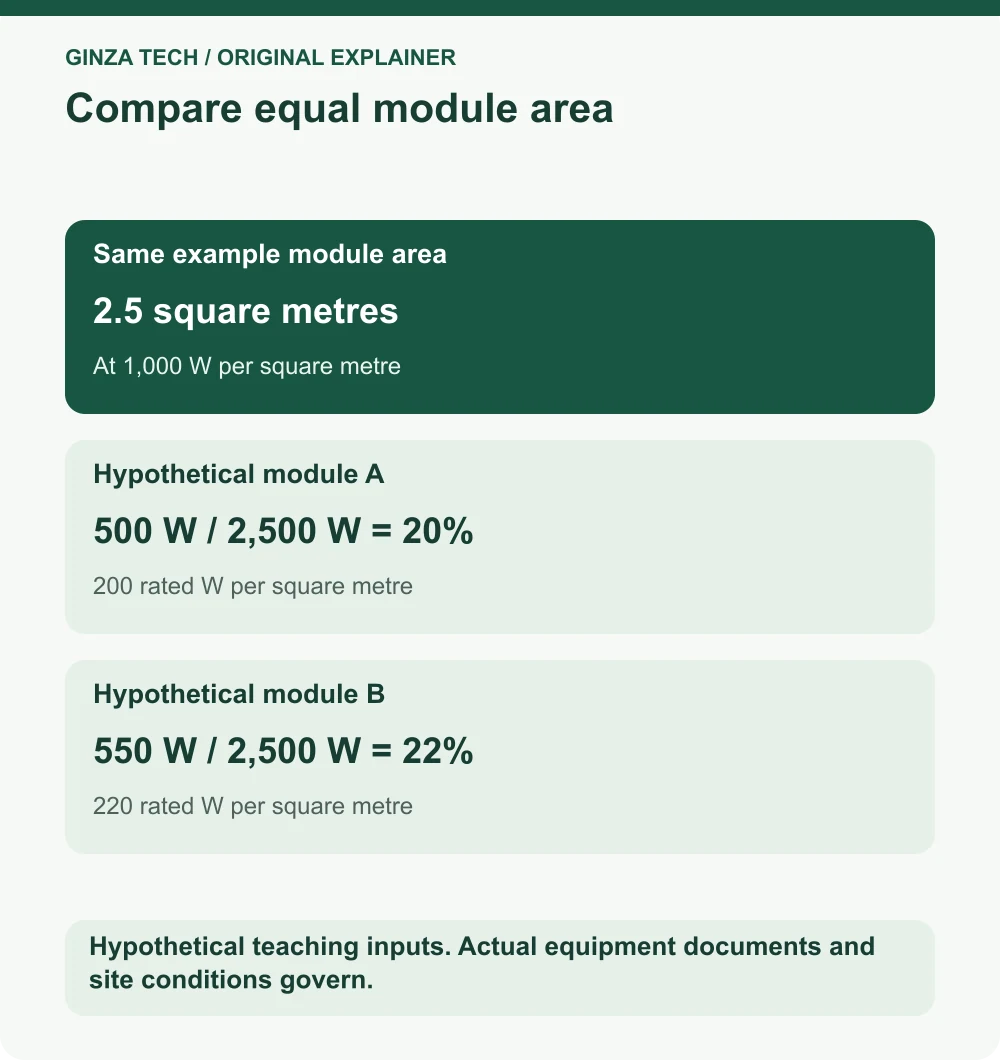
Consider two invented modules, each occupying 2.5 square metres. At standard irradiance of 1,000 W per square metre, a 500 W module has an illustrative efficiency of 500 ÷ 2,500 = 20 percent. A 550 W module of the same area gives 22 percent. The difference is 2 percentage points, or 10 percent more rated watts per unit area in this example.
Real layouts include setbacks, maintenance access, roof obstacles and permissible mounting positions. Ten extra rated watts on one module do not help if its dimensions remove an entire row. Ask for the module count on the actual drawing, not only a comparison of the highest advertised efficiency.
Use a complete quotation matrix
| Comparison field | What to record | Why it matters |
|---|---|---|
| Identity | Manufacturer, exact model, revision and power bin | Prevents mixing family-level claims |
| Physical layout | Dimensions, weight and mounting limits | Determines roof and structural fit |
| Electrical behavior | Voc, Vmp, Isc, Imp and thermal coefficients | Supports string and MPPT checks |
| Energy model | Weather, orientation, shading and rear assumptions | Compares useful annual output |
| Supply and warranty | Documents, delivery scope and claim responsibilities | Defines the actual purchase |
Put unresolved values in a visible question column. If one supplier supplies an exact current limit and another supplies only a brochure, the comparison is incomplete. Ask both for the missing documents before awarding a score. A spreadsheet filled with guessed values can look precise while giving the wrong purchasing signal.
Review temperature and rear response as separate inputs
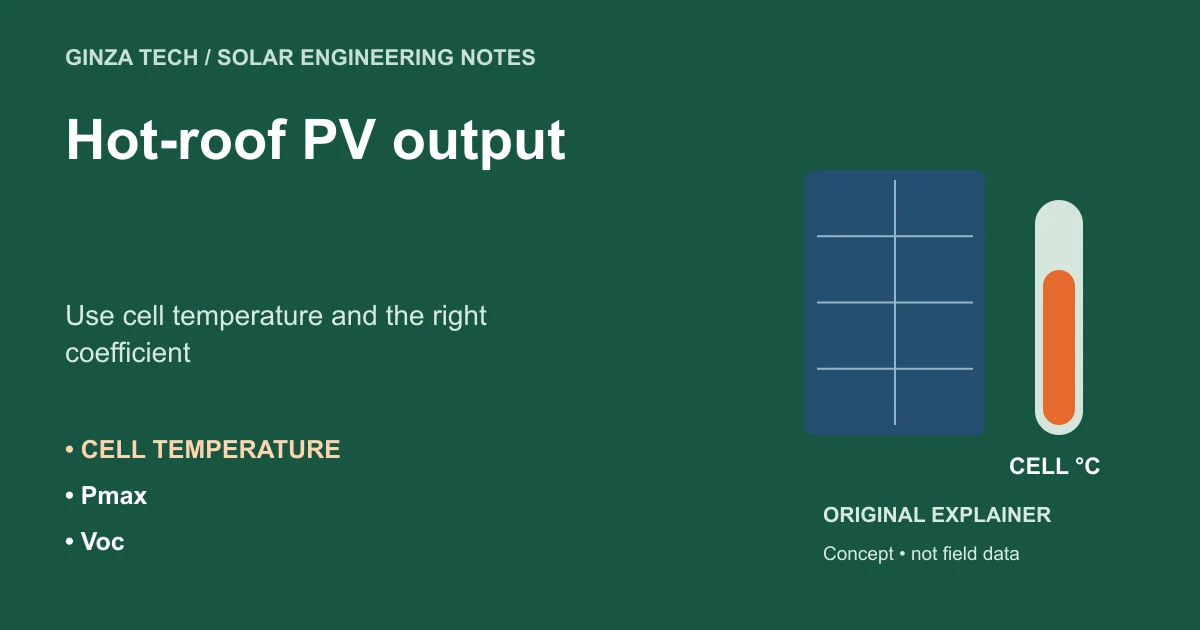
The temperature coefficient of maximum power describes a thermal sensitivity under the datasheet convention. Its effect depends on cell temperature and the rest of the operating conditions. Use the temperature-coefficient examples to compare hypothetical hot-cell cases without turning one instant into an annual yield forecast.
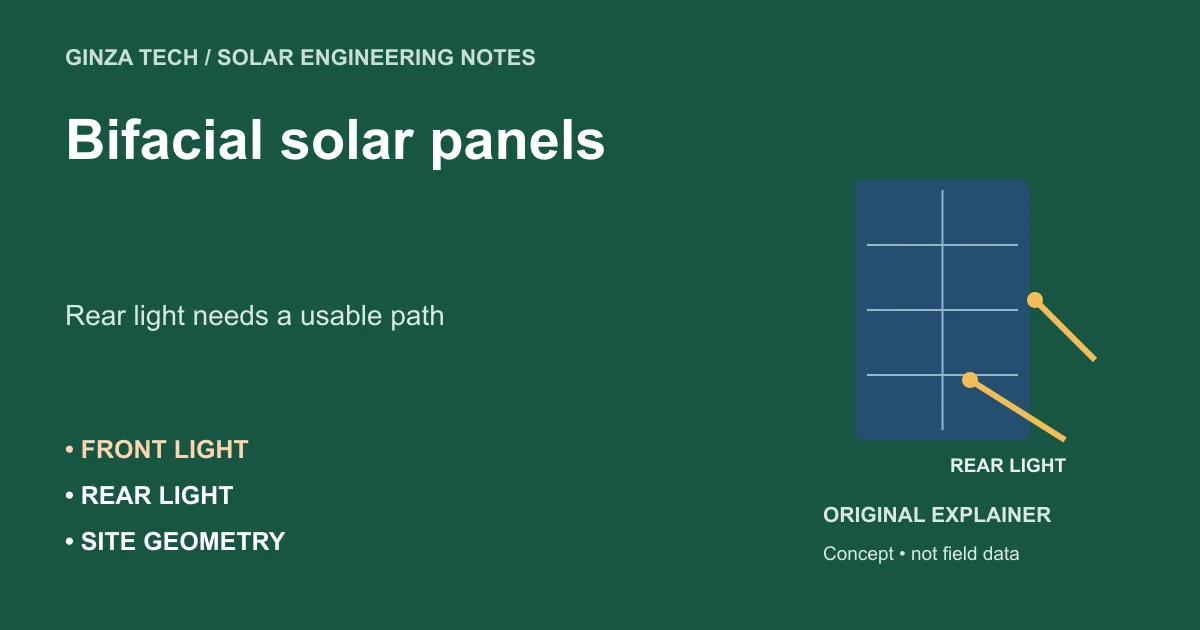
A bifacial module also needs usable rear light. Both the bifaciality factor and mounting geometry belong in that review. The rear-gain assessment explains why an opaque close-mounted roof differs from an open canopy. Do not count an assumed rear bonus twice in the annual model and the headline power comparison.
Check inverter and mounting compatibility before substituting a module
A module replacement can change operating current, open-circuit voltage, dimensions and approved clamp zones. The installer should revisit the string calculation and MPPT input limits using the exact replacement datasheet. The series and parallel planning guide shows why voltage and current are separate checks.
For a distributor, keep the approved substitution process with the order. A different cell technology may be acceptable, but acceptance should refer to electrical, mechanical and documentary requirements. Avoid promising that any module in the same wattage class can be mixed into an existing string.
Compare warranty language with the purchase scope
Request the written product and power-retention terms for the exact market and model. Include claim testing, freight, access and installation responsibilities in the commercial discussion. A longer headline period does not describe all the costs or evidence needed to resolve a claim.
The PV warranty comparison separates these obligations and provides a retention arithmetic example. Keep those terms alongside the quote revision. If the ordered model changes, reconfirm the applicable document rather than retaining the previous model’s warranty table.
Turn the comparison into an order decision
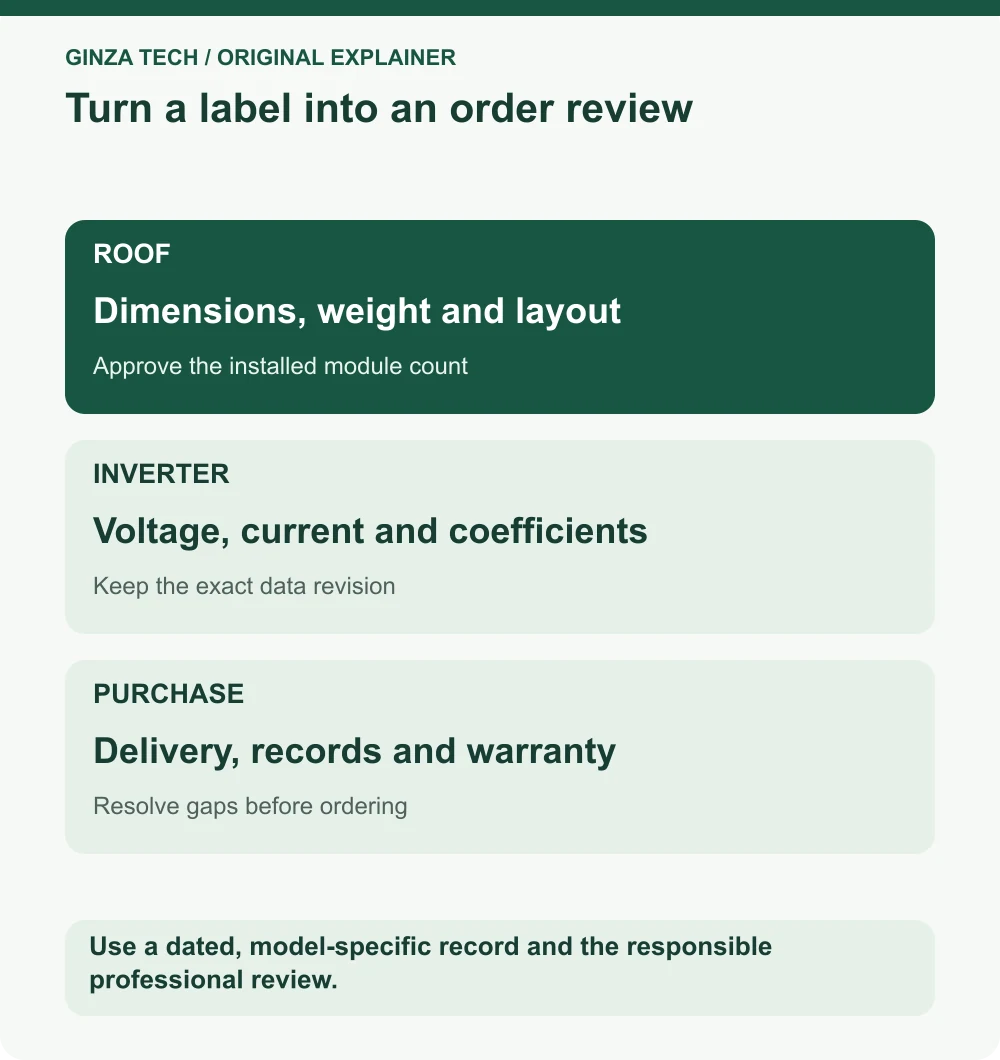
Start with requirements that must be satisfied: fit, allowable loading, inverter limits, required documents and the delivery arrangement. Only compare price and modeled output among offers that meet those requirements. This avoids a weighted score allowing a cheap but incompatible module to win.
Keep the selected model, accepted exceptions and responsible reviewer in a dated approval record. For repeat purchases, note the datasheet revision and check whether a later delivery changes connectors or dimensions. This small discipline makes a technology comparison useful to the installation team rather than leaving it as a sales presentation.
Reconcile the delivered modules with the accepted offer
Before installation, reconcile model labels, power bins and serial records with the approved purchase documents. Keep any accepted substitutions in writing. A pallet described broadly as n-type modules can still contain a configuration that differs from the mounting or inverter calculation used in the quotation.
For a repeat order, ask which changes trigger a new engineering review. A revised connector, frame dimension or operating current may matter even when the marketing name remains similar. Keep the delivery check separate from a performance claim: confirming the ordered identity does not prove an annual energy outcome. It establishes that the installation team is designing around the equipment actually supplied and gives future service staff a usable starting record.
Sources and interpretation
The research references explain cell-contact concepts; research-cell results are not module ratings. The equal-area example uses invented modules. Product performance, compatibility and warranty must be established from the current documents for the exact order.
- Fraunhofer ISE: TOPCon contact research
- Fraunhofer ISE: passivated contact and PERC context
- Astronergy: n-TOPCon cell structure white paper
Frequently asked questions
Is TOPCon the same thing as bifacial?
No. TOPCon describes a cell-contact approach, while bifacial describes response to light on both sides. Review both fields independently on the exact module document. A technology label does not supply a rear-gain percentage for your roof.
Should I compare price per panel or price per watt?
Both can inform procurement, but neither includes every system effect. Compare delivered scope, installed module count, compatible hardware and modeled useful energy. A lower module price can be outweighed by a layout or compatibility constraint.
Which specifications does GINZA need to review?
Use the solar module range to identify a family, then send the country, roof drawing, inverter, quantity and document requirements through the GINZA enquiry form. Confirm the current order datasheet before design approval.