A 100kWh-class commercial battery’s runtime depends on usable energy, the actual business load, PCS capability and auxiliary consumption. A preliminary energy calculation is available AC kWh divided by average load kW. It must then be checked against the power and operating limits of the complete installation.
For a GINZA 100.3kWh reference, an illustrative 85% energy window and 94% discharge conversion efficiency give about 80.14kWh AC before separate auxiliary use. That represents approximately four hours at a constant 20kW load under those assumptions. It is a planning calculation, not a product runtime test.
Read the exact cabinet specification
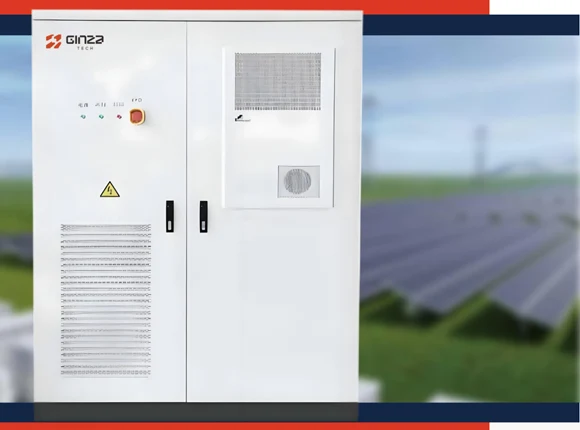
The published GINZA GIB-100KP reference lists 100.3kWh nominal energy and a 50kVA PCS platform. Those are different ratings. The supplied system documentation and engineering review must establish the applicable continuous output, power factor, environment and supported operating modes.
The 100.3kWh listing is a rounded published system rating. Do not substitute another supplier’s 102.4kWh figure or treat every “100kWh” cabinet as identical. Compare the exact battery, PCS, cooling, protection, control and installation scope.
| Rating or condition | Why it matters |
|---|---|
| Nominal battery kWh | Starting energy label, before the available operating window. |
| Available energy window | Reserve and approved discharge limits reduce energy available now. |
| PCS kVA and operating limits | Constrain the supported load and reactive-power requirement. |
| Conversion and auxiliary use | Reduce energy delivered to the intended loads. |
| Backup architecture | Determines whether and how designated circuits can operate during an outage. |
Calculate an illustrative usable-energy budget
Using 100.3kWh nominal, an assumed 85% window leaves 85.255kWh DC. Multiplying by an illustrative 94% conversion efficiency gives 80.1397kWh AC. These percentages are modelling assumptions for this example, not published GIB-100KP efficiency or discharge-setting recommendations.
With no recharging and before separate auxiliary consumption, the constant-load runtime is:
| Average selected load | Calculated hours from 80.14kWh |
|---|---|
| 10kW | 8.01 hours |
| 20kW | 4.01 hours |
| 35kW | 2.29 hours |
| 50kW | 1.60 hours, energy calculation only |
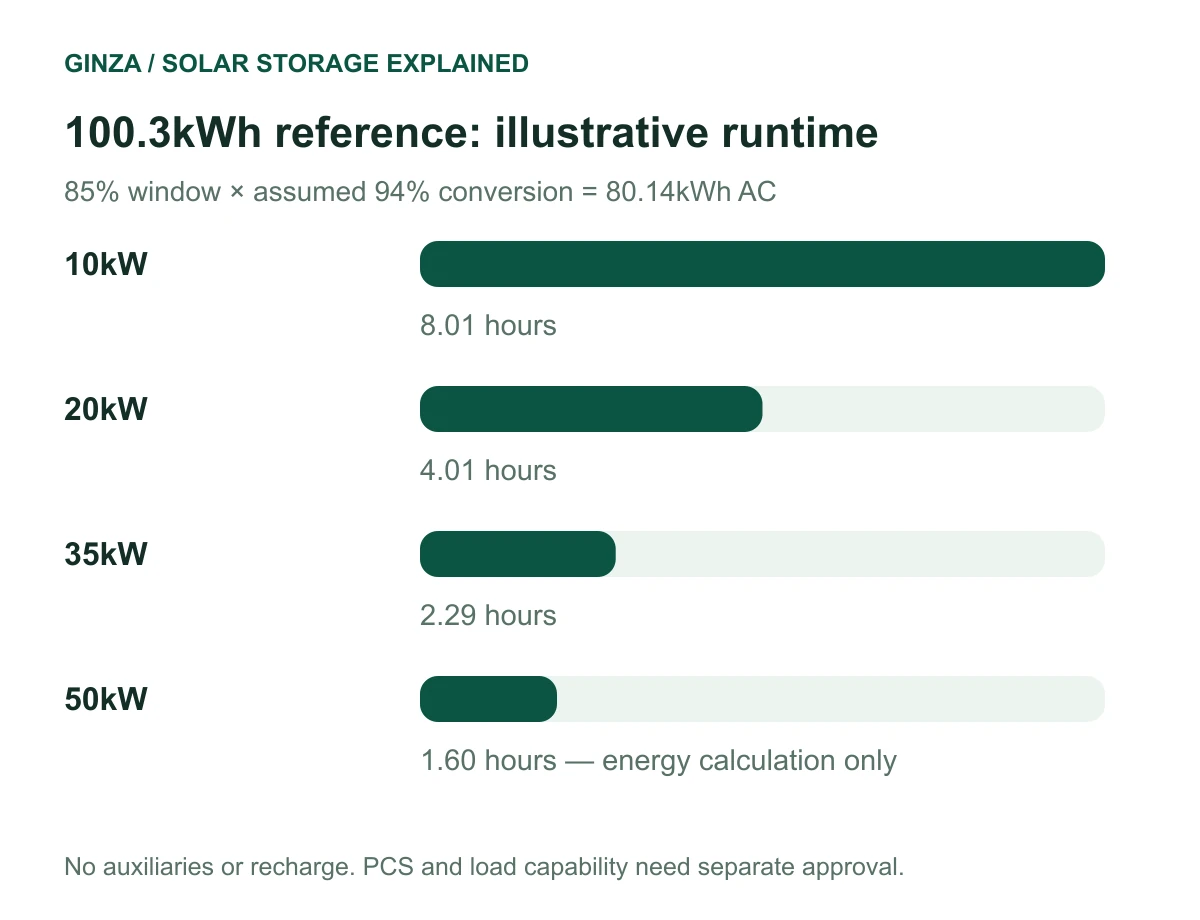
The 50kW row does not approve that load on the referenced PCS. Apparent power, power factor, thermal limits and the supported operating mode must also pass review. The table is an energy comparison, not a load-acceptance schedule.
Why 50kVA is not always 50kW of usable output
Apparent power is measured in kVA; active power is measured in kW. In a simplified calculation, active power equals apparent power multiplied by power factor. At 50kVA and a power factor of 0.8, the corresponding active power is 40kW, subject to the actual equipment’s capability.
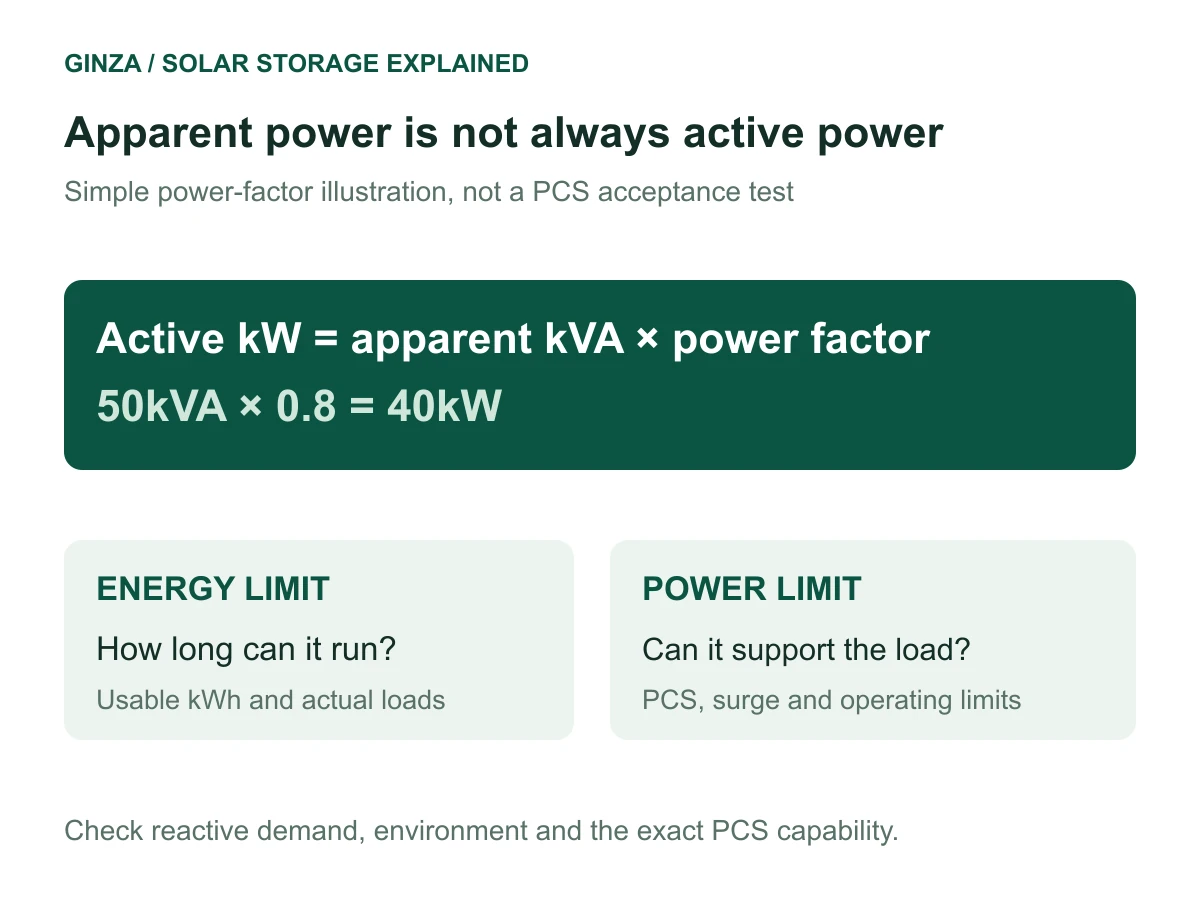
That relationship alone is not a complete PCS design. Motor starts, unbalanced loads, reactive-power requirements, harmonics and ambient conditions can matter. Ask the engineering team to assess the load data and approved operating envelope rather than selecting output power from one label.
The same distinction applies when comparing cabinets. A larger battery energy rating does not necessarily increase PCS output. Two products with similar kWh can support different instantaneous loads and operating functions.
Include cooling, controls and other auxiliary demand
A commercial installation can consume energy in cooling, controls and associated equipment. Establish where those loads are measured and whether the quoted usable-energy or efficiency figure already includes them. Do not subtract the same allowance twice. The efficiency measurement guide explains how separately fed auxiliaries change the comparison boundary.
For a simple example, treat 1kW as an assumed constant AC-equivalent auxiliary demand in addition to a 20kW business load. Runtime becomes 80.1397 ÷ 21, or about 3.82 hours. The 1kW is not a GINZA auxiliary specification; obtain the actual duty-dependent figures for a project model.
Auxiliary use can become especially important when the business load is small and backup duration is long. Review the full installation rather than relying solely on battery-cell energy.
Use a critical-load schedule
Define which activities must continue: controls, communications, refrigeration, selected lighting or specific production equipment. Separate their energy requirement from the building’s maximum connected load. For buildings with a three-phase supply, the three-phase backup load guide shows how to check the most heavily loaded phase and the motor restart separately.
| Illustrative business function | Information needed |
|---|---|
| Office and IT | Actual steady load, transfer needs and separate UPS arrangements. |
| Refrigeration | Operating cycle, peak demand and motor-start behaviour. |
| Warehouse | Lighting, communications, doors and any equipment that must remain available. |
| Production | Permitted process interruption, safe shutdown and restart sequence. |
A cabinet should not automatically be described as a whole-building backup system or uninterrupted supply. Confirm isolation, transfer behaviour, protected circuits and the operation of other energy sources. These are engineering acceptance requirements, not consequences of having 100kWh on site.
Check the charge available at the start
A bank used for daily peak shaving may not be full when an outage begins. With a starting SOC of 60% and a protected lower reserve of 15%, the available window is 45 percentage points. Applying the same assumed 94% conversion to the 100.3kWh reference gives about 42.43kWh AC before auxiliary use.
At 20kW, that is around 2.12 hours before auxiliaries rather than the earlier four-hour full-window estimate. Agree on how the controller prioritises financial dispatch and backup readiness. The peak-shaving and load-shifting guide explains competing objectives.
Review the recharge window and charging source
If 85.255kWh DC must be replaced and net charging power actually reaching the battery were a steady 30kW, the arithmetic time would be about 2.84 hours. That is not a guarantee for a 30kWp PV array or a charging period that includes derating and other limits.
Model daytime loads, available PV, permitted grid charging and the next operating period. Consider what changes after a long event or during poor weather. A system needs a repeatable operating plan, not merely enough energy for one ideal discharge.
The regional project-planning review places commercial cabinets alongside household and grid-scale applications. This guide addresses one capacity class and its load limits; it does not substitute for a regional market forecast or programme eligibility review.
Agree on continuity and restart requirements
Four hours of calculated energy does not establish that a production process can tolerate the system’s transfer behaviour. Identify loads that require a separate UPS, processes that must shut down safely and equipment that cannot restart simultaneously. Ask the engineering team to record the sequence and operating limits in the acceptance plan.
For the final test, retain the selected load, starting SOC, relevant temperatures, operating mode, auxiliary-load treatment and observed energy or duration. A light-load demonstration does not prove the full business-duty claim. Keep unresolved items visible and retest after approved corrective work before accepting the promised operating outcome.
What to provide for a commercial quotation
- Country, utility account class, connection and site information.
- Interval load data, operating calendar and critical-load requirements.
- Tariff and intended objectives: backup, peak reduction or energy shifting.
- Existing PV, generators, UPS and control systems.
- Space, access, environmental and engineering constraints.
- Required commissioning, monitoring and service responsibilities.
Check apparent output as well as active power for the selected PCS. The kVA-versus-kW commercial backup guide shows why an acceptable kW total can still exceed an apparent-power limit, and keeps motor starting separate from runtime.
Sources and interpretation
The linked GINZA listing supplies the published 100.3 kWh and 50 kVA reference ratings. The 85 percent window, 94 percent conversion and auxiliary draw are illustrative assumptions, not measured cabinet specifications. Energy duration and PCS load acceptance require separate evidence for the actual configuration.
Frequently asked questions
Can a 100kWh battery power a business for a full day?
It depends on the selected energy and power requirements. A low average critical load and a whole production facility are very different duties. Use actual kWh and peak data.
Can I connect a commercial cabinet like a home battery?
No generic procedure applies. Commercial high-voltage ESS requires the appropriate engineering, equipment integration, protection and qualified installation.
Can solar extend the example runtimes?
Potentially, when generation is available and the approved operating mode supports it. The tables exclude recharging so their energy basis remains clear.
Compare the 61.44kWh, 100.3kWh and 215kWh-class options, then request a project engineering review. Current datasheets and the supplied configuration govern the final selection.