
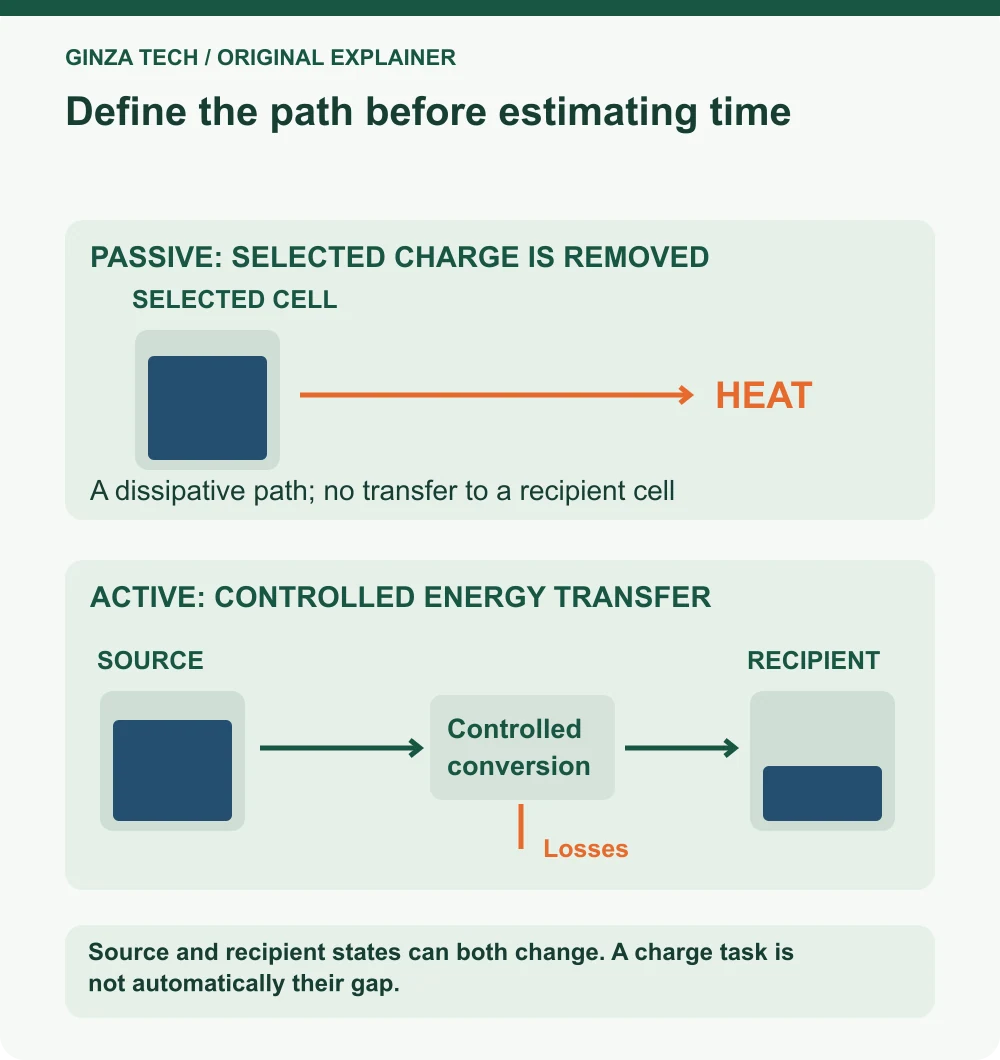
Passive battery balancing generally reduces excess charge in selected cells by dissipating energy, while active balancing transfers charge between cells or other parts of the pack through a controlled circuit. Both approaches belong within the battery’s management design. Their usefulness depends on the implementation, conditions and mismatch being addressed.
For a LiFePO4 buyer, the important questions concern what the BMS actually does, when it is enabled and what evidence the supplier can provide. A large advertised balancing-current number alone does not establish better usable energy, a shorter service visit or longer life.
Start with the cell mismatch being managed
A series-connected pack must keep every cell within its permitted operating limits. Differences in charge state, capacity, resistance or self-discharge can affect which cell reaches a limit first. Equalizing charge state can help a suitable pack use its available capacity more consistently; it does not turn a degraded cell into a new one.
Analog Devices’ passive-balancing article describes the dissipation approach. Its active-balancing article describes charge redistribution. The engineering tradeoff includes circuit complexity, energy transfer, thermal behavior and control strategy.
These technical references explain methods, not the measured behavior of a GINZA battery. For a particular unit, request the current BMS specification and the conditions under which the listed capability is available.
Compare the enabled behavior, not only the method name
| Question | Evidence to request |
|---|---|
| Which method and topology? | Model-specific BMS description |
| When does it operate? | Allowed charge states, voltage conditions and operating modes |
| What current is available? | Defined rating, conditions and any duty limitation |
| What can the user observe? | Documented cell data, status and timestamps |
| What happens on a persistent mismatch? | Approved investigation and service procedure |
Texas Instruments’ BQ769x2 balancing application note illustrates a specific passive-balancing implementation, including interruptions for measurement and the control conditions that determine availability. For procurement, ask the battery supplier to connect the description to the actual product instead of listing an integrated-circuit capability as if it were the complete pack rating.
Clarify whether a current is a maximum, a typical value or available only under selected conditions. If a circuit shares a transfer path between cells, the number of simultaneously serviced cells can also matter. The supplier’s defined test and operating conditions are more useful than a number without a boundary.
Estimate ideal balancing time with explicit limitations
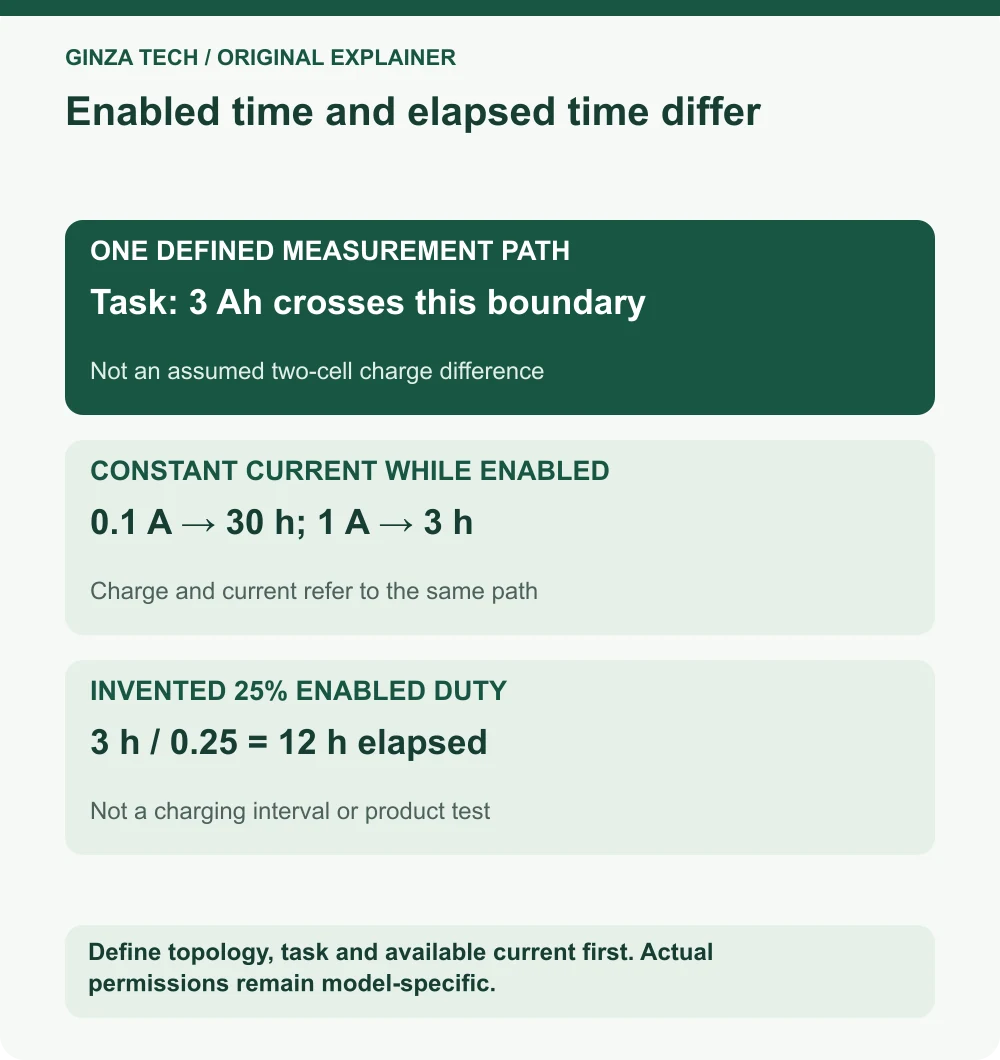
First define the charge task and the measurement path. Ideal enabled time = specified charge moved or removed ÷ average current while enabled, with both quantities measured at the same boundary. For an invented 3 Ah task on one defined path, a constant 0.1 A gives 30 enabled hours; a constant 1 A gives three enabled hours.
The 3 Ah task is not automatically a 3 Ah difference between two cells. In active transfer, the source and destination states can both change, and the topology, voltage relationship and losses determine how a measured flow changes their mismatch. Establish the task from the actual circuit and state assessment before applying the arithmetic.
Enabled time and wall-clock time also differ. If the assumed 1 A path is available for only one quarter of the elapsed period, the ideal three enabled hours would span 3 ÷ 0.25 = 12 hours. This is another invented duty example. Current variation, thermal limits and operating permissions can change the available task and current; it is not a charging schedule.
The example is not an instruction to hold a battery at an elevated charge state for 30 hours or change its voltage settings. Follow the model’s approved charging and balancing behavior. Do not open the battery, attach aftermarket cell leads or bypass protective controls to reproduce the arithmetic.
Separate cell balancing from state-of-charge calibration
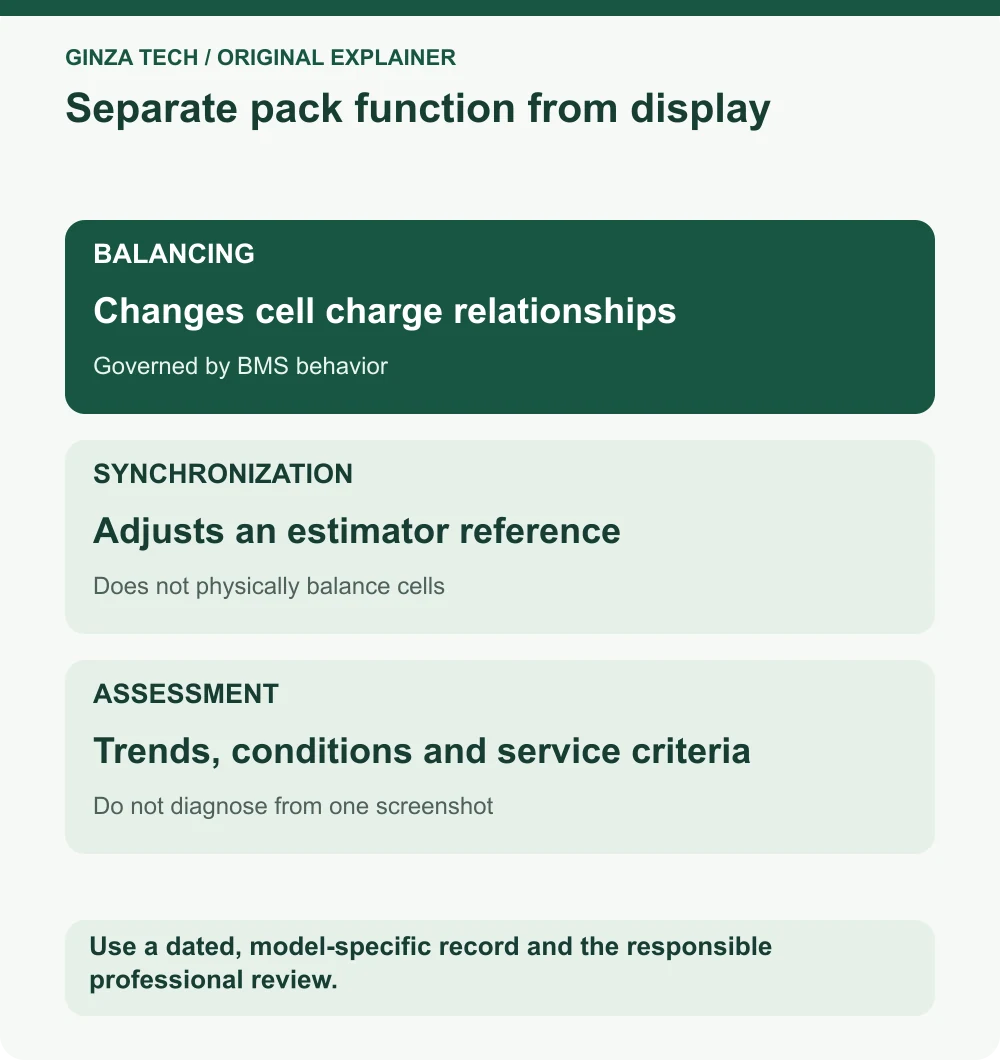
Cell balancing concerns the charge relationship among cells. State-of-charge synchronization concerns an estimator’s reference. A manual change to a displayed percentage does not move charge between cells, and a balanced pack does not prove that every connected monitor reports an accurate percentage.
The SmartShunt settings reference shows synchronization as a monitor function. Its procedure and thresholds are specific to that product and setup. They should not be copied into another BMS or treated as a universal LiFePO4 calibration sequence.
Use the monitoring and log guide to identify whether the displayed information comes from a BMS, inverter or separate monitor. Keep the data source and timestamp with a reported mismatch. A stale dashboard value should not become evidence of a failing cell.
Interpret voltage spread in its operating context
A cell-voltage difference needs the associated current, temperature, charge state, time and recent operating history. Comparing one loaded reading with another resting reading can produce a misleading conclusion. The acceptable range and assessment method come from the supplier’s service procedure.
Ask for a trend over the relevant operating window rather than a single cropped screenshot. Persistent early limits, recurring alarms or an increasing mismatch should be reviewed by the qualified provider. Balancing is not a general cure for damaged cells, poor connections, incorrect configuration or incompatible equipment.
The SoC and reserve guide explains how reported percentages relate to an operating window. It complements cell-level assessment without assigning a universal healthy voltage-spread threshold.
Use a repeatable supplier comparison
For two battery offers, record the BMS method, stated current, enabled conditions, data visibility, protective behavior and service process. Ask how the manufacturer verifies the claimed capability and what evidence applies to the exact model and hardware revision.
A demonstration should identify its initial conditions, measurement boundary and completion criterion. Keep any resulting claim narrow enough to match the test. Showing charge transfer in a laboratory does not establish that every field unit will gain a particular runtime or recover an arbitrary imbalance in a fixed period.
Keep balancing within the complete battery decision
Compare the battery’s usable energy, output limits, inverter protocol, environmental requirements and support alongside its balancing description. A headline balancing feature cannot compensate for an incompatible voltage range or undocumented installation requirement.
GINZA’s Gen5 product page lists active balancing as part of its battery design. Request the current specification for the confirmed model and keep any quoted capability tied to that document. Do not extend one product’s feature to every battery in the range.
Distinguish cell balancing from current sharing between batteries
Internal cell balancing acts within the pack’s management design. Current sharing between complete batteries connected in parallel involves the approved bank arrangement, connections, controls and each unit’s operating state. A strong internal balancing feature does not establish that an arbitrary parallel bank will share current correctly.
Use the parallel-bank review for a proposed addition. Keep the supported model combination and the required installation procedure separate from a cell-level feature comparison.
Sources and interpretation
The semiconductor references explain balancing methods; the monitor reference describes a separate synchronization function. The 3 Ah value is an invented charge task across a specified path, not an assumed two-cell charge difference; current and duty examples are also hypothetical. Actual BMS behavior, approved charging and service thresholds are model-specific.
- Analog Devices: active cell balancing
- Analog Devices: passive cell balancing
- Texas Instruments: Cell Balancing With BQ769x2 Battery Monitors, Rev. A
- Victron: state-of-charge synchronization is a separate monitor function
Frequently asked questions
Is active balancing always the better purchase?
A method label alone cannot answer that question. Compare the complete implementation, enabled behavior, cell quality, documentation and application. Both methods can be appropriate engineering choices.
Does balancing fix a low dashboard percentage?
Not necessarily. The reported percentage may involve a different estimator or reference issue. Identify the data source and review logs before connecting a display symptom to cell imbalance.
What information helps a technical enquiry?
Send the exact battery and inverter models, hardware or firmware identification, symptom times and available cell and current records through the GINZA technical enquiry. Follow the provider’s approved investigation process.