
Adding LiFePO4 batteries in parallel can increase energy capacity, but expansion needs approval for the complete bank and inverter combination. Matching the nominal voltage is only the starting point. The exact models, condition, firmware, communication, current sharing, protection and charging opportunity all need review.
This guide is for planning and procurement with an installer. It does not provide a live connection sequence, terminal instructions or universal voltage difference for joining banks. Those details must come from the equipment manufacturers and the approved design.
First decide what expansion is meant to solve
More storage can support a longer energy requirement when the existing system is sound and enough charging energy is available. It will not automatically resolve a communication fault, unsuitable inverter, inadequate PV production or incorrectly configured reserve.
| Problem or objective | Review before buying another battery |
|---|---|
| Runs out of energy too early | Measured load, starting charge, reserve and present usable capacity. |
| Trips when an appliance starts | Surge, inverter output, current limits and protection. |
| Rarely reaches the target charge | Net charging energy, source capability and operating schedule. |
| New appliances are being added | Both additional kWh and maximum simultaneous power. |
| An old bank has an unresolved fault | Diagnosis and condition assessment before expansion. |
Use the charging evidence guide for persistent undercharging. A larger energy reservoir still needs the energy that will fill it.
What parallel capacity changes mathematically
For an approved bank of identical batteries in parallel, nominal voltage remains the same while Ah and nominal energy add. For example, one 51.2V 110Ah unit represents 5.632kWh. Two represent 220Ah and 11.264kWh nominal; three represent 330Ah and 16.896kWh nominal.
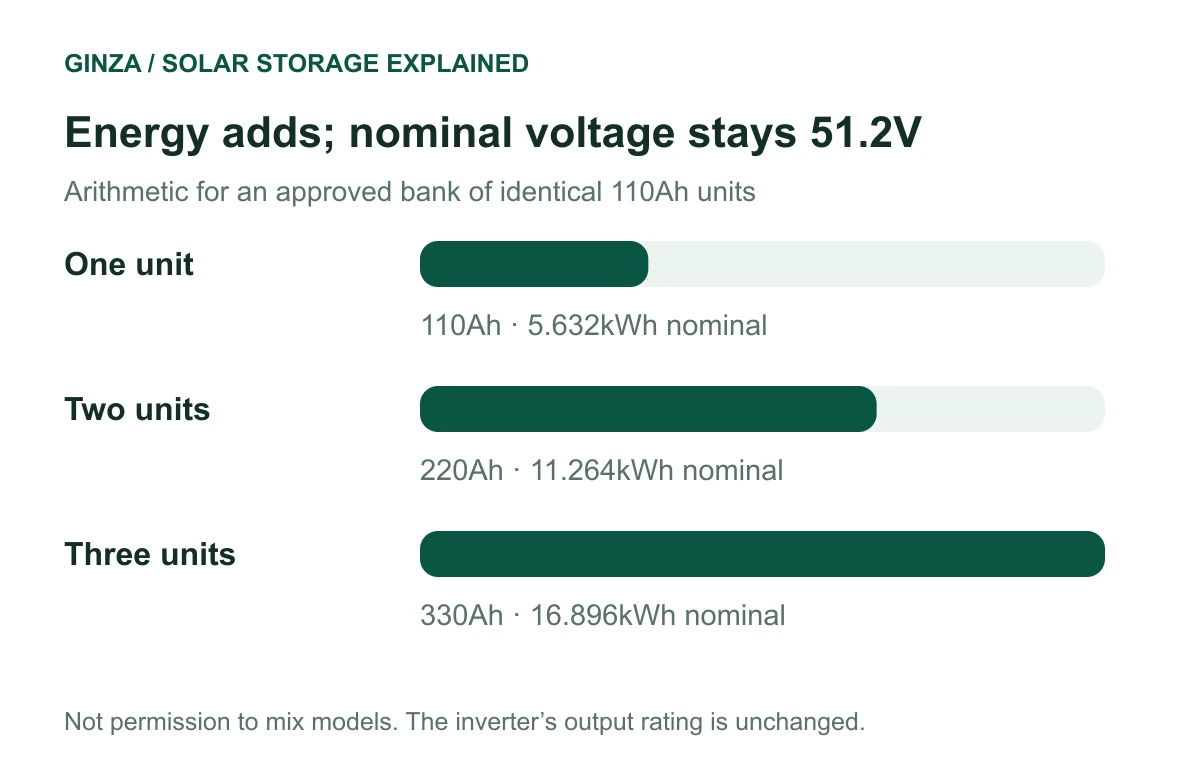
These are arithmetic examples, not permission to connect any selected units. A bank of two 110Ah units and a single 220Ah model share a nominal energy figure but may have different installation, communication, current and service considerations. Energy equivalence is not product equivalence.
Parallel expansion also does not raise the inverter’s rated AC output. If a 5kW inverter is the output limit, doubling battery energy does not turn it into a 10kW inverter. Battery current capability and inverter power must each be checked against the actual installation.
Confirm model-specific expansion limits
GINZA’s published 330Ah Gen5 information lists up to 20 units in parallel, subject to system design. The 330Ah Gen3 reference lists up to 15. Those figures belong to their respective products; they should not be combined into a permission to mix generations or different capacities.
Ask GINZA and the inverter provider to confirm the exact proposed combination, permitted quantity, communication topology and operating limits. Keep that response with the current datasheets and the equipment list used by the installer.
Can old and new batteries be mixed?
There is no universal approval for all LiFePO4 products. An older unit may differ in remaining capacity, resistance, firmware, BMS behaviour or service condition. Different models can also have different permitted current and communication requirements even when their nominal voltage matches.
Provide the supplier with the existing model, age, operating record and condition information. Ask whether the proposed addition is permitted and whether a particular assessment or preparation is required. If approval is unavailable, consider a supported replacement or separately engineered architecture rather than assuming direct parallel connection is acceptable.
Victron’s battery installation manual illustrates why bank configuration and preparation are product-specific. Its permitted quantities and procedures apply to that equipment, not to a GINZA installation.
Current sharing is an engineering check
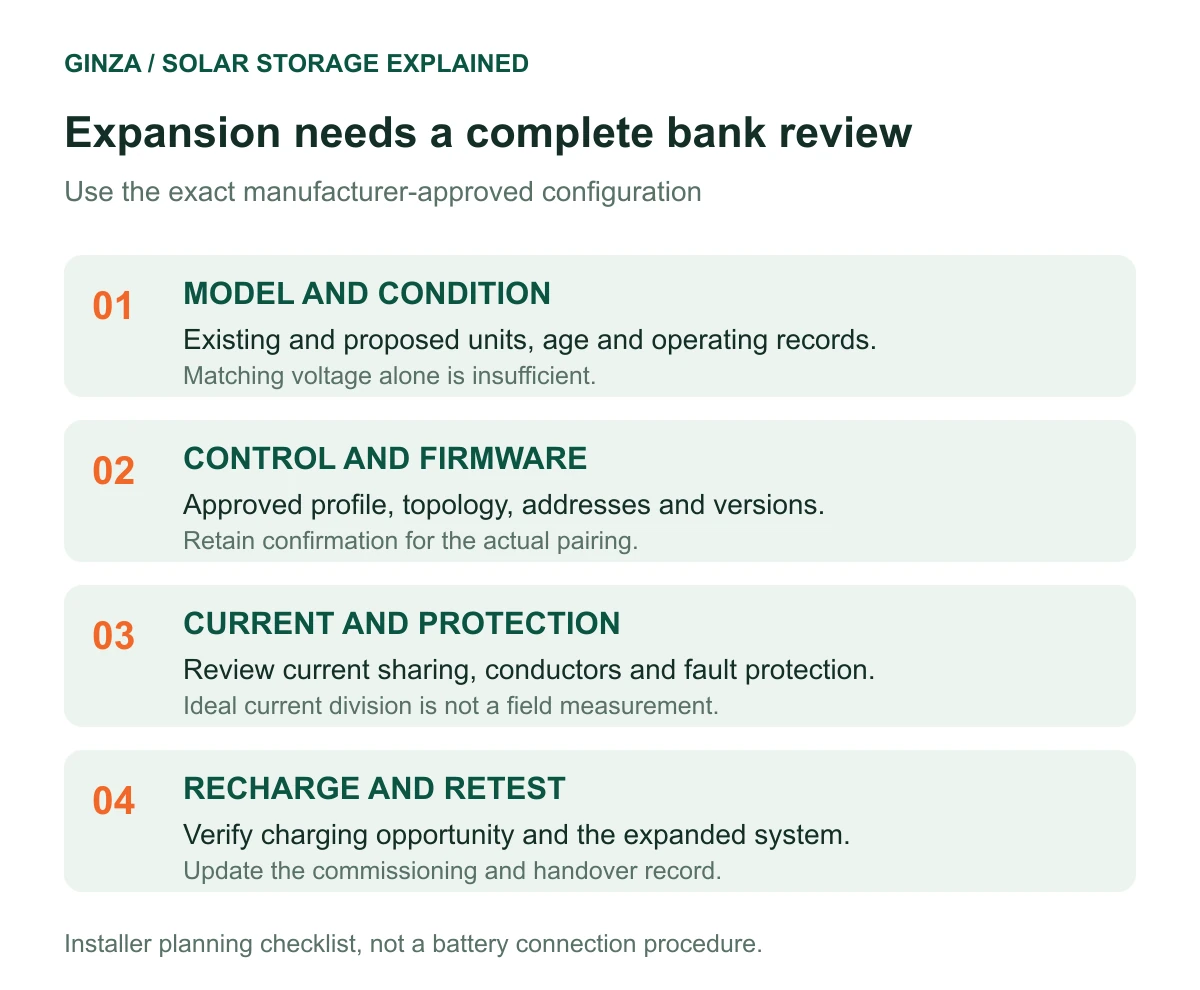
Nominally identical batteries do not automatically carry identical current in every arrangement. Cable paths, connection resistance, equipment limits and battery condition affect the result. The installer needs a supported connection design and appropriate verification under controlled operation.
For scale, a hypothetical 5kW AC load at 51.2V nominal and 90% conversion efficiency represents about 108.5A of battery-side current before additional losses. Dividing by two gives 54.3A per unit only in an ideal equal-sharing calculation. That is not evidence that a real two-unit bank shares equally or supports that load.
Review conductor and protection coordination, fault conditions, isolation and service access as part of the complete expansion design. Do not choose protection or cables by dividing a headline current figure without the applicable engineering review.
Communication must describe the expanded bank correctly
A multi-battery system may have model-specific master-device, address, cable and termination rules. Confirm the approved protocol and firmware pairing with the inverter. A connector that fits does not establish compatibility, and a display that shows voltage does not prove the bank’s limits are being communicated correctly.
The final settings must reflect the actual quantity and capability of the bank, as well as the inverter, charging source and protection. Retain the previous configuration before making an approved change so support can understand what was altered.
Additional units also need a renewed location and service-access assessment. A permitted parallel quantity does not establish that the existing space, support and access remain suitable.
Check the recharge requirement after expansion
Suppose a household adds capacity because overnight energy use has increased by 4kWh AC. With an assumed 90% discharge conversion efficiency, the battery needs to supply about 4.44kWh DC for that extra use, before standby and other losses. Charging must replace that energy as well as the original daily use. The 4.44 kWh is battery-side discharge energy. A source-side recharge calculation must also account for its charging path; use the measurement-boundary guide and charging-time worksheet without counting a loss twice.
Compare surplus PV after daytime loads with the new charging requirement. Also check the permitted charging current and the available charging period. A larger bank may reduce the relative stress of a given duty, but it does not create additional solar generation or remove source limits.
For a backup-only goal, discuss how the larger bank is kept ready and what reserve is protected. For daily cycling, compare the complete operating schedule and the expected useful energy rather than capacity alone.
Retest and update the customer record
Expansion changes the commissioned system. Keep the new equipment list, bank configuration, approved settings, diagram and functional test record. Record which quantities are monitored and how the complete bank is checked.
Confirm controlled charging, discharging, alarms and any included backup behaviour using the approved procedure. Explain the revised energy and power limits to the customer. The commissioning checklist provides a documentation framework without replacing model-specific instructions.
Get the expansion conditions before paying a deposit
Request a written equipment list covering the existing bank, proposed addition, inverter and any required control accessories. Identify who confirms compatibility, who performs the condition assessment and who updates the installation record. Ask what happens if the original model is no longer available. A first-sale promise that “more can be added later” should identify its limits, rather than leaving the customer to discover unsupported combinations after purchasing another unit. Keep approved substitutions and exclusions with the final quotation and warranty documents.
Current sharing between complete parallel batteries is different from balancing cells inside one pack. The active-versus-passive cell-balancing guide explains that internal function and its limits; it does not establish permission for a proposed bank combination.
Sources and interpretation
The 110 Ah parallel sums show nominal energy arithmetic for an approved configuration. They do not approve mixing models, generations or differently aged units. The Victron installation reference applies to its own family. A GINZA expansion needs its own documented equipment approval, power review and updated commissioning record.
Frequently asked questions
Do batteries in parallel increase voltage?
In the supported parallel arrangement described here, nominal voltage stays the same while Ah and energy add. A series arrangement changes voltage and is a different design question; do not assume a model permits it.
Can I add any battery marked 51.2V?
No. Exact model approval, bank configuration, current limits, firmware, BMS and communication matter. Matching one label is insufficient.
Can expansion be promised at the first sale?
A proposal can document the supported expansion path and its conditions. Future model availability, equipment compatibility and site changes still need checking when the addition is made.
Request an expansion review with the current models, quantity, installation records and new load objective. Compare the current GINZA range and the capacity and service-life guide before deciding how to upgrade.