To choose battery backup for a refrigerator, check two numbers separately. Measure the refrigerator’s energy use in kWh over a representative period, then confirm that the proposed inverter can start the compressor. A battery that stores enough energy for the planned outage can still fail to run the refrigerator if the inverter cannot handle startup or restart.
For households and small shops in the Philippines, the useful goal is an agreed number of hours with the refrigerator and a short list of other essentials running. This worksheet uses invented inputs to show the method. It works with a compatible portable backup device or a properly installed stationary solar battery system, provided you measure and specify each boundary correctly.
Measure a full day of normal refrigerator use
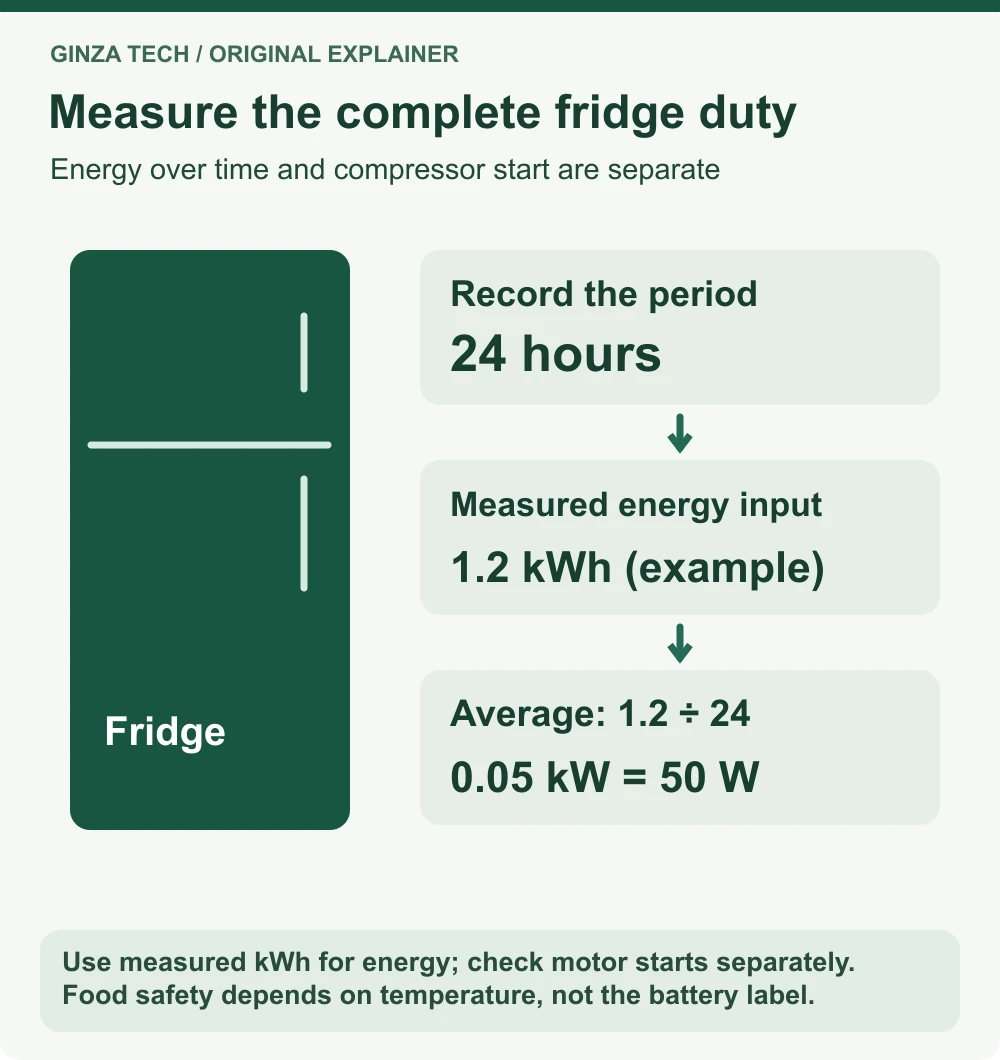
Use the energy label for an initial estimate. If the label states annual kWh, divide by 365 to obtain an average day under the label’s test conditions. Then collect a representative meter reading. For a plug-in appliance, a suitable rated energy meter may be useful when approved for that application. Ask a qualified provider to measure fixed wiring or any appliance that cannot be safely checked with an ordinary plug-in meter.
Record the energy over 24 hours or longer, the room temperature, occupancy, door openings and normal defrost behavior. A warm shop with frequent door openings may differ substantially from a lightly used household appliance. A brief running-watt reading misses compressor cycling. If a brownout often happens during a busy shift, measure a comparable shift as well as a quiet day.
Convert the measurement to the outage you plan for
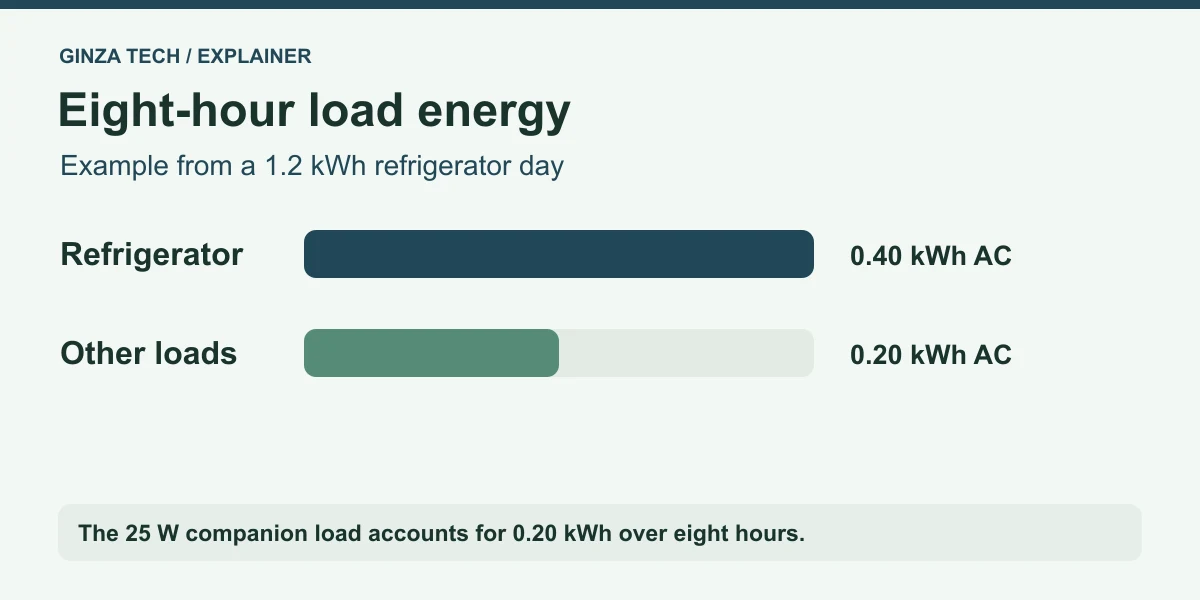
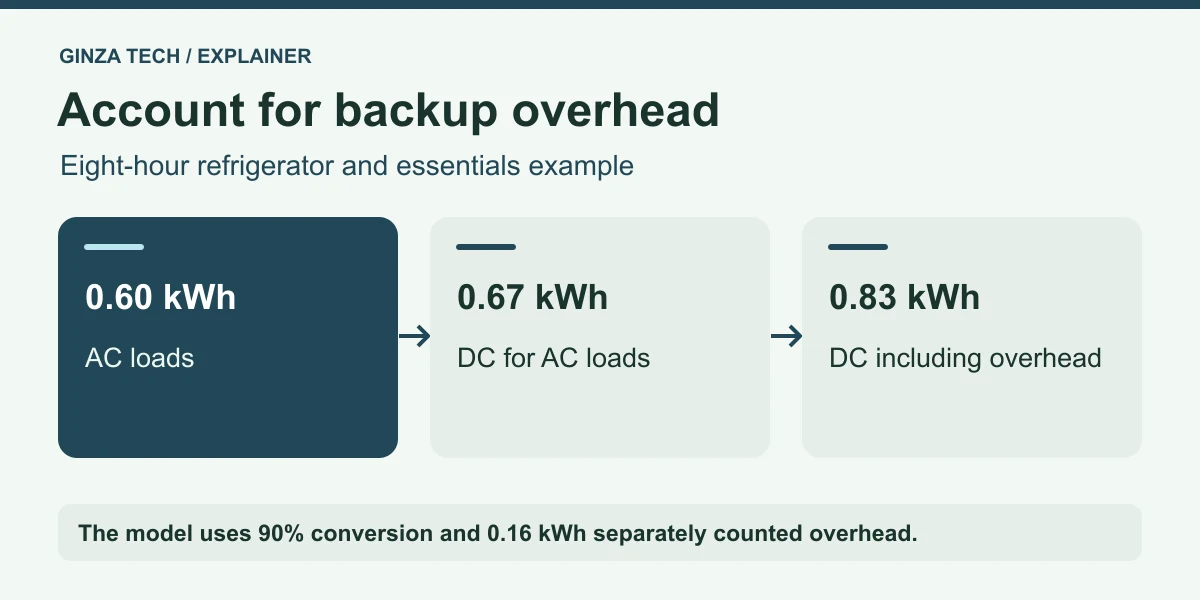
Suppose a refrigerator uses 1.2 kWh in a representative 24-hour period. Its average is 50 W. A first-pass eight-hour budget is 0.40 kWh for refrigeration. An assumed 25 W of other loads adds 0.20 kWh during the same period. That makes 0.60 kWh of AC load energy. Real eight-hour use can differ from the daily average if room temperature, door use or defrost events differ.
If an illustrative battery-to-AC conversion factor of 90 percent applies to these loads and excludes idle draw, the battery supplies about 0.67 kWh for the AC loads. An additional 20 W of average DC-side inverter overhead over eight hours adds 0.16 kWh. The estimated battery draw is therefore 0.83 kWh. If you measure usable AC energy with the inverter overhead already included, avoid counting the same overhead again.
| Example line | Calculation | Energy |
|---|---|---|
| Refrigerator | 1.2 kWh × 8 ÷ 24 | 0.40 kWh AC |
| Other appliances | 25 W × 8 hours | 0.20 kWh AC |
| Combined battery demand for AC loads | 0.60 kWh ÷ 0.90 | About 0.67 kWh DC |
| Separate overhead | 20 W × 8 hours | 0.16 kWh DC |
| Estimated battery draw | 0.67 + 0.16 | About 0.83 kWh DC |
Check compressor starts and automatic restart
Ask for the refrigerator manufacturer’s starting information or have a qualified provider measure the relevant transient. Compare the magnitude and duration against the proposed inverter’s overload capability, voltage, frequency and supported load type. Make sure the system can restart the refrigerator after a brief transfer interruption or recovery from a power fault. Preserve any compressor restart delay specified by the manufacturer.
For a shop with two refrigerators, consider whether both can restart together after a transfer. Test the actual load combination with the installer. A device that starts each appliance alone may fail when both start together. Compare total continuous power, startup power and battery current. See the battery discharge current guide if the battery limits the available inverter power.
Compare a dedicated appliance solution with home backup
A portable unit can suit an individual appliance when the manufacturer supports the load and intended connection. Check usable output energy, inverter consumption, recharge time and whether the product supports your use while charging. A stationary system makes sense to evaluate when several circuits need backup or a longer reserve. Verify which refrigerator circuit is supplied by the installed transfer arrangement. The solar outage guide explains how that arrangement changes what stays on.
For a multi-day outage, add a recharge plan. A battery that supports a single evening may still run out after a cloudy day or a short restoration period. Specify the low-solar case, minimum starting charge and loads you can defer. Use the home storage sizing guide to combine other circuits into one plan. If communications are also essential, the router and ONT worksheet helps measure that companion load rather than assuming every network device is included.
Verify temperature as well as electricity
Keep appliance thermometers and plan for food safety if the power source fails. The FDA’s outage guidance says an unopened refrigerator generally keeps food cold for about four hours and provides temperature-based guidance for what to do afterward. The actual temperature matters. Keep doors closed as much as possible and follow the relevant food safety guidance for your home or business. A commercial refrigerator, pharmacy or critical cold chain needs a plan and validation appropriate to its products.
Plan a warmer-day scenario
Repeat the arithmetic with a day that better represents the busiest or warmest conditions you expect. If measured consumption is 1.8 kWh per day, a proportional eight-hour estimate rises from 0.40 to 0.60 kWh AC for the refrigerator. The 25 W companion load brings the total to 0.80 kWh AC. With the same assumed conversion and separate overhead, battery-side draw is about 1.05 kWh. This comparison can change the equipment decision before any allowance for reserve or longer outages.
Record the available energy at the likely start of the outage. A backup unit may begin the evening partially charged, particularly after a previous interruption. Take the more demanding measurement and ask the supplier for the expected output energy at that starting state. If the result leaves very little margin, review whether some companion loads can move to another supply or switch off during a power interruption.
At handover, check that the refrigerator returns to operation as expected after the test and that the occupant knows how to monitor temperature. Keep the measurement notes with the selected equipment so a change of refrigerator or business hours prompts a new check.
For a shop, list other equipment that staff might put on the same backup outlet. A display light, fan or payment terminal can add modest continuous demand. A hot-water appliance can use more power than the refrigeration load. Identify which loads are included in the proposal and leave the list with staff who work during an outage.
Sources and interpretation
Refrigerator energy, companion loads and overhead figures are hypothetical. A daily average is an energy estimate, not proof of compressor start capability or safe food temperature. The FDA reference addresses food safety separately. Keep representative appliance measurements and the backup equipment's supported output conditions with the proposal.
Frequently asked questions
How long will a 1 kWh battery run a refrigerator?
Start with the usable energy at the output or the battery-side energy available at your actual starting charge. Divide by the measured average demand at the same boundary and include overhead once. Check whether startup is supported before relying on the duration estimate.
Do I need to size for the label’s running watts all night?
Use measured kWh for the duration estimate and use running and transient power for equipment checks. A refrigerator cycles, so the nameplate and average energy reading describe different parts of the job.
What should I send for a quote?
Use the project enquiry form with the appliance model, measured kWh and time period, target backup hours and other loads. Include available startup information, the power source used for charging and any existing inverter.