
The right solar battery location must satisfy the exact product’s installation conditions, not just its IP rating. In a tropical site, heat, water exposure, flooding, access and the surrounding building use all deserve review. An enclosure marked IP65 is not permission for unrestricted outdoor exposure or immersion.
Start with the equipment manual and an installer-led location assessment. A location that is convenient for a photograph may be poor for inspection, heat management or emergency access. This guide helps an owner prepare the discussion without replacing applicable electrical and building requirements.
What the IP code tells you
The IEC explanation of IP ratings describes enclosure resistance to solids and liquids. The first digit concerns solid-object ingress; the second concerns liquid ingress. These are defined protection classifications, not a complete description of the installation environment.
IP65 describes dust protection and protection against specified water jets. It does not establish suitability for immersion, flooding, every pressure-washing method, prolonged extreme weather or every installation orientation. Cable entries, covers, accessories and the installation method also need to preserve the intended protection.
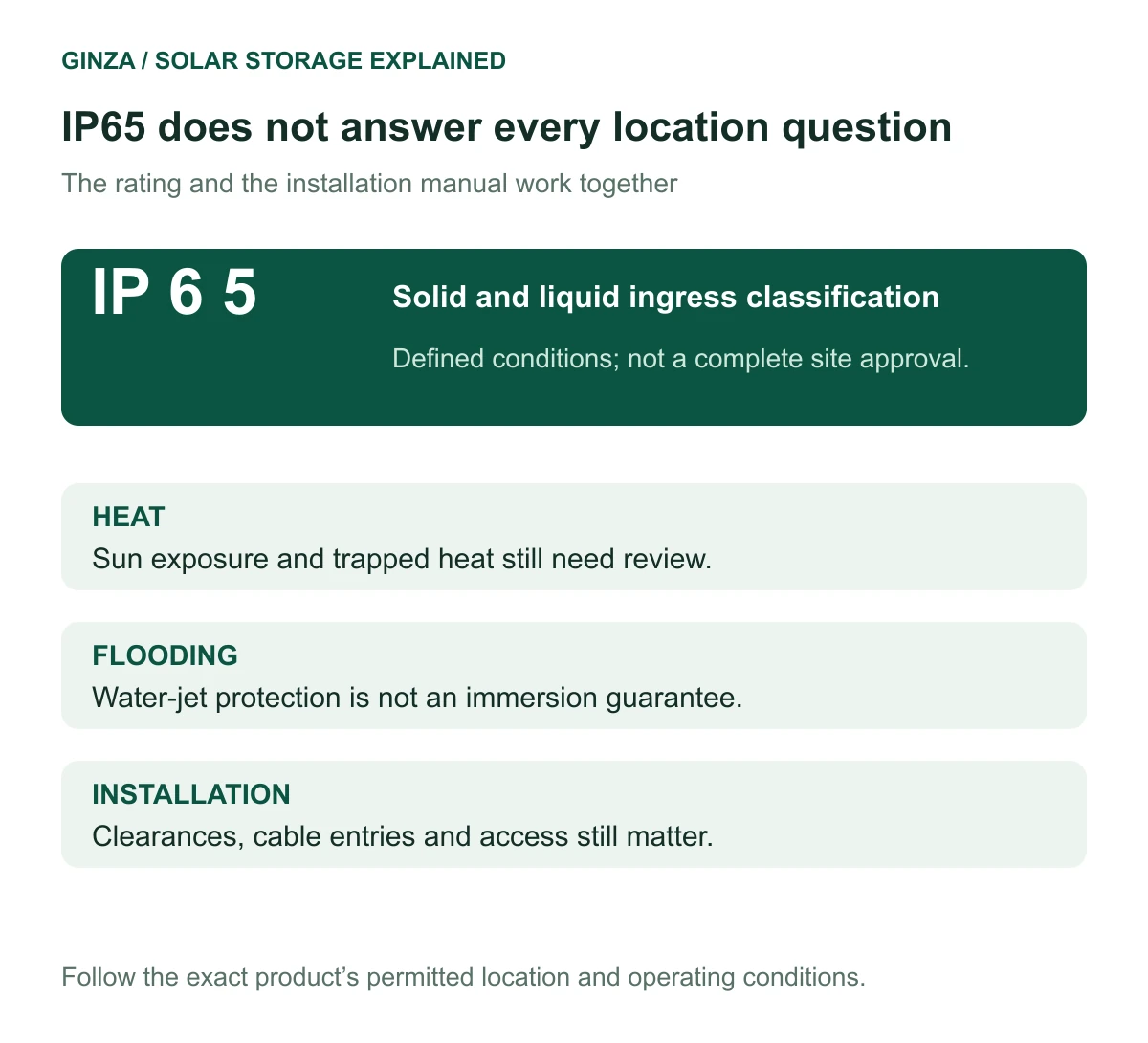
The manufacturer’s installation documentation remains essential even when the rating looks suitable. A roof edge, flood-prone garage or enclosed metal cupboard introduces conditions that one enclosure number cannot answer.
Compare the actual GINZA models
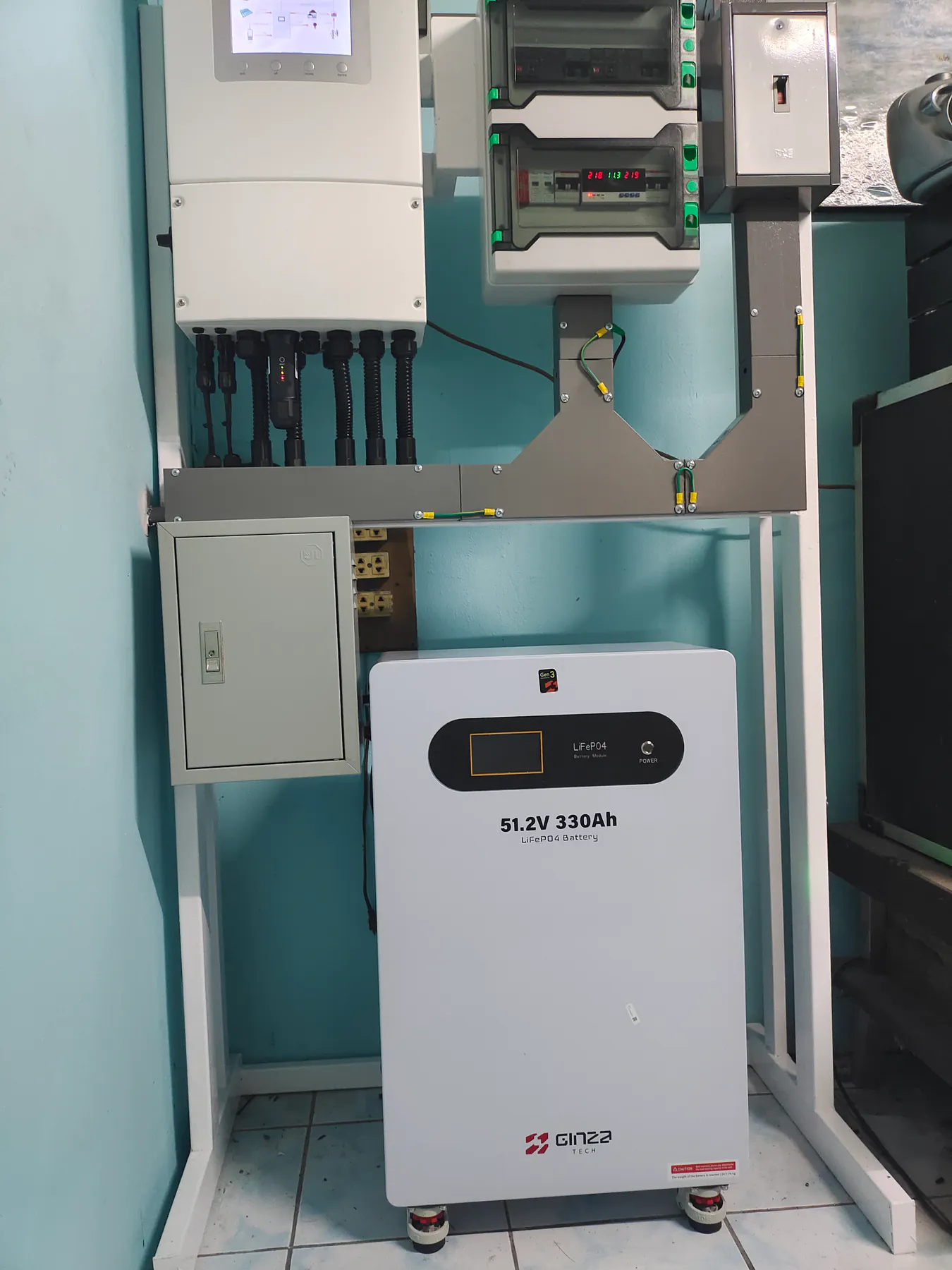
The GINZA 330Ah Gen3 reference lists IP20, while Gen5 low-voltage references list IP65. They should not be treated as the same enclosure simply because both use LiFePO4 and a 51.2V nominal platform. Each model needs its own permitted location, clearances and operating conditions checked.
The Gen5 information also lists charge and discharge temperature ranges. Those are product limits, not a recommendation to keep the unit continuously near an extreme. Ask how the proposed location behaves during the hottest part of the day and during charging, rather than judging it from a comfortable morning inspection.
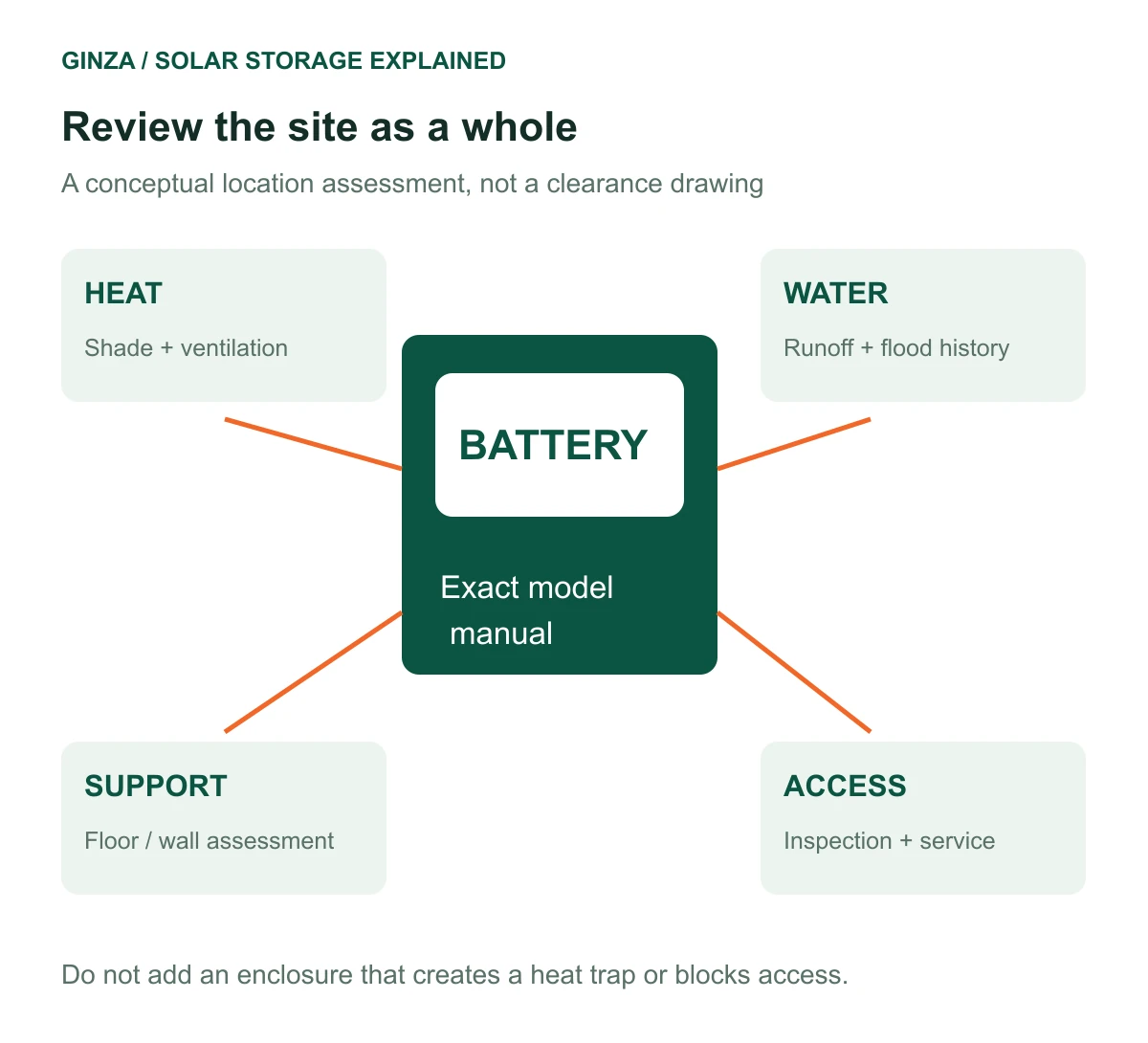
| Site question | Evidence to collect |
|---|---|
| Heat | Sun exposure, nearby heat sources and the space’s hottest conditions. |
| Water | Roof runoff, wind-driven rain, plumbing and drainage. |
| Flooding | Known flood history, low points and access during severe weather. |
| Support | Floor or wall suitability for the exact equipment. |
| Access | Inspection route, equipment isolation access and service space. |
Indoor versus outdoor is not a complete decision
An indoor site may protect from rain but trap heat or obstruct a passage. An outdoor site may have airflow but face direct sun, impact, salt exposure or stormwater. Review the actual conditions rather than treating “indoors” as automatically suitable or “IP65” as automatically outdoors-ready.
Also consider how the building is used. The responsible designer needs to assess occupants, escape routes, nearby materials and applicable location restrictions. This guide does not supply a universal distance from doors, windows or habitable spaces because the relevant rules and product conditions must govern.
The ACT Government’s home battery guidance notes that some products need a covered location or protection from extreme weather. It is a useful planning principle; Australian installer and programme requirements are not Philippine or Malaysian rules.
Avoid turning weather protection into a heat trap
A cover or enclosure added on site can change the environment around the equipment. Ask whether it affects ventilation, access, clearances, water drainage or the permitted installation arrangement. A tight cupboard may protect against casual contact while making heat and service access worse.
Do not add fans, covers, insulation or other modifications without the appropriate approval. The designer should address the location as a system: the battery, inverter, protective equipment and their heat and access needs may differ.
Maintain the space over time. Stored boxes, laundry, gardening equipment or a later building alteration can turn an initially suitable installation into an obstructed one. Include the location requirements in the customer handover rather than leaving them only in a technical file.
Plan for service and normal observation
An owner should be able to use the normal display or monitoring system and report an alarm without opening equipment. The responsible service provider should have practical access to identification labels, covers and isolation points using the approved procedure.
Photograph the final installation and retain its documents privately. Identify the battery, inverter, support contact and the location of the supplied operating instructions. Ask what signs should trigger a service call and which owner inspections are appropriate.
A suggested owner-level routine may include keeping the area clear and observing for external damage or unusual behaviour from a safe position. The exact routine comes from the manufacturer and installer; internal electrical inspections are different work. The maintenance checklist helps keep those observations and the responsible service contact with the location record.
What to do after severe weather or water exposure
If the equipment has been flooded, damaged or exposed to an electrical hazard, keep people clear and follow the supplied emergency instructions and local emergency-service advice. Do not touch, move, open or re-energise it to see whether it still works.
An IP rating is not a post-flood inspection result. Have the responsible qualified provider assess the complete installation, including equipment that may look externally intact. Retain the event date, safe external photographs and relevant operating records for the service process.
This is also a reason to decide the support route before installation. Know who can assess the battery and inverter together and how the customer reports an issue after a storm.
Location affects future expansion
If another battery may be added, ask the installer to consider the supported expansion arrangement now: available footprint, support structure, access, cable routes and protection. Leaving empty space alone does not establish that future models can be combined.
The parallel expansion guide explains model and system checks. A later addition should receive an updated location and commissioning review rather than simply being placed beside the original battery.
Questions for the installation proposal
Discuss coastal and changing site conditions
An ingress code does not establish resistance to every corrosive environment, chemical exposure or long-term sunlight condition. For a coastal property, workshop or location near cleaning chemicals, ask the manufacturer what environmental conditions the exact product permits. Also consider foreseeable changes: a new roof drain, a vehicle parking position or stored materials can alter the original assessment. Keep location photographs and the agreed restrictions with the handover record so a future owner or service technician can see the basis on which the installation was accepted.
- Which manual and local requirements establish the proposed location?
- How are sun, heat, runoff and flood history addressed?
- What structural support and clearances does the exact product require?
- Can owners and service staff access the information and equipment they need?
- What must remain clear after handover?
- What is the process after severe weather, damage or an alarm?
Sources and interpretation
An IP code describes specified ingress tests; it is one part of a location assessment. The ACT guidance is an Australian planning reference rather than Philippine or Malaysian installation law. GINZA model listings identify their enclosure ratings, while the actual manual, local requirements and site conditions determine the permitted location.
Frequently asked questions
Is IP65 the same as waterproof?
“Waterproof” is too broad to describe the installation conditions. IP65 is a defined ingress classification; it is not an immersion or flood guarantee.
Can the battery sit in direct sun because it operates up to a stated temperature?
Do not infer permission from the maximum temperature alone. Direct sun and charging can change the equipment temperature. Follow the exact installation limits and site design.
Can I build a cabinet around an existing battery?
Only after the responsible provider reviews the effect on heat, access, clearances and protection. A protective-looking enclosure may introduce other problems.
Review the Gen5 reference and Gen3 reference, then send GINZA the model, country and location photographs. Keep the final location conditions in the handover record.