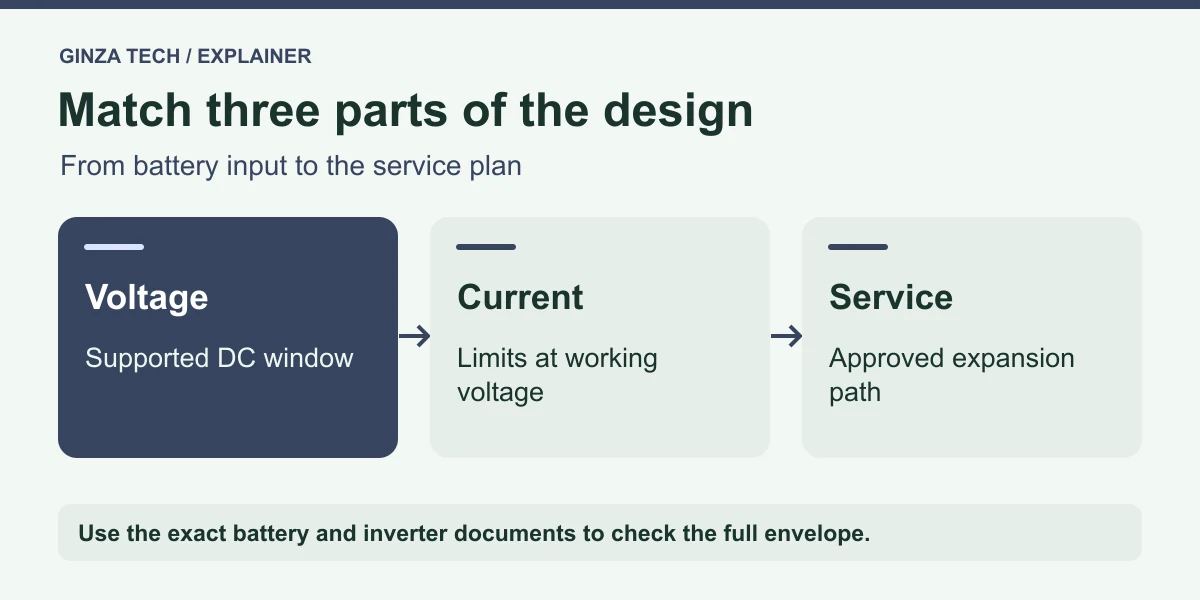
A high-voltage solar battery typically supplies the same DC power at lower current than a 48 V class battery. The inverter determines which voltage range it can use, and the equipment design determines which batteries can operate with it. Start with the approved voltage window, battery management system and intended power. Then compare installed cost, service access and the way capacity can grow.
Manufacturers use “low voltage” and “high voltage” as product family descriptions. The examples here use 51.2 V and 400 V as planning numbers. Neither label is a legal voltage classification or a statement about safe handling. A qualified designer must verify the site’s protection and approval requirements.
Keep battery DC voltage separate from the AC supply
The voltage printed on the battery is DC. The voltage at the grid connection or backup output is AC. A three-phase inverter can have a low-voltage battery input, a high-voltage input or another architecture depending on its design. The solar PV string input also has its own voltage range. Equipment with three voltage values on the same datasheet needs to be read port by port.
A nominal voltage is a useful descriptor, while an inverter works across a specified range. Battery voltage moves with state of charge, temperature and load. Ask the manufacturer for the permitted operating window and the voltage available at the intended discharge current. A high-voltage stack may also require a minimum and maximum module count. Check the full operating window before comparing package sizes.
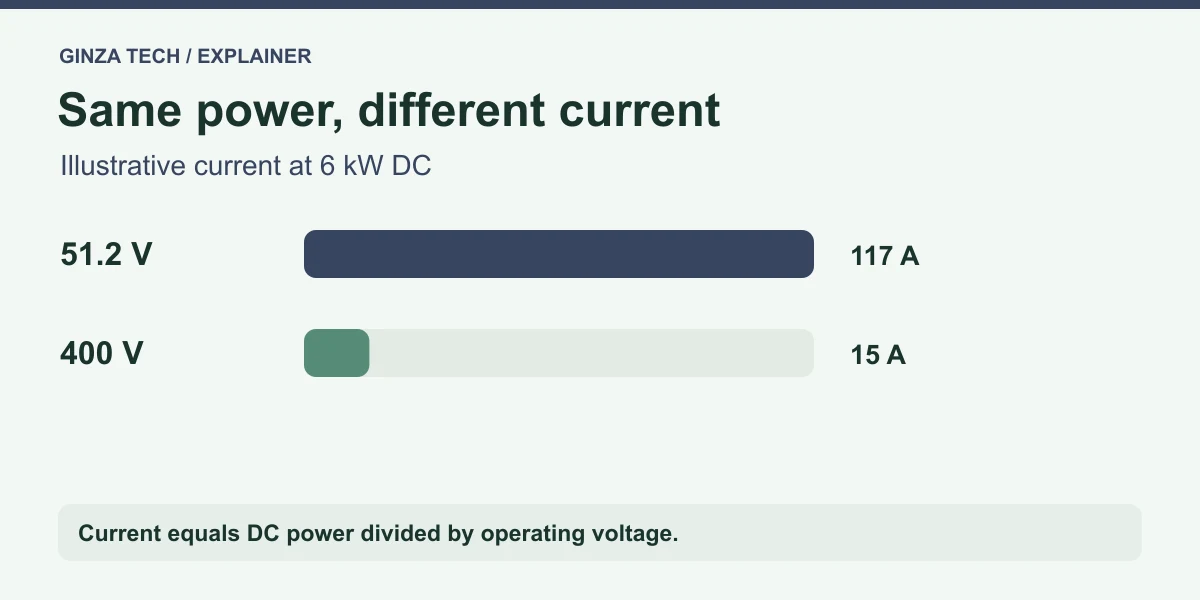
See what changes at the same DC power
Use power divided by voltage to estimate DC current at a chosen operating point. A hypothetical 6,000 W DC demand at 51.2 V corresponds to about 117 A. The same DC demand at 400 V corresponds to 15 A. The Wiring Unlimited electrical theory guide gives the underlying relationship between voltage, power and current.
The actual battery must supply the inverter’s conversion losses as well as the delivered AC power. If an illustrative inverter delivers 6 kW AC at 94 percent conversion efficiency, its battery side needs about 6.38 kW DC, excluding separately supplied auxiliaries. At 48 V under load, that means about 133 A. Treat these figures as a feasibility screen. Protection, cables and terminations must be designed for the supported system, operating environment and fault conditions.
| Decision | 48 V class battery example | High-voltage stack example |
|---|---|---|
| DC current at 6 kW | About 117 A at 51.2 V | 15 A at 400 V |
| Capacity change | May use approved identical units in parallel | May require an approved stack height or approved additional stack |
| Service documents | Current sharing, disconnects and protection coordination | Stack controller, isolation and supported module replacement |
Check the battery’s current limits before buying
Higher current matters to terminals, disconnects, current sharing and cable losses. Lower current at a given power can simplify part of the design, while a higher DC voltage changes insulation, isolation and protection requirements. An acceptable design accounts for both. The manufacturer’s minimum and maximum voltage values and the battery’s available current limits have to remain inside the approved envelope together.
Ask for the continuous rating, the transient rating and duration, and the restrictions at low state of charge or temperature extremes. A battery’s kWh describes energy. It does not specify how much power is available for simultaneous appliances or motor startup. The C-rate and discharge current guide shows how to read those values together.
Review expansion and service as part of the purchase
A low-voltage system can be attractive when the approved battery family lets the site add identical units over time. Ask how many units the inverter and BMS support, how current sharing is verified and what the manufacturer allows when the existing units have aged. If later expansion changes recharge time or installation space, compare the revised proposal before assuming the first purchase is the lowest-cost route. The parallel expansion guide lists the questions to ask.
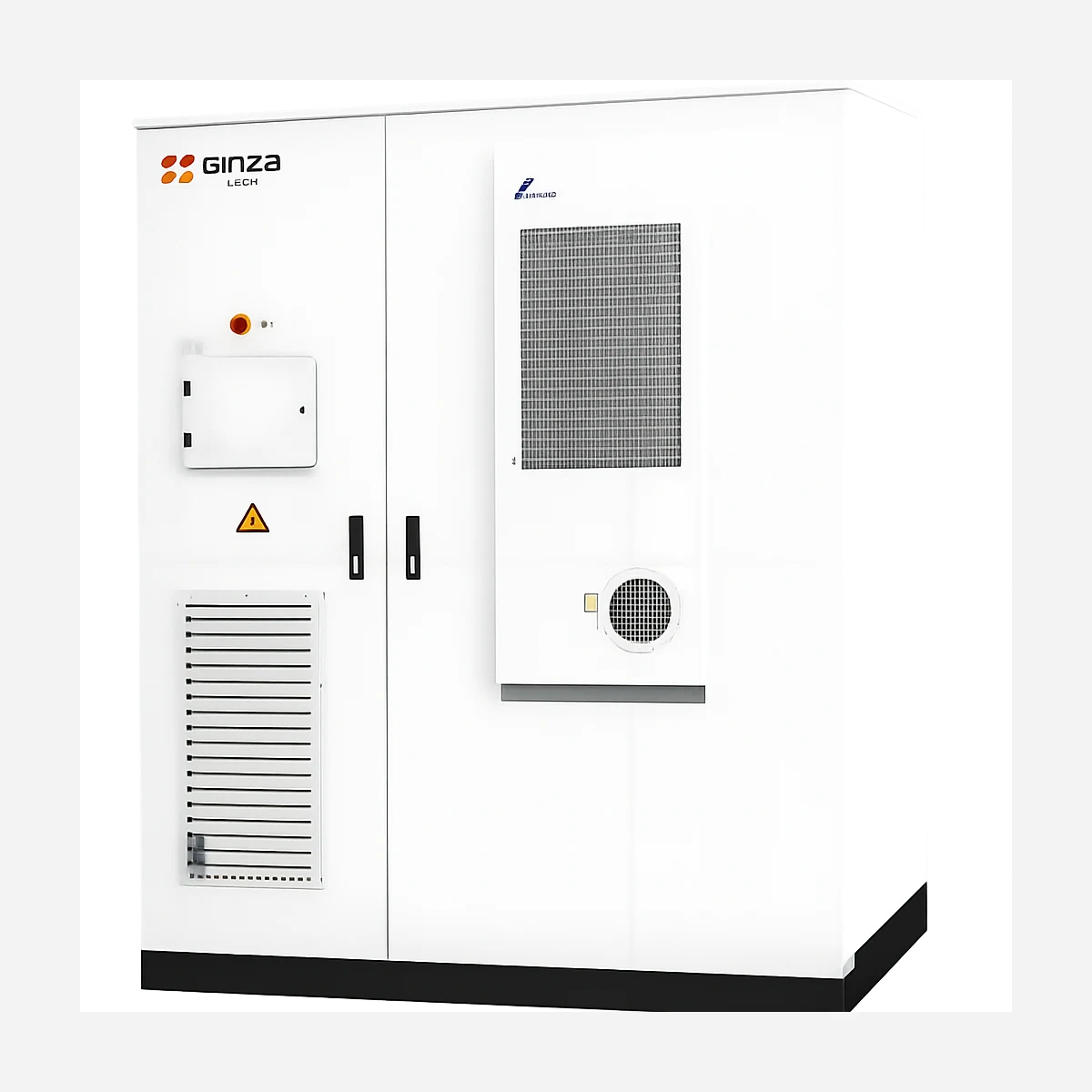
A high-voltage stack may let the supplier expand within a supported family, but adding modules can change stack voltage and control requirements. Ask how the controller and inverter recognize the changed stack and whether module replacements must follow a service process. A cabinet’s integrated design can simplify procurement if the package includes the required protection and power conversion equipment. Compare the actual bill of materials for each option.
Compare two proposals with the same output requirement
Give both suppliers the same peak power, continuous power, load duration, recharge target and site conditions. Ask them to return an exact inverter and battery pairing, usable energy at the chosen operating limits, and the cost of installation and service. Include the planned expansion in a second line. Review voltage class only after checking that both offers deliver the same outcome.
Keep a dated copy of the compatibility evidence. For example, the Victron high-voltage compatibility documentation illustrates a model-specific check with voltage and module ranges. Use the inverter and battery compatibility guide to request corresponding evidence for your own equipment.
Find the constraint that sets the size of the system
Take a hypothetical low-voltage inverter whose battery port allows 100 A continuously. At 48 V under load, the input ceiling is 4.8 kW DC. An assumed 94 percent discharge conversion would make about 4.51 kW AC available from that path before separately measured auxiliaries. A larger battery capacity could provide more runtime, while the inverter port still sets the same ceiling. This is why a quote showing 6 kW on the inverter nameplate should also state how much can come from the battery in backup mode.
Ask how the alternative high-voltage system behaves near the minimum supported stack voltage. Its design might meet the current requirement and still have a smaller usable state-of-charge range for the proposed duty. Request the written assumptions for both alternatives, including whether the quoted output depends on utility or PV contribution. Compare battery-only backup under the same site conditions.
If the equipment is meant for a coastal or humid site, review the enclosure and service environment independently of voltage class. Use the tropical installation location guide to collect the site constraints.
Ask for a serviceable layout before approving either design. Include space to reach disconnects, replace approved components and handle the equipment at delivery. A voltage architecture that looks attractive on a single-line diagram may be harder to service if the cabinet location restricts access. Have the supplier include that layout in the quoted scope.
Sources and interpretation
The 51.2 V, 400 V, current and conversion examples compare operating points rather than defining a legal voltage class. Victron's references explain electrical relationships and model-specific compatibility. A proposed system must satisfy its complete operating voltage window, current capability, protection and service requirements.
Frequently asked questions
Does a 400 V battery store more energy than a 51.2 V battery?
Voltage alone cannot tell you the energy capacity. Compare the rated kWh, available discharge window and supported power. The two packages can store the same energy while delivering it at different voltage and current.
Can a high-voltage battery replace a low-voltage bank?
Confirm a supported architecture with the equipment suppliers. The inverter input, controls, protection and service plan must all match the replacement. A project can require a different inverter and enclosure as well as the new battery. For an existing PV installation, the retrofit route comparison identifies retained equipment and replacement work to include in that assessment.
Where can I compare GINZA storage families?
Review the low-voltage storage range and high-voltage storage range. For a project enquiry, send the equipment model, continuous load, start surge and desired runtime so the proposal can be reviewed against the application.