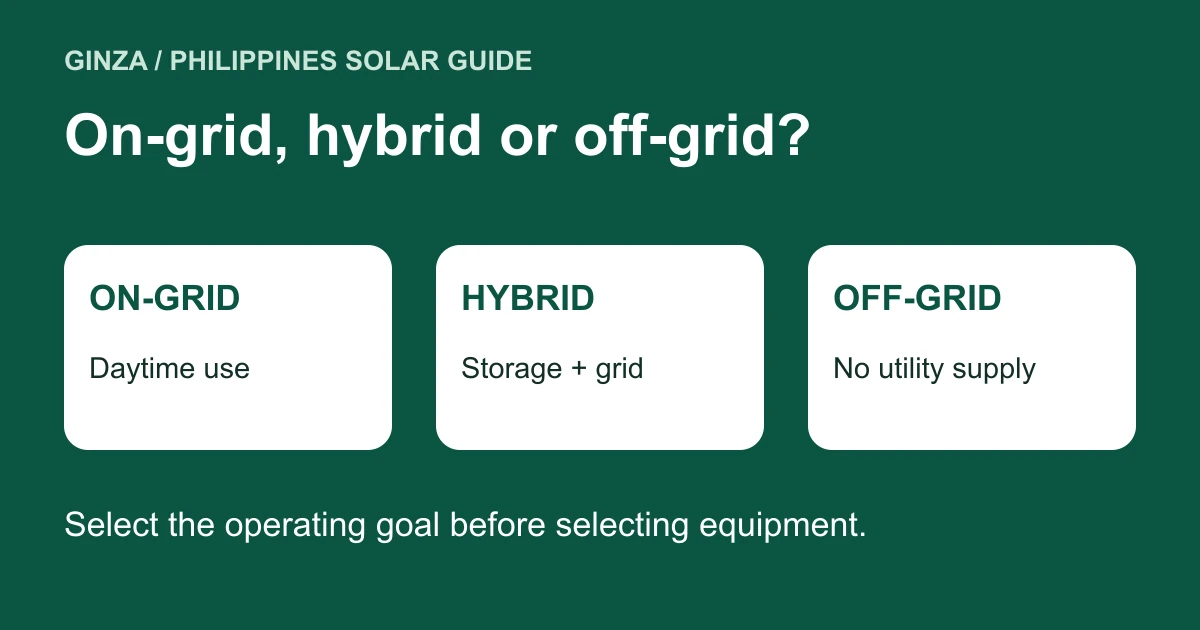
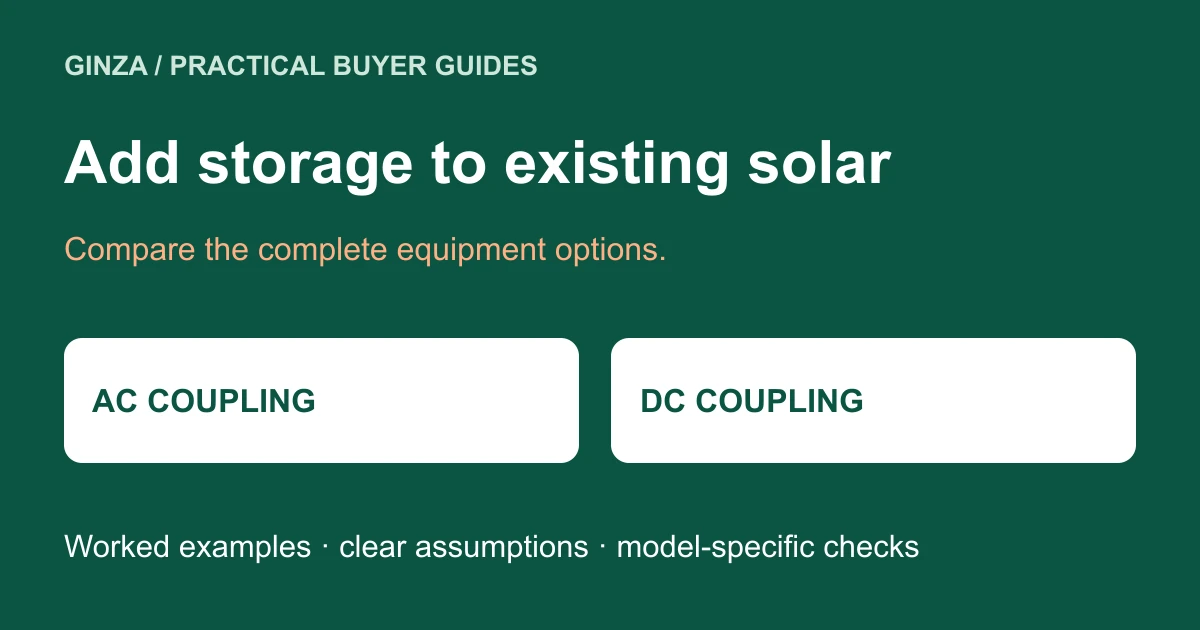
A battery can often be added to an existing solar installation, but the appropriate route depends on the current inverter and the desired operating mode. AC coupling typically adds a battery inverter alongside the solar inverter. A DC-coupled approach commonly connects solar and storage through a suitable hybrid inverter. The exact supported products and design decide what can be retained.
Start with three questions: what equipment is already installed, why storage is being added, and what should operate during an outage? Answer them before buying a battery advertised as “48V compatible” or “retrofit ready.”
Collect an equipment file before requesting a retrofit quote
Record the existing solar inverter’s full model, age, firmware if available, PV array details, utility connection and any metering or export controls. Keep the original system diagram and commissioning information. Where documents are missing, ask the installer to establish the actual configuration.
| Existing information | What the designer needs to determine |
|---|---|
| Solar inverter and PV strings | Whether equipment can remain and how it will operate with storage. |
| Battery or hybrid ports | Supported voltage, battery models, firmware and operating functions. |
| Grid and export arrangement | Metering, connection approval and control changes. |
| Distribution board and circuits | Where designated backup loads could be connected. |
| Location and cable route | Space, access, environmental limits and installation work. |
What AC coupling means
In a conceptual AC-coupled arrangement, the solar inverter converts PV DC into AC. A separate battery inverter can convert AC into DC for charging and convert stored DC back into AC for loads. The battery inverter may be separate from or integrated with its battery system.
This can be a useful option when the existing PV inverter is worth retaining and the proposed equipment supports the required integration. It does not mean any battery can be connected to any AC supply. The controls, installation, metering and approved equipment architecture still matter.
What DC coupling means
In a typical DC-coupled solar-plus-storage arrangement, a suitable hybrid inverter manages the PV and battery connections, then supplies AC to the building. A retrofit may use an existing compatible hybrid inverter or require inverter replacement and associated PV design checks.
The Australian Government’s battery technology guide explains these coupling concepts. The technical distinction is relevant here; its Australian programmes and approval rules are separate from the requirements of a Philippine or Malaysian installation.
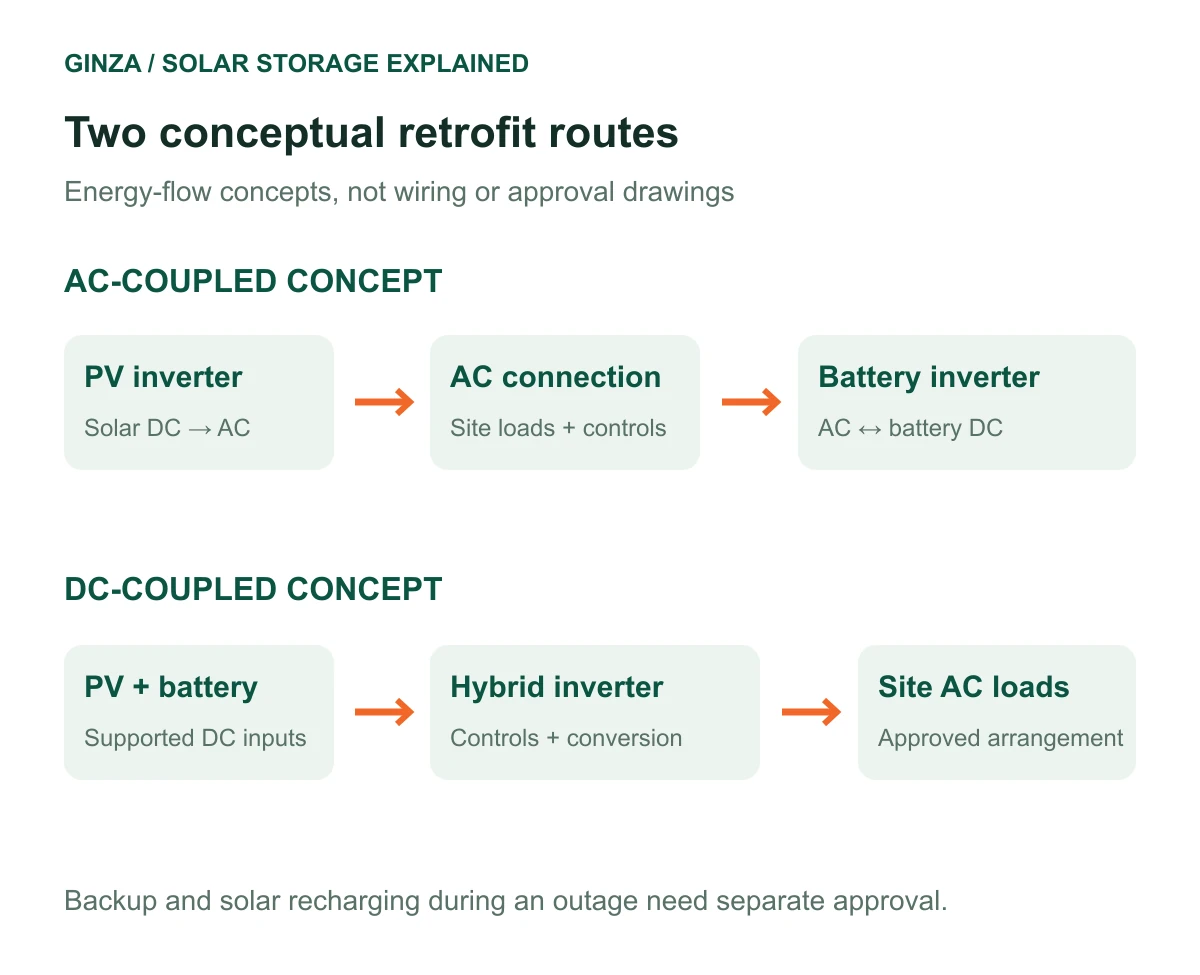
These energy routes are conceptual, not a wiring diagram. Equipment can have other supported architectures, so assess the actual manuals instead of selecting a design from the labels alone.
Compare the complete retrofit routes
| Question | AC-coupled route | DC-coupled route |
|---|---|---|
| Existing PV inverter | May be retained if the design supports it. | May be retained if suitably hybrid, or replaced. |
| Battery control | Handled by an appropriate battery inverter and controls. | Handled through a compatible hybrid arrangement. |
| Energy conversions | PV-to-storage commonly includes AC conversion stages. | PV may charge the battery on the DC side. |
| Backup behaviour | Must be specifically supported and designed. | Must be specifically supported and designed. |
| Final cost | Depends on retained equipment and additional work. | Depends on inverter suitability and replacement work. |
Extra conversion stages can affect efficiency, but a route should not be chosen by a generic percentage alone. Compare actual equipment efficiency at the intended duty, available charging energy, installation cost and the value of retaining a sound existing inverter.
Backup is a separate acceptance question
Ask which equipment establishes the backup supply, how the designated circuits are isolated and which PV equipment can operate during an outage. An existing grid-following PV inverter may stop when the utility fails. Its behaviour in a battery-backed arrangement depends on supported controls and the approved design.
Specifically ask whether solar recharging remains available in backup mode and under what limits. Also check what happens with a full battery and strong PV generation, a low battery and heavy demand, and restoration of the utility supply. These cases need equipment-specific answers.
The system-type guide explains the broader operating objectives. For Meralco customers, its connection and net-metering guidance is a starting point for the utility discussion; other utilities may have different requirements.
Check the actual battery and inverter pairing
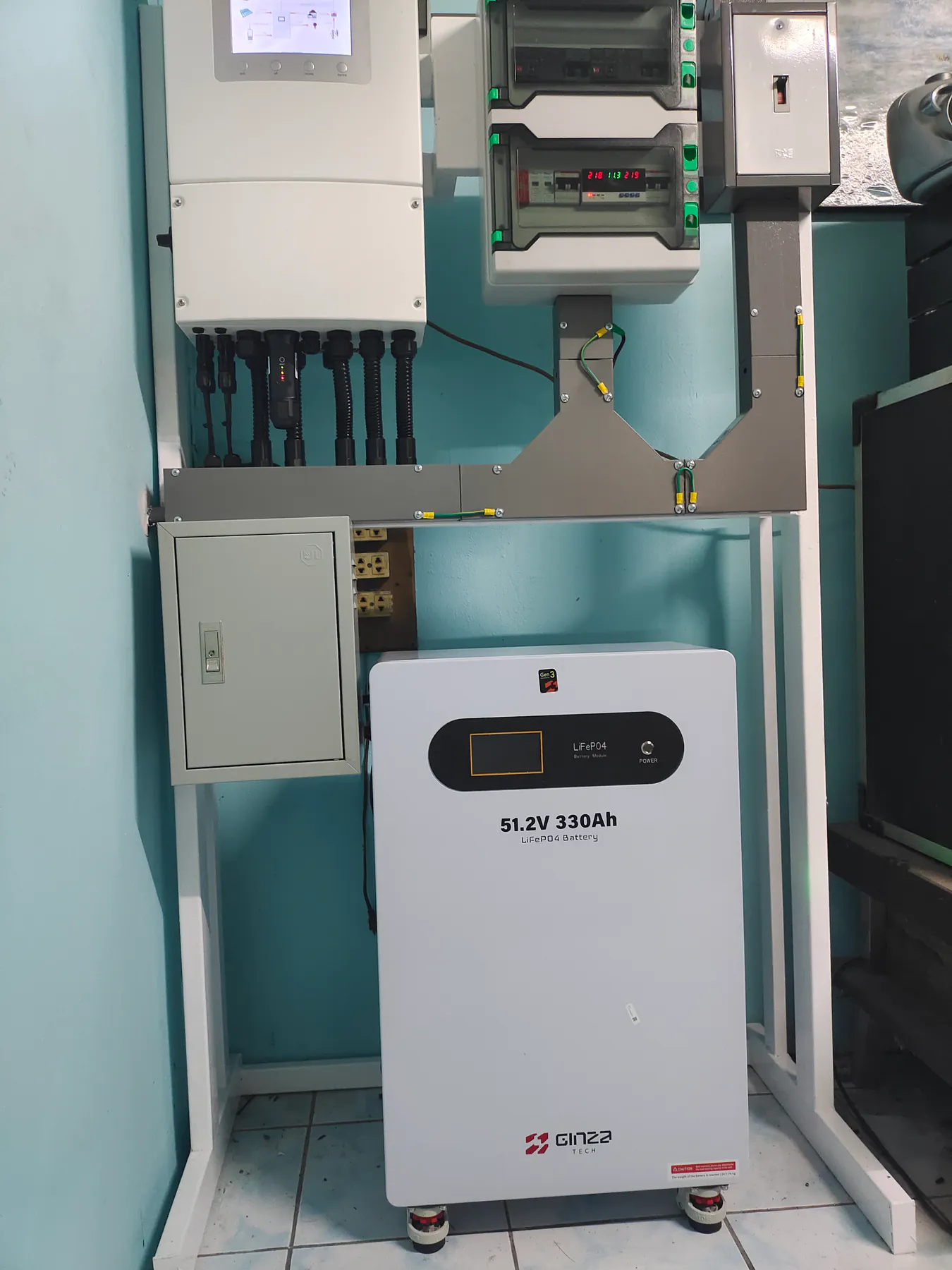
A nominal voltage family does not establish compatibility. Confirm the supported battery operating range, current limits, communication protocol, cable specification, firmware and the manufacturer’s approved configuration. “CAN available” and “CAN supported for this exact battery” are different statements. The pairing checklist organizes that approval evidence before the retrofit is priced.
For a GINZA low-voltage proposal, identify whether the intended inverter supports the exact Gen3 or Gen5 model and quantity. An AC-coupled system using a different voltage platform may require a different battery architecture. Do not assume the GINZA 51.2V range fits every retrofit route. If the retrofit requires a new battery architecture, use the high- and low-voltage battery comparison to compare current and equipment limits across the supported voltage window.
Reassess the energy plan rather than copying the old PV size
Look at actual daytime surplus and evening consumption. If an occupied building already uses nearly all its solar production during daylight, there may be little energy left to store. A battery bought for evening solar use may then charge less often than expected. Use the PV recharge budget to check whether the retained array has usable energy left after daytime demand.
Backup can still be a separate objective, depending on the approved charging sources and reserve policy. Record that distinction in the proposal. The sizing tool calculates energy requirements; it does not establish how that energy will be replenished.
Price all changes and responsibilities
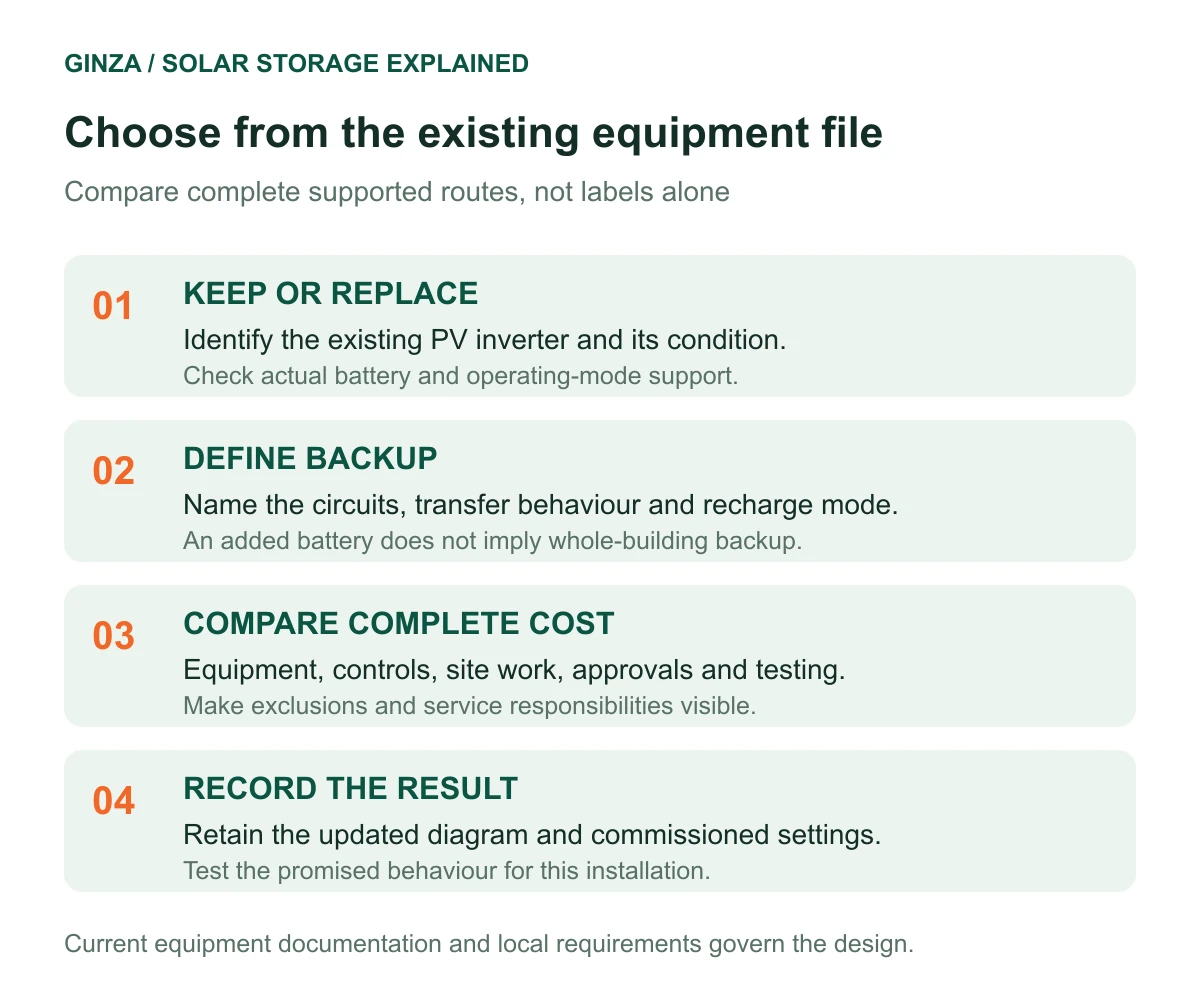
Request itemised proposals showing retained equipment, new equipment, controls, protection, circuit changes, metering, labour, testing and any approval work. Include removal and disposal arrangements where equipment is replaced.
Confirm who supports the combined system after the retrofit. An existing solar installer, a new battery supplier and an inverter manufacturer may each cover a different part. Keep the warranty and diagnostic responsibilities explicit before the work begins.
A cheaper product-only option may require more site work. A proposal that replaces a working inverter may offer useful integration, but its additional cost needs a clear purpose. Use the quotation comparison worksheet to compare complete scopes.
Set a documented handover test
The final record should show normal charging and discharging, the intended reserve and schedule, relevant monitoring values and any included backup test. Keep the updated system diagram, equipment list and settings. The customer should know which circuits remain powered and what actions require technical support.
Use an approved commissioning procedure for the actual system. A successful test from another project is not evidence that this installation supports the same transfer or PV-recharging behaviour.
Before assuming an added battery can use every apparent solar surplus, identify the limiting point using the inverter clipping and DC-to-AC ratio guide. A battery downstream of an AC conversion bottleneck does not automatically recover PV energy that was never converted.
If the existing roof hardware affects the retrofit, identify the optimizer or microinverter conversion path before evaluating backup operation.
Sources and interpretation
AC and DC coupling are conceptual equipment routes. The Australian battery guide explains the distinction, while the utility source addresses its connection context. Neither proves that an existing PV inverter supports islanded operation. The retained hardware, approved pairing, controls and intended mode determine the actual retrofit.
Frequently asked questions
Must I replace the solar inverter to add a battery?
Not always. A supported AC-coupled route may retain it, while an existing compatible hybrid inverter may support a DC-coupled addition. A site and equipment review establishes the available options.
Is DC coupling always more economical?
No. Conversion efficiency is one input. Equipment replacement, installation scope, charging opportunity and the desired operating modes can change the comparison.
Will the old solar inverter work during a brownout?
Only if that behaviour is supported by the complete backup architecture. Ask for the exact design and test conditions; do not infer it from the presence of a battery.
Send GINZA the existing equipment file and storage objective for a model-specific discussion. Keep the commissioning record with the final retrofit documents.