A solar battery can run air conditioning overnight when the available energy, inverter output and charging opportunity match the actual load. The useful calculation starts with measured average electrical watts and operating hours. A horsepower label, room size or battery Ah number alone cannot establish the answer.
In the worked example below, an air conditioner averaging 900W for eight hours uses 7.2kWh. Add an illustrative 1.2kWh for other overnight loads and the total becomes 8.4kWh AC. At an 85% battery window and an assumed 90% conversion efficiency, that requires approximately 10.98kWh nominal before further allowances.
Measure electrical consumption, not just cooling capacity
Cooling capacity and electrical input are different quantities. Two air conditioners advertised for a similar room can consume different energy, and the same unit can draw different average power on different nights. Room temperature, thermostat setting, insulation, humidity, occupancy and operating mode all influence the pattern.
Use the appliance’s monitoring data, an appropriate energy meter or installer-supported measurement. For a fixed-wired air conditioner, have the appropriate qualified person obtain the data. Do not open equipment or alter wiring to collect a number for this guide.
| Record | Why it matters |
|---|---|
| Total kWh over the actual night | Provides the energy requirement directly. |
| Average input W | Allows an hours-based calculation. |
| Maximum demand and starting behaviour | Supports the inverter and battery-current review. |
| Temperature setting and room conditions | Explains variation between measurements. |
| Other loads operating at the same time | Prevents underestimating the complete backup requirement. |
Build a complete eight-hour energy budget
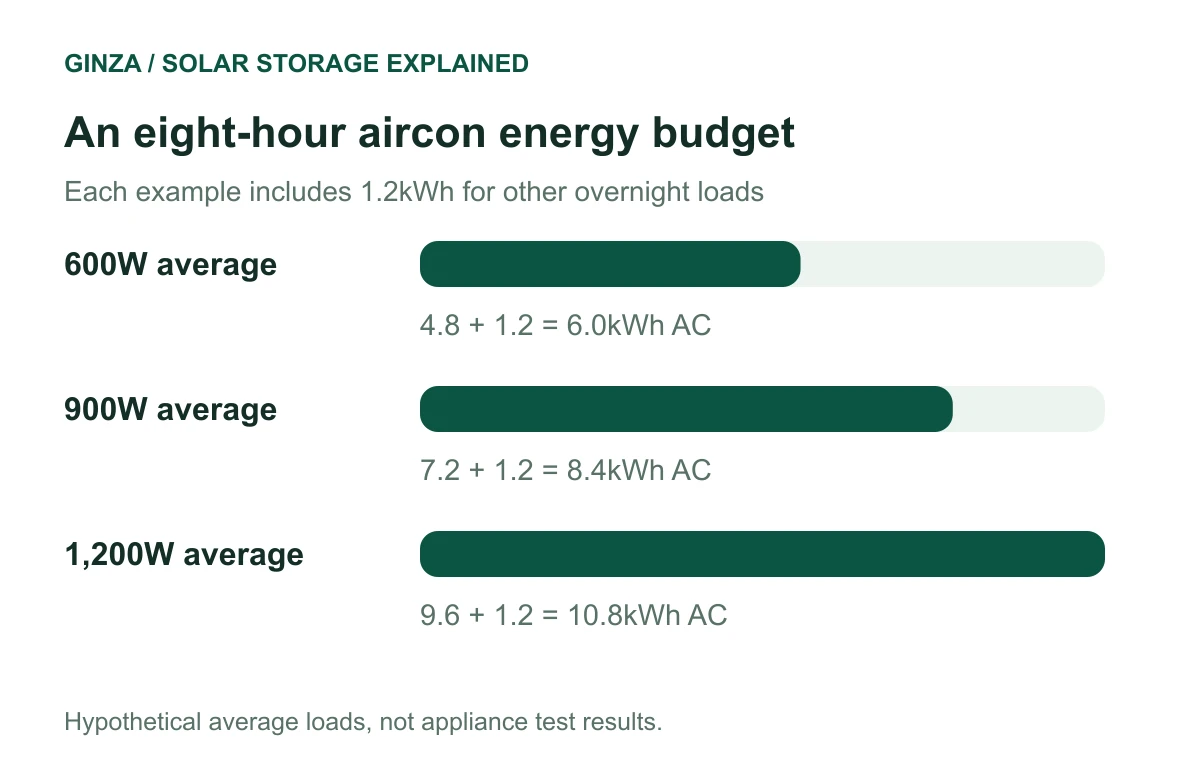
Average power in kW multiplied by hours gives kWh. The following examples use eight hours of aircon operation plus the same 1.2kWh allowance for other loads. All values are hypothetical planning inputs, not appliance tests or promised GINZA runtimes.
| Average aircon input | Aircon energy | Total with other loads | Nominal battery at 85% / 90% |
|---|---|---|---|
| 600W | 4.8kWh | 6.0kWh | 7.84kWh |
| 900W | 7.2kWh | 8.4kWh | 10.98kWh |
| 1,200W | 9.6kWh | 10.8kWh | 14.12kWh |
The conversion is AC energy ÷ 0.85 ÷ 0.90. It excludes a separate inverter standby allowance, cable losses, temperature effects and aging. A design also needs to establish the reserve and the energy actually available when the overnight period begins.
Compare the GINZA capacity steps
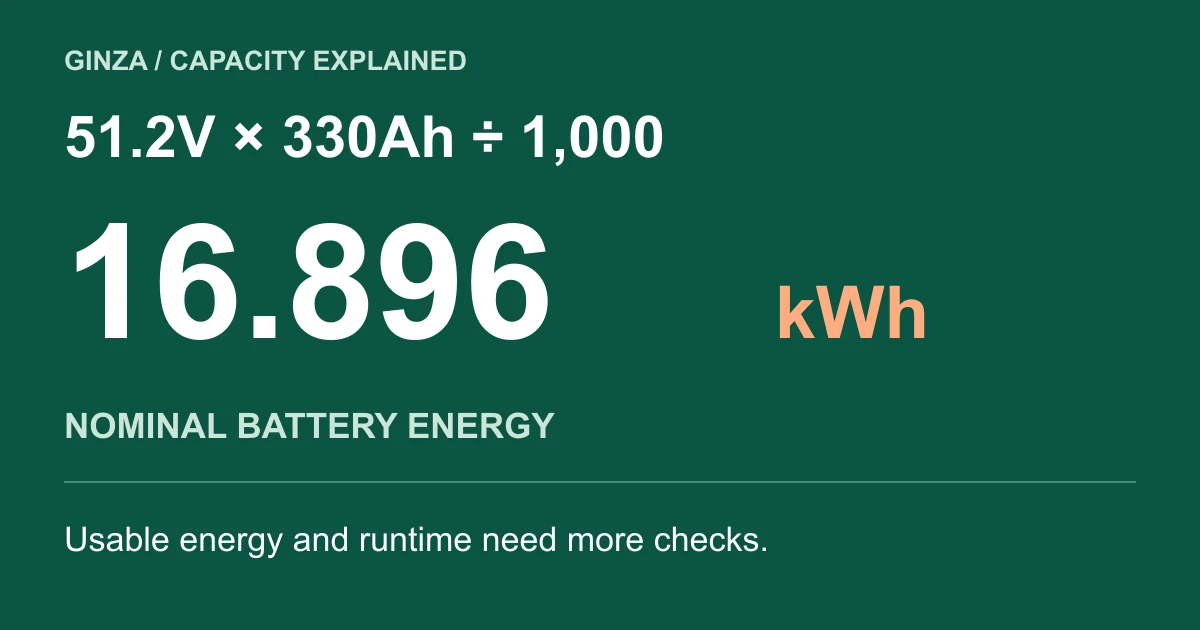
The Gen5 range lists 5.632kWh, 11.264kWh and 16.896kWh nominal. At the same illustrative 85% window and 90% efficiency, these correspond to about 4.31kWh, 8.62kWh and 12.93kWh AC before standby. Compare those figures with the complete night’s load rather than the air conditioner alone.
The 8.4kWh example is close to the calculated 8.62kWh for the 220Ah model. The small difference is not a recommendation to operate with almost no headroom: additional consumption, an incomplete starting charge or a warmer night can use it. Ask the installer to evaluate the margin and the customer’s tolerance for reducing comfort loads.
A 330Ah option provides more nominal energy, but more storage is useful only if the installation can recharge it and the inverter can support the required loads. The existing 330Ah runtime calculator lets you explore constant-load assumptions separately.
How long could an 11.264kWh battery run the aircon?
For an energy-only illustration, start with 8.61696kWh AC, calculated from 11.264 × 0.85 × 0.90. If other appliances consume 1.2kWh over the assessed period, 7.41696kWh remains for air conditioning. Divide that remainder by its average kW input.
| Average aircon demand | Hours from the remaining energy |
|---|---|
| 500W | About 14.8 hours |
| 750W | About 9.9 hours |
| 1,000W | About 7.4 hours |
| 1,500W | About 4.9 hours |
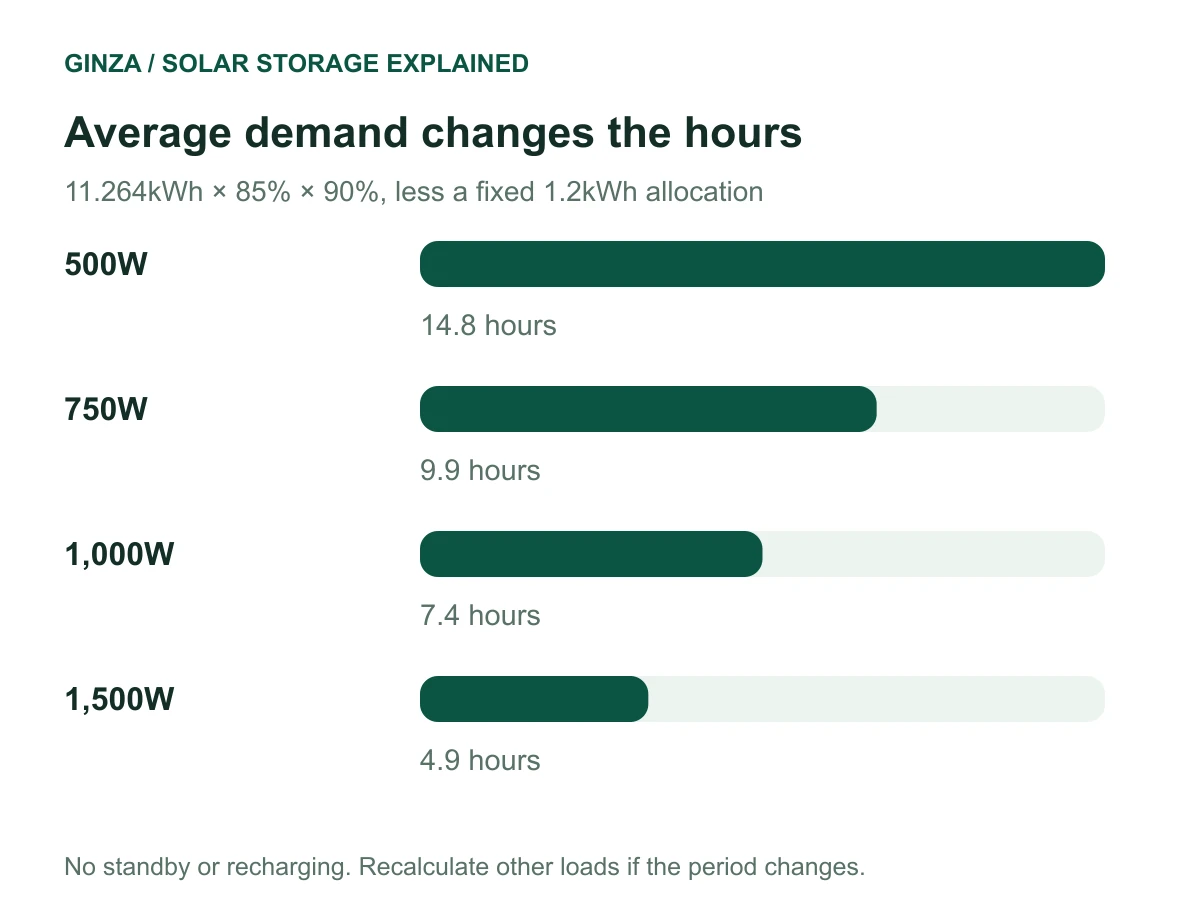
Here the 1.2kWh is a fixed energy allocation for the assessed period. If the other appliances run for longer when runtime extends, their consumption must be recalculated. The table does not prove that any particular air conditioner can start or operate on a specific inverter.
Reserve changes the answer substantially
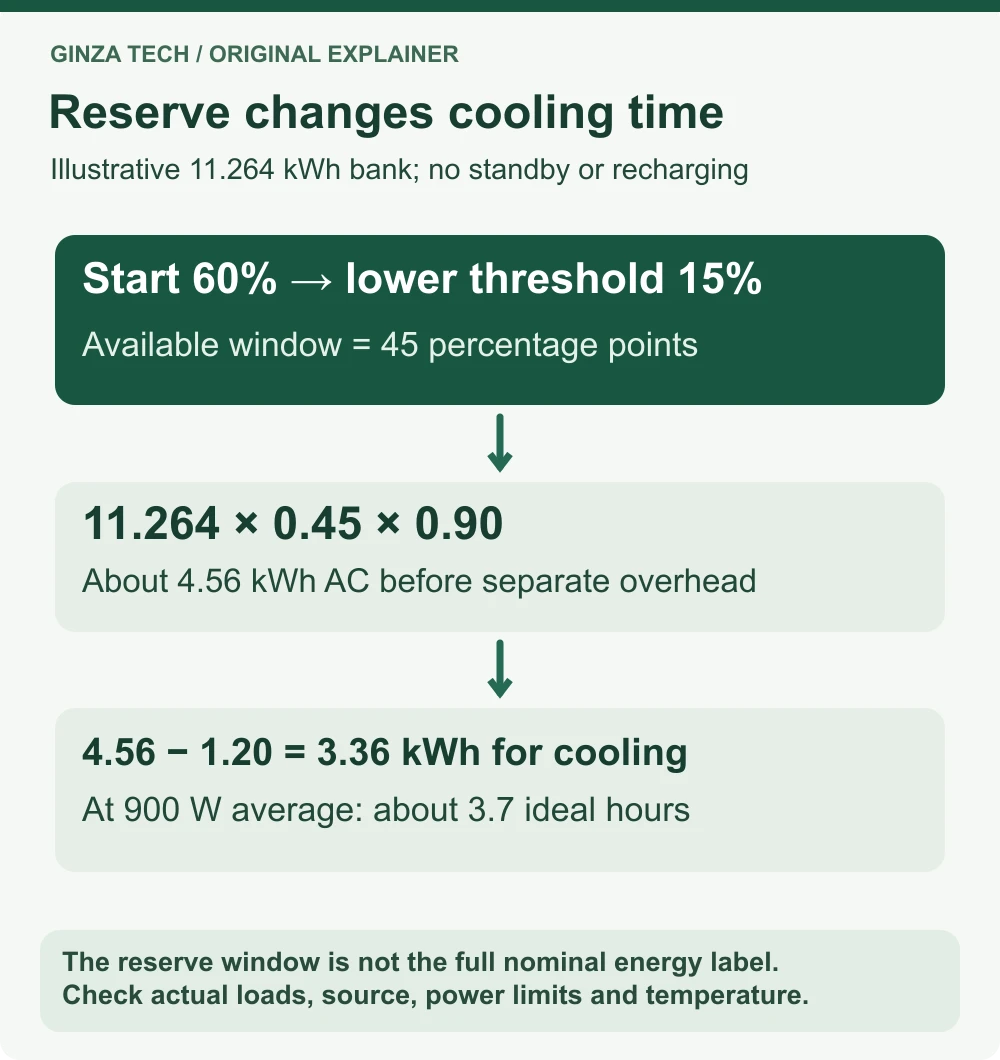
An overnight battery may already have supplied cooking, lighting or other evening use. If it begins at 60% state of charge with a 15% reserve, the available window is 45 percentage points. For an 11.264kWh battery and assumed 90% conversion, that is about 4.56kWh AC before standby.
Subtract the same 1.2kWh other-load allocation and about 3.36kWh remains. At 900W average aircon demand, that is around 3.7 hours. This illustrates why a “full battery” runtime advertisement may not describe the household’s condition when a brownout starts.
Discuss whether backup reserve is protected during normal self-consumption and what the user can reduce during a long interruption. Refrigeration, communications and safety-related lighting may have a different priority from cooling a second room. The reserve guide explains the capacity basis and the difference between a daily floor and a backup threshold.
Check inverter power, surge and backup operation
Battery energy is only one design limit. Ask for a review of the highest simultaneous AC load, motor-start behaviour, inverter output, permitted battery current and relevant protection. An inverter air conditioner may change its demand during operation; that does not remove the need for a power review.
Also identify whether the relevant aircon circuit is actually on the approved backup arrangement. Battery storage does not automatically energise every circuit during a grid outage. Meralco’s solar guidance distinguishes battery-backed critical loads and grid isolation. Confirm the exact installation and local utility context.
Can the solar array replace the overnight energy?
Review a day’s charging after daytime consumption. A household using 8.4kWh AC overnight needs more energy charged into the battery because of losses. Roof shading, weather, daytime cooling and charging limits all influence what is available.
Do not treat a 5kWp PV array as a constant 5kW charger. Use a generation profile and the actual daytime loads to establish the net charging opportunity. If several cloudy days matter to the backup objective, agree on a reduced-load plan or another approved charging source with the installer. The PV recharge worksheet tests that source-and-load budget separately from overnight battery capacity.
What changes when a second room needs cooling?
Add the measured energy of both rooms rather than doubling a marketing estimate. If one unit averages 800W and another 600W for eight hours, together they use 11.2kWh. Add the same illustrative 1.2kWh of other loads and the requirement becomes 12.4kWh AC, or about 16.21kWh nominal at the stated assumptions. That is already close to the 330Ah reference’s calculated 12.93kWh AC before standby. Check simultaneous power and design headroom as well as the energy total; a second room can change the complete installation proposal.
Questions to settle before accepting a proposal
- What measured aircon kWh and peak demand were used?
- Which other loads operate during the same night?
- What starting charge and reserve are assumed?
- Are standby, conversion losses and design headroom included?
- Which circuits operate in a brownout, and can PV recharge in that mode?
- What changes when weather or room conditions are less favourable?
Sources and interpretation
The average aircon loads, overnight schedules, starting charge and conversion figures are invented calculation inputs. They are separate from cooling-capacity labels or a measured GINZA appliance test. Meralco's reference supports the utility-isolation discussion; actual appliance energy, supported starting power and site measurements determine the proposal.
Frequently asked questions
Can a 10kWh battery run aircon all night?
It may, depending on the actual usable energy and total load. For the 8.4kWh AC example, a 10kWh nominal battery would provide only 7.65kWh under the stated 85% and 90% assumptions, before standby. The label alone cannot establish an overnight result.
Does a larger battery make an undersized inverter work?
No. Stored energy and output power are separate limits. The inverter, battery current and complete electrical design must support the load.
Should I turn aircon off during every outage?
Use the operating plan agreed for the installation. A system designed around selected essential loads may require different priorities from one specifically engineered for cooling backup.
Use the home battery sizing tool and send GINZA the measured load, inverter model and required hours. Philippine homeowners can request an assessment through the existing installation page.