Try your own load
51.2V battery energy and runtime calculator
Choose a Gen5 capacity and change the assumptions. This estimates constant-load energy use; it does not approve an inverter, appliance or installation.
Check the entered values and operating percentages.
Assumes the full selected battery window is available, a constant load and no solar recharging. It excludes battery aging, temperature effects and cable losses. Check maximum power, surge and current limits separately.
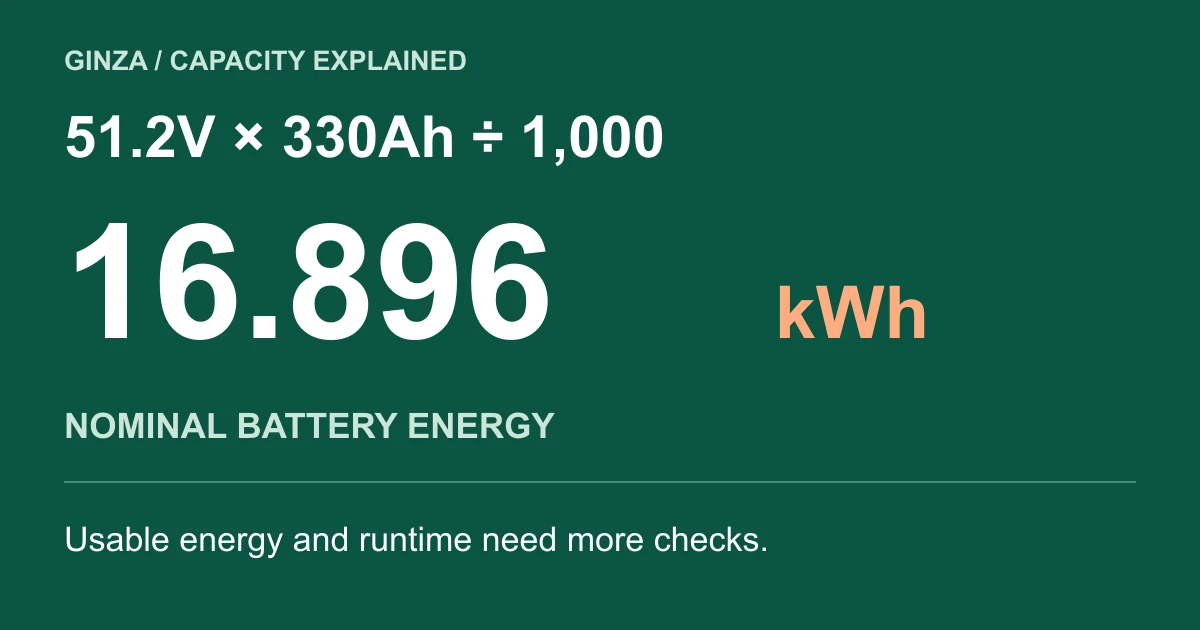
A 51.2V 330Ah battery contains 16.896kWh of nominal energy. Calculate it as 51.2 × 330 ÷ 1,000. That number answers the capacity-conversion question, but it does not tell you how long a home will run. Runtime depends on the available discharge window, inverter losses, standby consumption and the appliances operating at the same time.
For a GINZA 330Ah Gen5 planning example, an 85% discharge window leaves 14.3616kWh on the DC side. With an illustrative 90% conversion efficiency, that becomes about 12.93kWh of AC energy before standby consumption. A constant 1,000W load would therefore run for about 12.9 hours under those assumptions. This is a calculation, not a field test or a guaranteed backup duration.
1. Convert 51.2V 330Ah to kWh correctly
Amp-hours describe electrical charge; kilowatt-hours describe energy. Include the nominal battery voltage when comparing capacities:
Nominal kWh = nominal voltage × amp-hour capacity ÷ 1,000
For the GINZA 51.2V 330Ah Gen5, 51.2 × 330 = 16,896Wh, or 16.896kWh. “16.9kWh” is a rounded description of the same nominal capacity. “16.9kW” means power, so it should not be used as the energy rating.
| Rating example | Nominal calculation | Energy |
|---|---|---|
| 12V 330Ah | 12 × 330 ÷ 1,000 | 3.96kWh |
| 48V 330Ah | 48 × 330 ÷ 1,000 | 15.84kWh |
| 51.2V 330Ah | 51.2 × 330 ÷ 1,000 | 16.896kWh |
| 51.2V 300Ah | 51.2 × 300 ÷ 1,000 | 15.36kWh |
These rows illustrate the arithmetic, not a list of available GINZA models. They show why two batteries labelled “330Ah” may store very different amounts of energy. They also do not establish whether a battery is compatible with an inverter advertised as “48V.” The inverter’s actual operating range and communication requirements must be checked.
2. Separate nominal, usable DC and delivered AC energy
Three different numbers often appear in the same buying conversation. Nominal energy is the label calculation. Usable DC energy applies the permitted battery operating window. Delivered AC energy also accounts for the inverter and other losses.
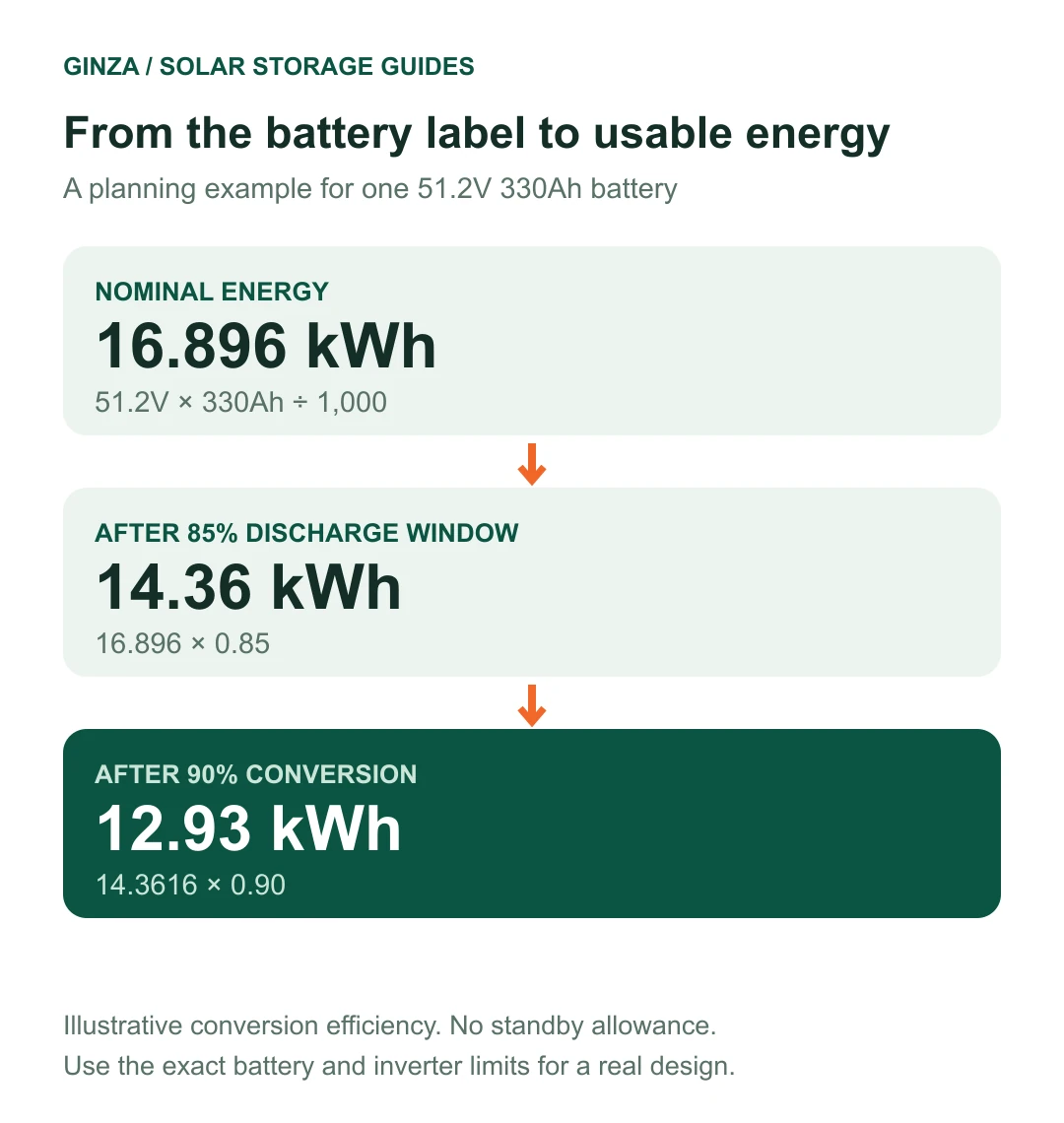
The published GINZA Gen5 specifications list 85% recommended depth of discharge and 90% maximum. Using the recommended 85% window and an assumed 90% inverter efficiency:
- Nominal: 16.896kWh.
- Usable DC: 16.896 × 0.85 = 14.3616kWh.
- AC before standby: 14.3616 × 0.90 = 12.92544kWh.
The 90% conversion figure is an example, not a published GINZA inverter rating. Real efficiency varies with equipment and load. Cable losses, battery aging and temperature also affect the energy reaching appliances.
3. Estimate runtime from the average load
When standby is excluded, divide available AC energy by average appliance demand in kW. A 500W average load is 0.5kW, so 12.92544 ÷ 0.5 gives about 25.9 hours. Do not divide kWh directly by watts without converting the units.
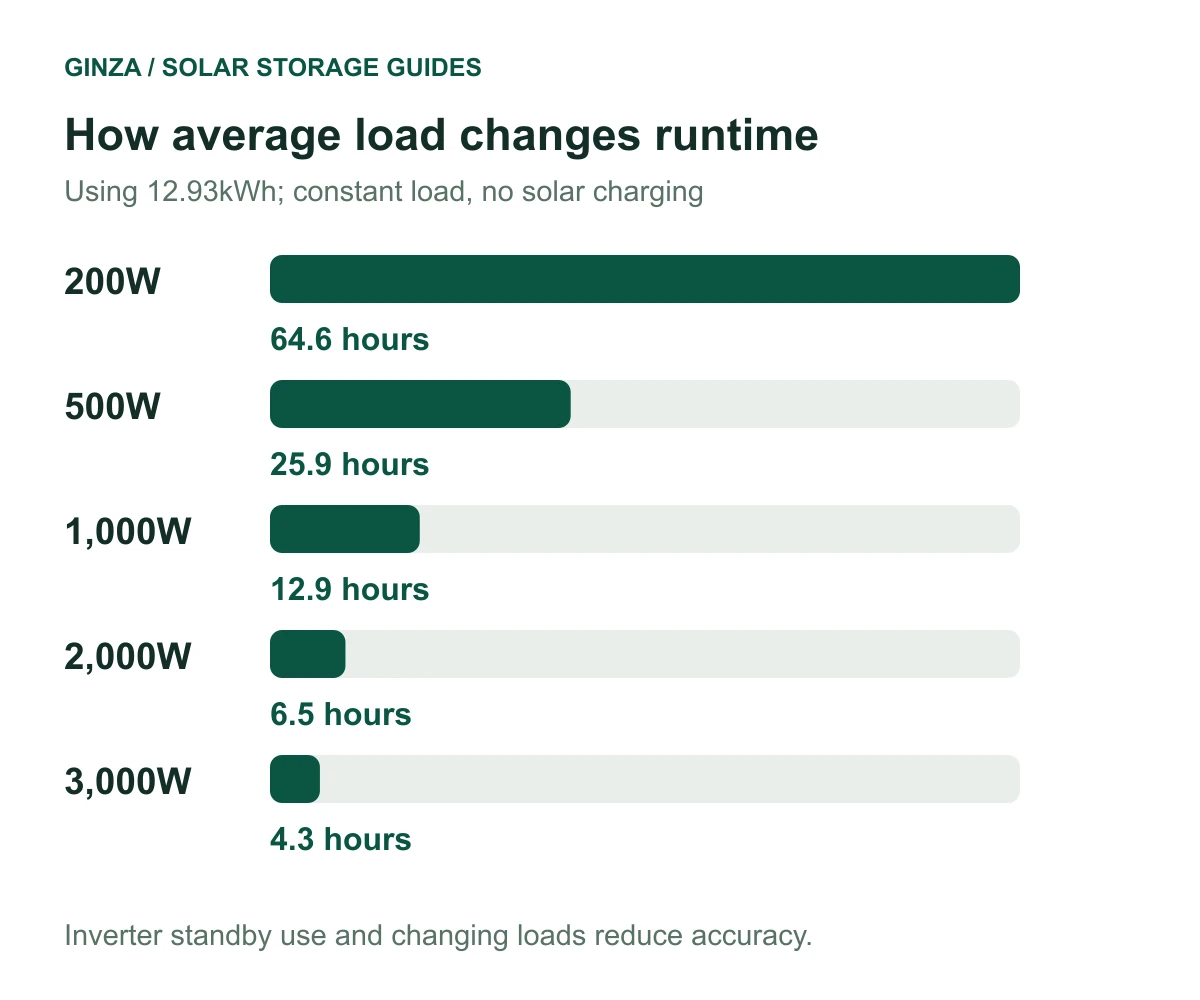
| Average appliance load | No standby allowance | With an illustrative 40W DC standby draw |
|---|---|---|
| 200W | 64.6 hours | 54.8 hours |
| 500W | 25.9 hours | 24.1 hours |
| 1,000W | 12.9 hours | 12.5 hours |
| 2,000W | 6.5 hours | 6.3 hours |
| 3,000W | 4.3 hours | 4.3 hours |
Both columns assume one full 85% battery window, 90% conversion efficiency, constant loads and no solar recharging. The 40W figure is only a calculation example. Standby draw should come from the relevant inverter documentation or a suitable measurement.
Standby consumption is significant when the appliance load is small. For a DC-side standby figure, the calculation is: usable DC Wh ÷ [(appliance W ÷ inverter efficiency) + standby W]. The calculator above follows that method rather than treating a DC standby figure as another AC appliance.
4. Build an overnight load schedule
Apply the available energy above to a defined load schedule. As a short illustration, a constant 1kW total AC load for eight hours needs 8kWh before any separate standby allowance; this is different from assuming that every appliance in a house runs continuously.
Use the household battery sizing worksheet to build the full schedule. For cycling cooling loads, the overnight aircon guide provides measured-input questions, other-load allowances and reserve examples. This article keeps the calculation centred on the 330Ah model rather than repeating those load-specific worksheets.
For an existing battery, separate the calculation from a measurement. An old runtime estimate based on the nominal kWh still answers the conversion question, but a recent, comparable AC energy test provides a better input to a runtime estimate for that site. Record the test’s load, reserve, temperature and meter location before comparing it with handover data. The battery health and charge guide gives a worked example of why similar starting SoC can produce different backup time.
5. Check the charge available when the outage starts
The earlier runtime table assumes the selected operating window is fully available. An outage may begin after the battery has already powered evening loads.
For example, if the starting state of charge is 60% and the planned reserve is 15%, the available window is 45 percentage points. The illustrative AC energy is then 16.896 × 0.45 × 0.90 = about 6.84kWh. At a constant 1kW, that is about 6.8 hours before standby, not 12.9 hours. The SoC, DoD and reserve explanation separates the ending percentage from the window used during that event.
Use the available window in the calculator, subject to the approved battery limits. A reserve setting is an operating decision that balances normal energy use with preparedness for an interruption.
6. Verify power, inverter compatibility and backup circuits
A large energy rating does not approve every appliance. At 51.2V nominal and 90% conversion efficiency, a 5kW AC load represents approximately 108.5A of battery current before additional losses. That arithmetic does not establish that a particular battery, BMS, inverter or conductor arrangement can support the load. The LiFePO4 C-rate and discharge-current guide shows how to compare an estimated current with continuous and surge limits.
Ask the installer to confirm continuous output, surge capability, permitted battery current, communication and protection for the exact combination. A matching connector is not proof of CAN or RS485 protocol compatibility.
Backup also needs an appropriate circuit arrangement. Meralco’s solar guidance explains that battery-backed critical loads must be isolated from the distribution grid during battery operation. This is separate from how many kWh the battery contains.
7. Check whether the battery can recharge
Storage is useful only if the energy used can be replaced. Compare overnight demand with the solar energy left after daytime consumption. Roof shading, weather and operating schedules matter; a PV array’s nameplate kWp is not a constant charging rate.
If the net power actually reaching the battery were a steady 3kW, replacing 14.3616kWh would take approximately 4.8 hours at that net rate. That does not mean any 3kWp array can refill this battery in 4.8 hours. Confirm the real generation profile, charging limits and daytime loads. Use the charging-time guide for changing current and source conditions; the PV recharge budget addresses array yield and daytime demand.
8. Gen3 and Gen5: equal kWh does not mean identical products
Both GINZA 330Ah models list 16.896kWh nominal energy. Their published specifications differ: the Gen3 model lists IP20 protection and up to 15 units in parallel, while the Gen5 model lists IP65 and up to 20, subject to system design. Installation conditions and current documentation still govern the application. An IP rating alone is not permission to expose equipment to every outdoor condition.
For a lightly loaded backup system, measure inverter standby power over the actual schedule before treating it as a constant in the runtime estimate.
Sources and interpretation
The 16.896 kWh nominal value is the 51.2 V × 330 Ah conversion for the linked model. The 90 percent conversion efficiency and standby scenarios are assumptions, not an inverter specification or measured runtime. Use the actual starting charge, operating window, load and supplied product documents when applying the calculator.
Frequently asked questions
Can a 330Ah battery power air conditioning overnight?
Possibly, within a correctly designed system. Use the dedicated aircon energy and reserve examples with the actual measured load, then compare it with the 330Ah energy budget above and the supported inverter and battery limits.
Does 51.2V 330Ah mean 16.8kWh or 16.9kWh?
The nominal calculation is 16.896kWh. It rounds to 16.9kWh to one decimal place. Use the exact published model rating rather than assuming every marketing abbreviation is equivalent.
Can solar extend the hours in the table?
Yes, where the system supports the required operating mode and usable generation is available. The table intentionally excludes recharging so its assumptions remain clear.
Should I choose a smaller battery?
Choose from measured demand, backup duration and recharging opportunity. A larger battery is not automatically better value. Compare the 110Ah, 220Ah and 330Ah specifications with the same load schedule.
For a model-specific review, send GINZA your inverter model, country, essential-load measurements and required backup hours. Philippine homeowners can use the existing installation assessment page.