Clean solar panels when the site’s soiling, production history and module instructions justify the work. In the Philippines, rainfall and dirt exposure vary by location, roof design and nearby activity. Start with a safe observation and a service review. A universal monthly cleaning schedule can miss a dusty site or add unnecessary work to an array that is performing normally.
This guide helps owners and installers decide when cleaning is worth investigating and what to include in a professional service scope. Rooftop access and electrical work require appropriate competence and planning. Use the cleaning instructions supplied for the installed module model and the site’s approved procedure.
Look for the kind of soiling the site actually has
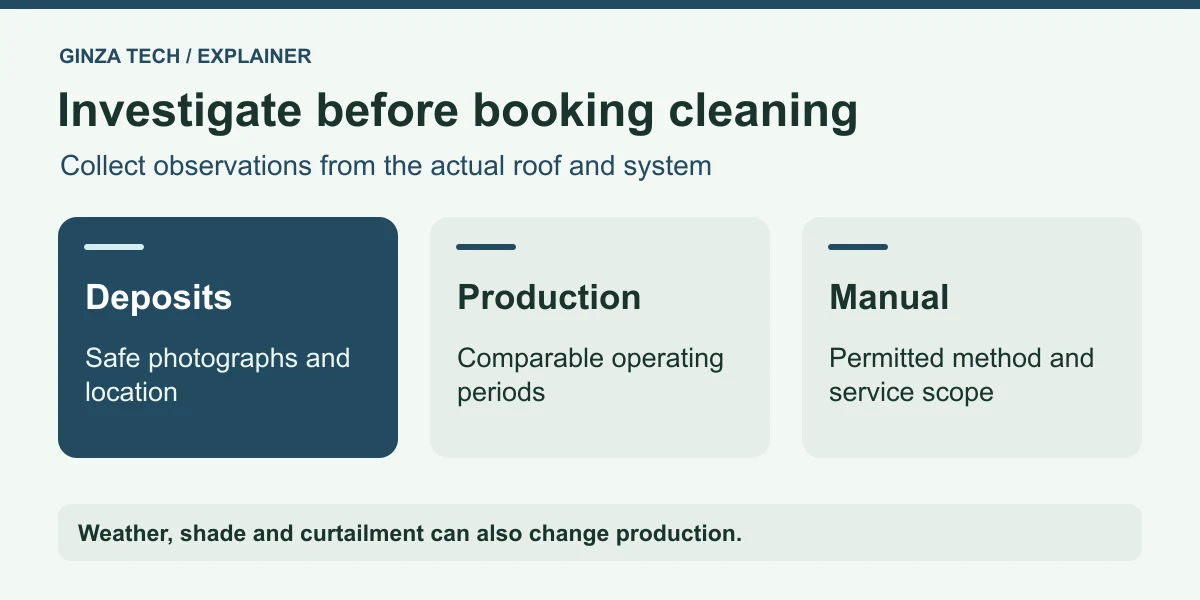
Record visible dust, bird deposits, leaves or other contamination from a safe location. Note whether it affects a few modules or most of the array and whether nearby construction or vegetation has changed. Ask the installer to review persistent deposits or damaged components. Some contamination may remain after rain, while a light surface film may have little practical effect on the site’s production.
PAGASA’s climate overview explains that rainfall distribution varies across Philippine regions. Use the actual weather history and exposure of the property when planning service. A calendar based on another province may be a poor match for the roof you operate.
Compare performance under comparable conditions
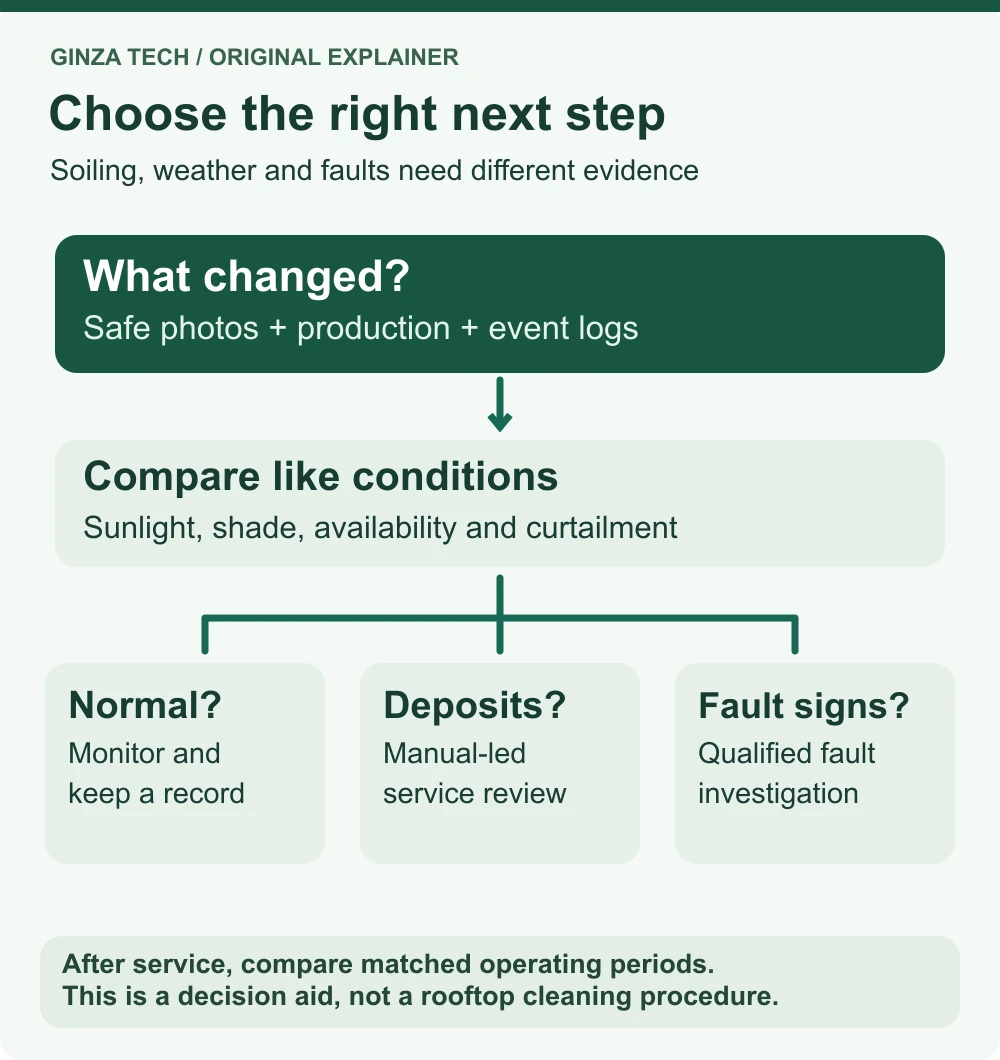
A low-generation day alone cannot identify a dirty array. Cloud, shade, equipment availability, temperature and export or charge limits can change the result. Review similar periods or a suitable weather-normalized comparison with the installer. Retain the time range and any changes in loads or equipment settings.
For example, a hypothetical 5 kWp array producing 18 kWh in a day has a specific yield of 3.6 kWh per kWp. A later 15 kWh day gives 3.0. The difference is about 16.7 percent, but the two daily totals cannot establish that soiling caused it. Ask what happened to irradiance, shading, inverter status and curtailment during the same period.
| Observation | Useful follow-up | Evidence to keep |
|---|---|---|
| Lower daily generation | Check weather, status and limits | Same-period production and event logs |
| Persistent deposits | Ask the provider about cleaning needs | Safe photographs and location notes |
| New shade | Review the shade source and timing | Time-of-day observations |
| Damage or abnormal condition | Use the provider’s service process | Equipment identity and reported symptoms |
Read the module instructions before selecting a method
Ask for the manual matching the installed model and revision. For example, the Canadian Solar module installation manual contains model-specific cleaning guidance, material restrictions and safety requirements. Use it as an example of the detail to request. Its procedure does not automatically apply to another manufacturer’s module.
Discuss permitted tools, water quality and any approved cleaning agents with the provider. The service plan should address roof access, module condition and nearby electrical equipment. Abrasive tools or an improvised high-pressure method can damage equipment. An inverter being switched off does not remove the sunlight falling on PV modules, so the electrical procedure needs to be planned by the responsible provider.
Turn the module manual into a usable service brief
The cited Canadian Solar manual’s maintenance and cleaning sections give concrete examples: work during a cooler part of the day, use permitted non-abrasive equipment, and avoid scraping dry deposits. It also assigns electrical and mechanical maintenance to qualified personnel. These are examples from that manual, not approval to apply its tools, chemicals or limits to another module.
| Before a cleaning visit | Put this in the service brief |
|---|---|
| Identify the equipment | Installed module model, matching manual revision and warranty restrictions |
| Choose the method | Manufacturer-approved tools, water and any permitted cleaning agent |
| Plan access and electrical work | Responsible qualified team, weather conditions and the approved site procedure |
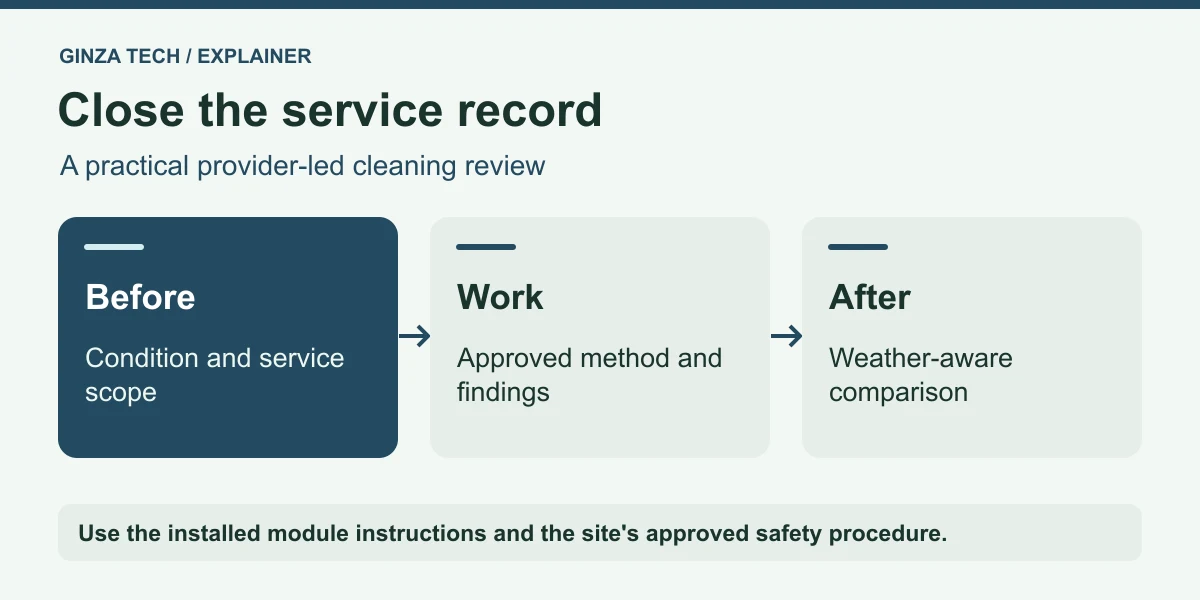
| Define completion | Before/after condition, defects found and a weather-aware performance review |
Where no persistent deposits or unexplained performance change are found, continued monitoring can be a reasonable outcome. A fixed promise to clean every month is not evidence that the service is needed.
Specify what the cleaning visit includes
- Identify the module models, array location and any manufacturer restrictions.
- Review safe access, weather conditions, damage observations and the approved electrical procedure.
- Define the cleaning scope, permitted materials, disposal or runoff considerations and service responsibilities.
- Record the pre-service condition, date, work performed and any defects requiring separate attention.
- Review production after service using a comparison that accounts for changing weather and operating conditions.
The DOE PV operation and maintenance overview treats cleaning as part of a wider service plan that includes performance tracking and corrective work. Keep any equipment defect separate from the cleaning task so the responsible technician can close it properly.
Measure the result without overstating the benefit
Suppose the installer compares matched operating conditions and estimates a useful increase of 1 kWh a day after cleaning. At an illustrative marginal energy value of ₱10 per kWh, 60 days of that increase would be worth ₱600. Compare that with the service cost and expected duration of the benefit. The example does not establish a typical recovery, current tariff or recommended cleaning interval.
The value also depends on where the extra energy goes. A daytime load can use it directly. A supported battery can accept some of it if there is charge headroom. An approved export arrangement may give it another value, while a constrained zero-export system may curtail it. Use the solar recharge budget to see whether energy supply is the actual bottleneck.
Review site changes that cleaning cannot solve
Vegetation, a new structure or changed equipment can create a different production pattern. Have the installer review the cause rather than repeatedly booking cleaning for the same symptom. Keep the original commissioning and service records so a new technician can see whether the array layout or controls have changed.
If the battery is charging poorly, compare the source, daytime loads and charging limit before attributing it to the panels. The charging diagnostic guide covers that evidence. The battery maintenance checklist keeps the storage service plan alongside the PV record.
Keep the service decision reviewable
Ask the provider to leave a short record showing what prompted the visit, which parts of the array were cleaned and what defects were observed. Use photographs taken safely and identify their date and location. If a section remains difficult to access, document how the provider handled that part of the scope and whether it needs a separate arrangement.
After the visit, compare several relevant operating periods instead of selecting the single best-looking day. Weather and changes in household consumption can alter the charts immediately. An approved zero-export controller may also limit production when the battery is full, making a generation-only comparison difficult. Ask the installer to identify those constrained periods.
If the result does not improve as expected, return to fault assessment with the records available. Repeated cleaning cannot resolve every inverter, shading or control issue. Retain the provider’s explanation of the next step, who is responsible and which data would help close the question. This makes a future maintenance decision more useful than an unsupported promise of a fixed percentage recovery.
Keep the module warranty and the cleaning provider’s scope together. Ask who handles any damage reported during the visit and what evidence the equipment supplier would need. A clear service record helps resolve that question and supports a consistent decision about the next inspection.
If the observed reduction follows a moving obstruction rather than accumulated dirt, use the shade-record and bypass-diode guide. Cleaning observations and electrical shade assessment answer different questions and should remain separate in the service record.
Sources and example boundaries
The production change and ₱600 value calculation are invented examples, not measured cleaning results. The manual reference is a model-specific example. Philippine rainfall context does not establish a cleaning interval for an individual roof.
- Canadian Solar installation manual, maintenance and cleaning sections
- PAGASA Philippine rainfall and climate overview
Frequently asked questions
Does rain remove the need for cleaning?
It depends on the deposits, module layout and local conditions. Check whether contamination remains and ask the provider to compare performance before setting an interval.
Should I expect a fixed percentage improvement?
Request evidence for the actual site and comparable conditions. A sales claim from another installation may involve a different type of soiling or a different measurement method.
What helps an installer quote the service?
Provide the module model, array size, roof and access information, safe photographs and relevant production history through the project enquiry form. For published installation information, see the Philippine solar installation page.