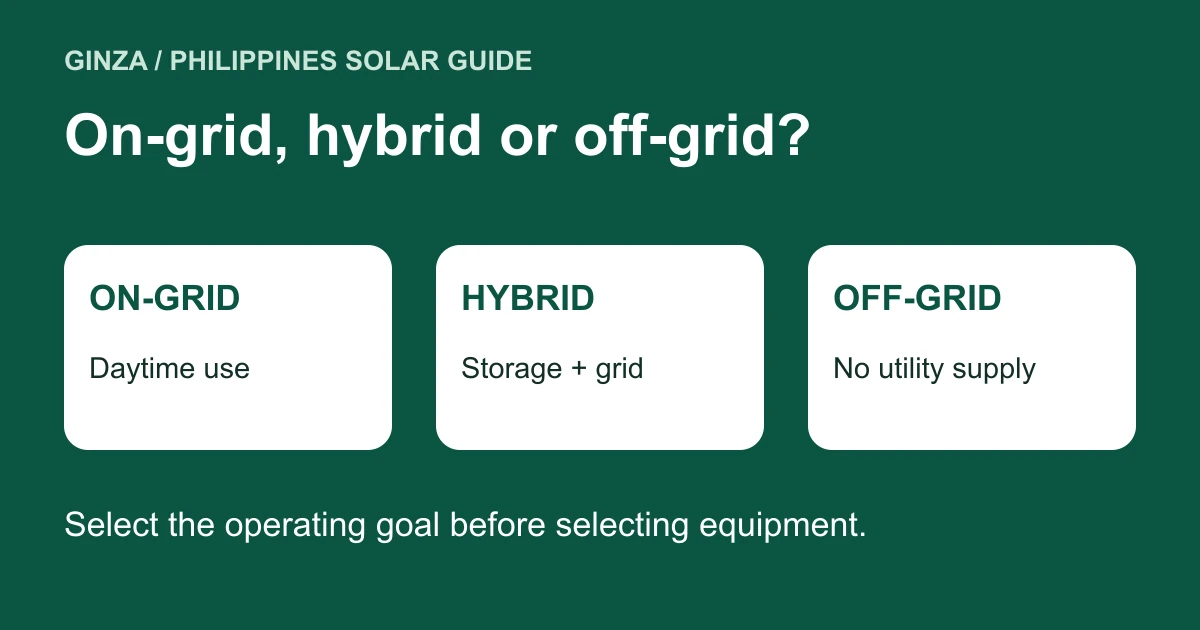
Grid-tied solar, hybrid solar and off-grid solar solve different operating problems. Grid-tied solar-only systems normally focus on using solar while the grid is available. A hybrid system combines solar, storage and a grid connection, but backup must be specifically designed. An off-grid system must meet its loads without normal utility support.
For a Philippine home or small business, start with the outcome: daytime electricity use, evening energy, backup during brownouts, or power at a location without a grid connection. The correct system is not determined by a label such as “6kW” or “hybrid-ready” alone.
A quick comparison of the three system types
| Question | Grid-tied solar only | Hybrid with battery | Off-grid solar |
|---|---|---|---|
| Utility connection | Yes | Yes | No normal utility supply |
| Stored energy | Usually none | Battery available for the selected operating objective | Usually needed outside generation hours |
| Brownout operation | Standard solar-only backup is not assumed | Only with suitable backup functions and isolation | Within available generation, storage and equipment limits |
| Primary design question | How much solar can be used during daylight? | Which loads use stored energy, and when? | How will demand be met through poor weather? |
| Export | Depends on the approved connection arrangement | Depends on equipment, utility rules and operating mode | No normal utility export |
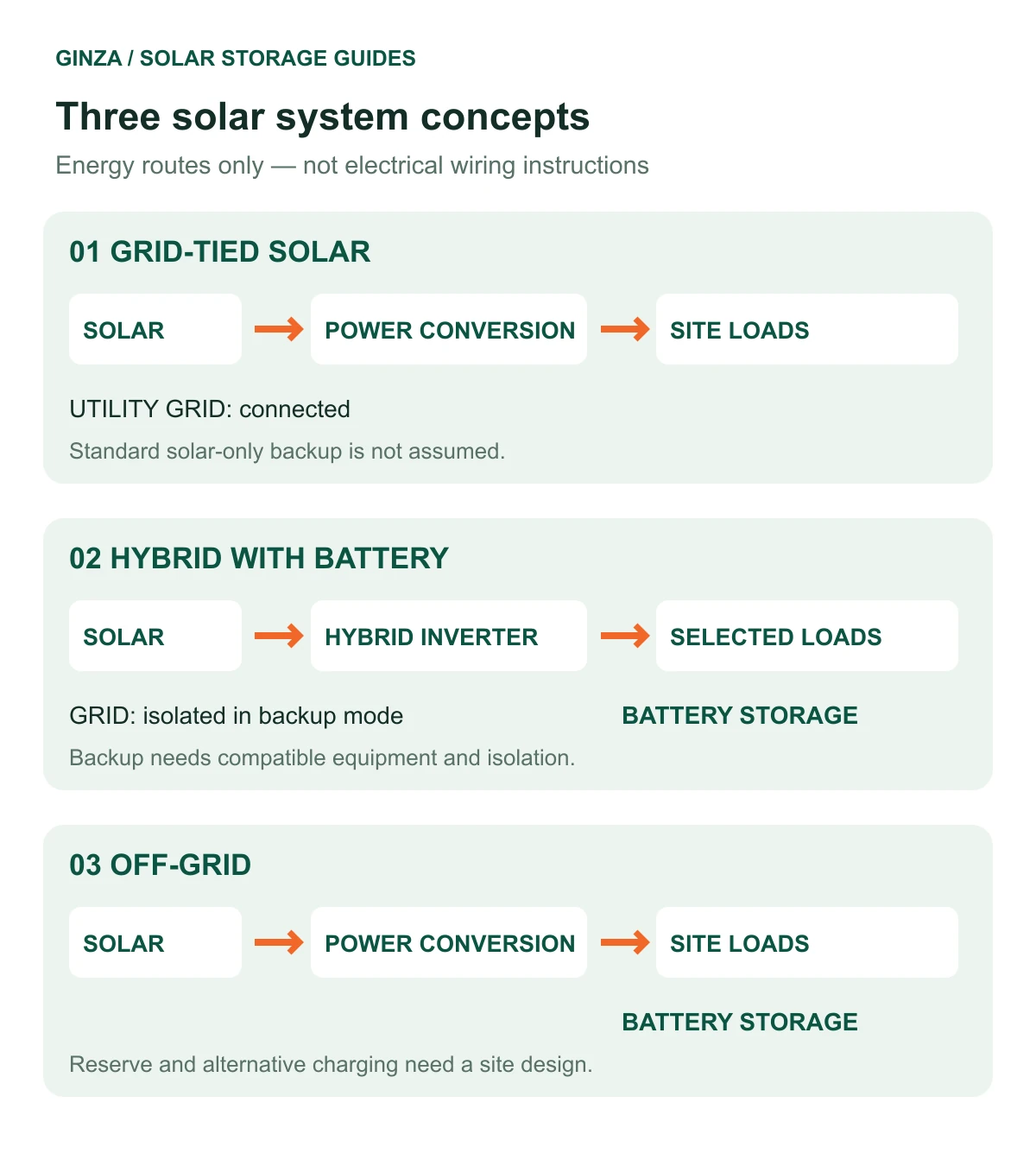
The diagram shows concepts, not wiring instructions. Actual installations need an approved design, appropriate equipment and applicable electrical inspections.
What a grid-tied solar-only system does well
When a building uses substantial energy during sunlight hours, solar generation can supply some of that demand directly. This may suit a daytime office, shop or household with flexible daytime loads. Compare generation and consumption at the same times of day, not just their monthly totals.
Surplus energy is a separate question. Export, metering and billing depend on the connection arrangement approved by the relevant distribution utility. For Meralco customers seeking export credits, review its net-metering application process. Do not assume an inverter’s export setting replaces the necessary utility coordination. For a worked comparison of utility import, export and peso credit, see the Meralco net metering bill guide. For an own-use alternative, the Philippine SGF ZESS and MSS review identifies the circular and notification distinctions. It addresses a different route from compensated exports.
The trade-off is that a conventional grid-following solar-only system generally stops when the grid fails. It should not be sold as automatic brownout protection merely because solar panels are installed.
What a hybrid solar system adds
Storage lets the design address energy use at another time, such as after sunset. A backup-capable arrangement may also support designated circuits during an interruption. Those are related but distinct objectives: a battery scheduled for evening self-consumption may have less energy available if an outage begins later.
A proposal should explain how the system handles three situations:
- Sunny daytime: how solar serves loads and whether surplus energy charges the battery or is exported under the approved arrangement.
- Evening: which loads use stored energy and what reserve is retained.
- Grid failure: which circuits remain available, how they are isolated, and whether solar can recharge the battery in that mode.
The Australian Government’s inverter guide describes the combined solar and battery functions of a hybrid inverter. That technical distinction is useful; Australian approval lists and incentives should not be treated as Philippine rules.
Why the word “hybrid” does not guarantee backup
Ask the supplier to identify the exact backup output, transfer arrangement and supported operating modes. Equipment described as hybrid may have different capabilities, and a battery connection alone does not establish which household circuits can operate during a brownout. Use the brownout backup checklist to verify which circuits transfer, which can restart and how much reserve is available.
Meralco’s solar guidance distinguishes battery-backed critical loads from the distribution grid during battery operation. The isolation and protection must be part of the installation design. Sensitive loads also require the actual transfer behaviour to be checked; a general solar package should not automatically be assumed to perform like an uninterrupted power supply.
Some specialised solar-only equipment can provide a limited backup function. Therefore, compare the exact equipment and operating conditions rather than assuming every product follows one universal rule.
When off-grid solar is the relevant starting point
Off-grid planning is appropriate when the site has no normal utility supply. Storage, solar generation and any permitted alternative charging source have to support the expected demand through changing weather. Running out of usable energy cannot simply be resolved by normal grid import.
The installer needs to review the load schedule, the site’s generation conditions, required autonomy and a plan for periods of poor solar production. Reducing nonessential loads may be part of that operating plan. An off-grid design should not be based on an average monthly bill or an assumed number of sunny hours alone.
“Off-grid inverter” and “off-grid site” are also different descriptions. Some equipment can accept an AC charging source; that does not by itself establish whether it can export, provide approved grid-parallel operation or meet the site’s connection requirements.
Use a decision guide before comparing quotations
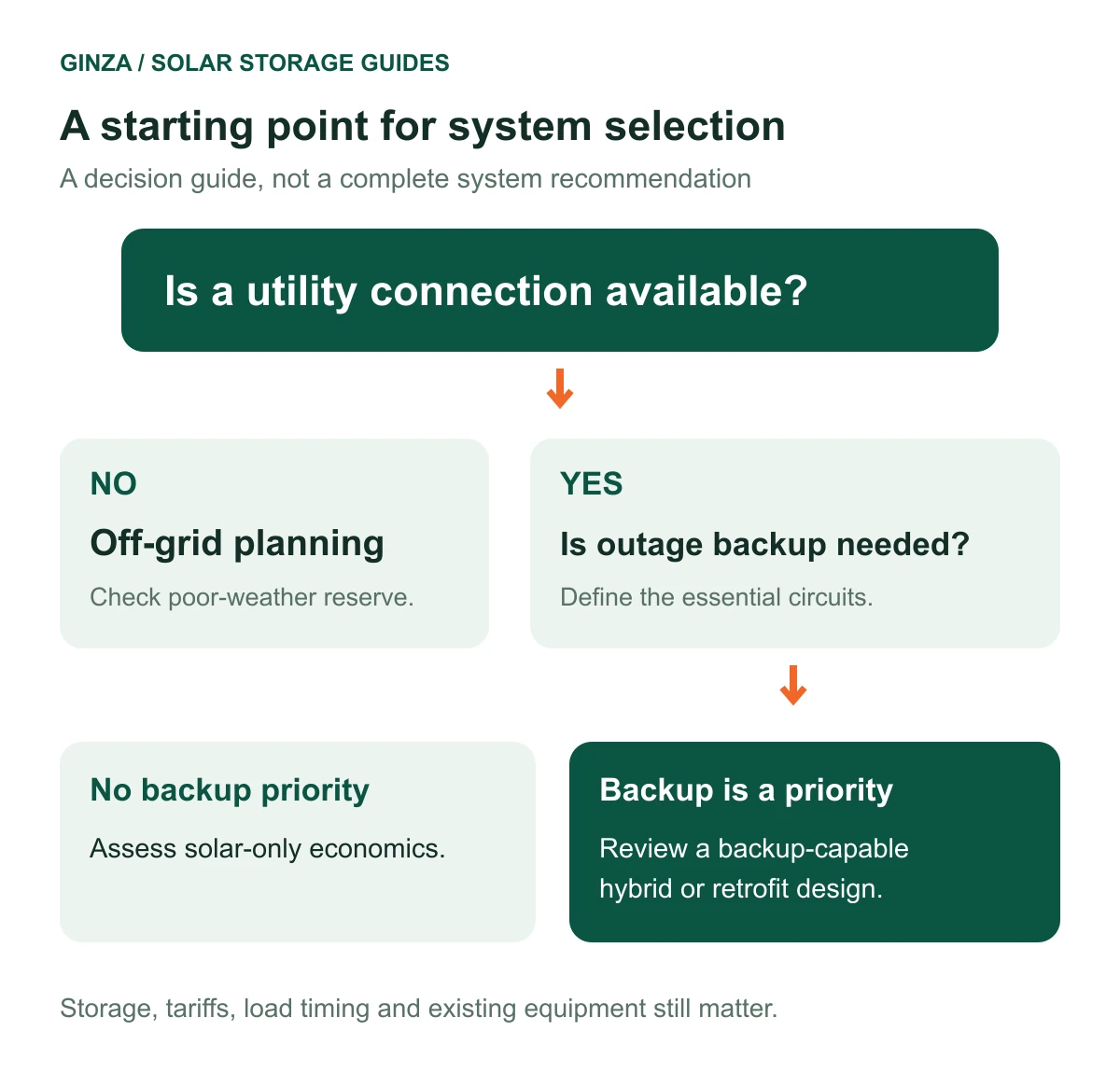
This guide helps organise the initial conversation. It does not mean storage is useful only for backup: a grid-connected customer may also want to shift solar energy into the evening. Include that objective explicitly when comparing proposals.
Example A: daytime use is the priority
A small office operates mostly during daylight and can tolerate ordinary grid interruptions. Begin by assessing solar-only self-consumption and the relevant export arrangement. Add storage only after explaining what extra benefit it should deliver.
Example B: a grid-connected home needs selected backup loads
The household wants refrigeration, fans, lighting and communications during brownouts. Identify those circuits, measure their energy use, establish a backup period and assess a suitable hybrid or retrofit arrangement. Do not quietly include all air conditioners, pumps and cooking appliances in an “essential loads” assumption.
Example C: a remote site has no normal utility supply
Begin with off-grid energy availability and the operating plan for poor-weather periods. A system adequate for an occasional weekend visit may not suit a continuously occupied building with refrigeration and other daily loads.
Battery kWh and inverter kW must be sized separately
Inverter kW describes output power. Battery kWh describes stored energy. A 6kW inverter does not tell you whether the battery provides two hours or a full night of energy. Conversely, a large-kWh battery cannot make a smaller inverter run loads beyond its output rating.
GINZA’s 51.2V Gen5 range provides 5.632kWh, 11.264kWh and 16.896kWh nominal capacity options. These are product energy ratings, not a recommendation for every building. Use the home battery sizing guide and the 330Ah runtime calculator and examples to prepare a load-based discussion.
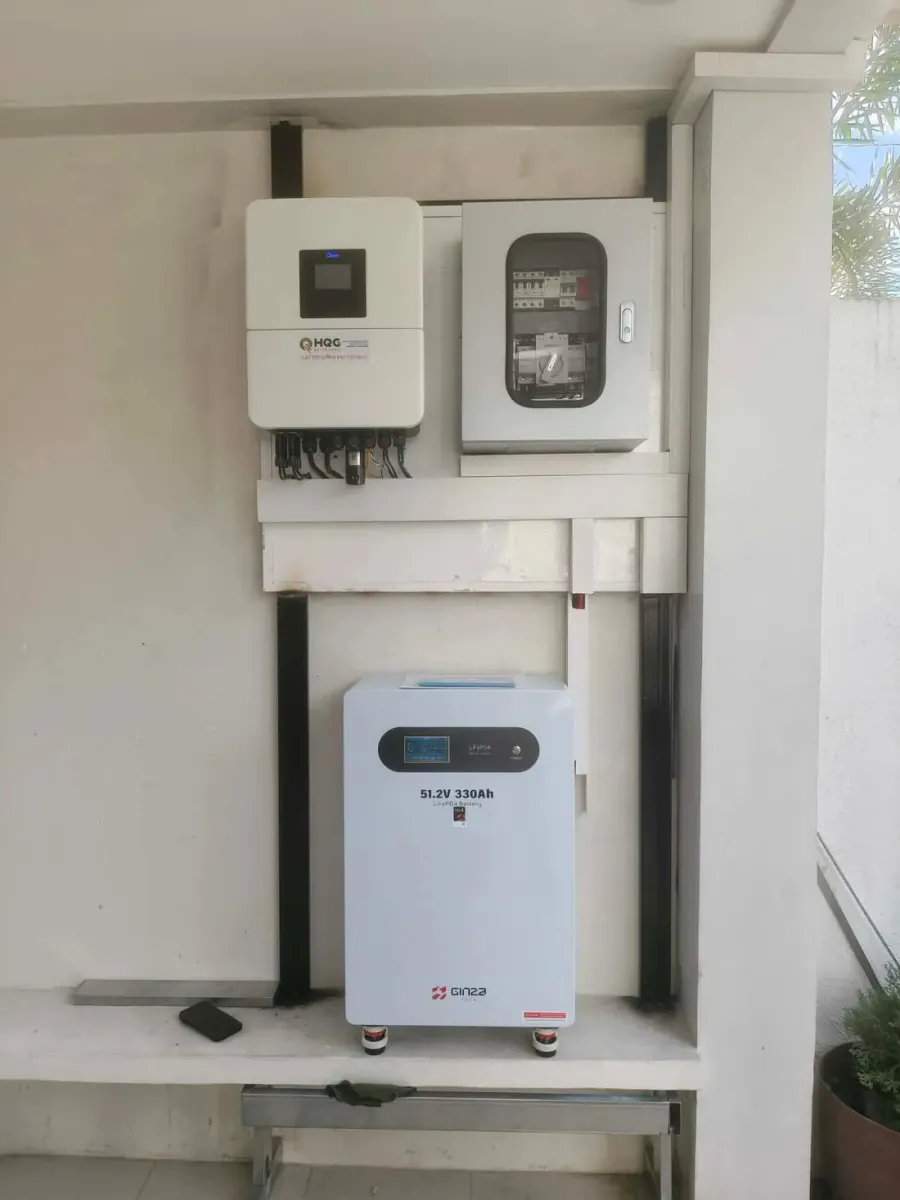
What are the disadvantages of hybrid solar?
A hybrid proposal adds storage and its associated design, settings and service requirements. The extra equipment needs to deliver a useful outcome; otherwise it may add complexity without enough benefit. Review battery replacement planning, installation space, operating temperature, access for maintenance and who supports the battery/inverter combination.
Financial results depend on the actual installed quotation, tariff, export treatment, usable energy, charging opportunity and load schedule. Ask the supplier to separate expected energy savings from the household’s value of backup. Neither a battery label nor a headline package price proves a fixed payback period.
Can an existing grid-tied installation be upgraded?
Possibly. First establish the operating goal here: daytime solar use, evening storage or specifically designed backup. Then use the AC-versus-DC retrofit guide to compare retained equipment, inverter replacement, metering and the exact supported battery route.
After installation, retain an equipment-specific commissioning and handover record. Compare the complete battery quotation scope separately from the system-type label.
A practical checklist for comparing proposals
| Ask for | Why it matters |
|---|---|
| Named inverter and battery models | A broad system label does not establish compatibility. |
| Nominal and usable kWh | The operating reserve changes available backup energy. |
| Backup circuits and maximum loads | Selected circuits are different from whole-building backup. |
| Daytime and overnight load assumptions | Generation and use must be compared at the relevant times. |
| Utility connection and export arrangement | Billing, export and safety requirements are distinct. |
| Testing, warranty documents and service route | Customers need a record of what was installed and how it is supported. |
The PV input also needs its own electrical design. The solar-panel series and parallel guide explains why the array voltage and current must fit the selected MPPT, regardless of which system architecture is chosen.
Sources and interpretation
The system diagrams describe energy routes rather than electrical wiring. Meralco sources cover the relevant utility context; the Australian inverter reference explains technical functions in its own jurisdiction. A system-type label, an export arrangement and demonstrated backup are separate decisions. Confirm the installed equipment and applicable Philippine route.
Frequently asked questions
Which system is best for a Philippine home?
There is no best type for every household. Choose from the available utility supply, daytime consumption, backup priorities, site conditions and the complete proposal.
Is hybrid better than off-grid?
They address different circumstances. A grid-connected home with backup needs and a remote site without utility supply should not be treated as the same design problem.
Do I need to back up the whole house?
No. Selecting essential circuits can make the operating objective clearer. Confirm the circuit arrangement and maximum demand with the installer.
Where can I see GINZA’s Philippine installation options?
Use the existing Philippines solar installation page for current published information. This comparison guide does not introduce new prices or replace a site assessment.
For installer, distributor or commercial-project enquiries, contact GINZA with the country, application, inverter plan and required storage. Larger commercial systems need their own engineering review.