A useful solar battery quotation in the Philippines prices a working outcome: usable energy, suitable inverter power, installation and support. A battery-only listing and an installed backup proposal cannot be compared by the headline amount alone. First decide whether you are buying replacement storage, evening solar use or a tested brownout arrangement.
This guide explains what to request and how to compare it. It does not publish a GINZA price list or turn a calculation example into a current market quotation. For a priced proposal, provide the actual inverter model, location and load requirement so the supplier can identify the equipment and work included.
Start with the scope behind the price
Online offers may describe a battery pack, an inverter-and-battery bundle, or a complete solar installation. Some include delivery and commissioning; others leave those items to the buyer. The lowest number can therefore describe the smallest scope rather than the best-value system.
| Quote type | What to establish | Likely separate questions |
|---|---|---|
| Battery only | Exact model, nominal kWh and included accessories. | Compatibility, protection, installation, delivery and tests. |
| Battery with inverter | Named models, supported pairing and operating functions. | Site wiring, backup circuits, metering and approvals. |
| Installed storage retrofit | All equipment and changes to the existing system. | What existing equipment is retained, replaced or excluded? |
| New solar plus storage | PV, inverter, battery and complete installation scope. | Generation assumptions, export arrangement and roof work. |
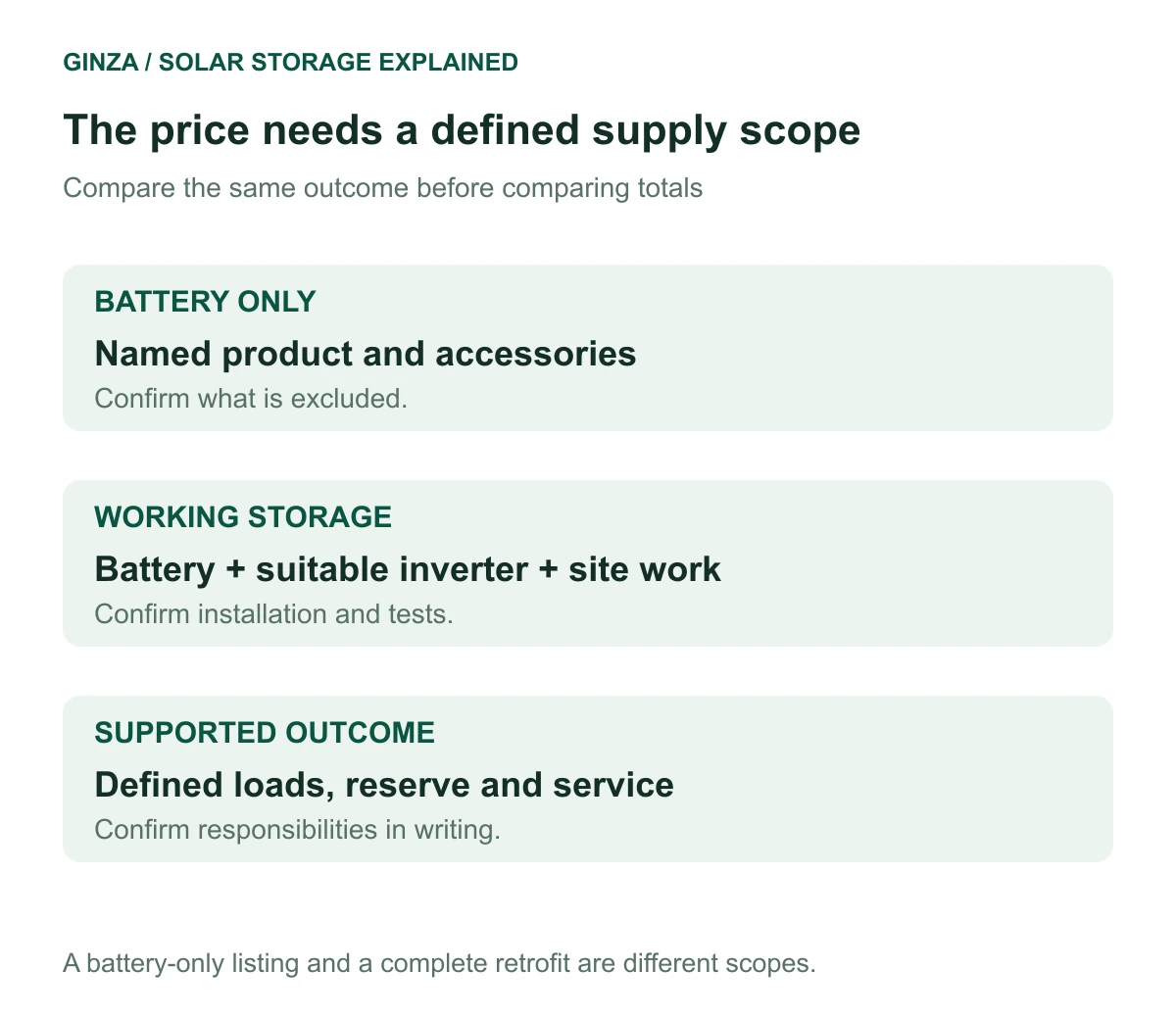
Ask for one written scope with exclusions beside it. A statement such as “installation included” should identify the installation assumptions: cable route, equipment location, access, distance and the circuits involved. A later site change may alter the work, so keep the conditions visible when comparing proposals.
Compare kWh at the correct voltage
Amp-hours alone do not give a fair energy comparison. Nominal battery energy is voltage multiplied by Ah, divided by 1,000. At 51.2V, GINZA Gen5 reference capacities are 5.632kWh for 110Ah, 11.264kWh for 220Ah and 16.896kWh for 330Ah. Those are energy ratings, not installed prices or backup guarantees.
Also distinguish nominal energy from the energy available to appliances. The published Gen5 reference window is 85% recommended depth of discharge. With an illustrative 90% inverter conversion efficiency, the calculated AC energy before standby is as follows:
| Gen5 reference | Nominal kWh | Illustrative AC kWh |
|---|---|---|
| 110Ah | 5.632 | 4.31 |
| 220Ah | 11.264 | 8.62 |
| 330Ah | 16.896 | 12.93 |
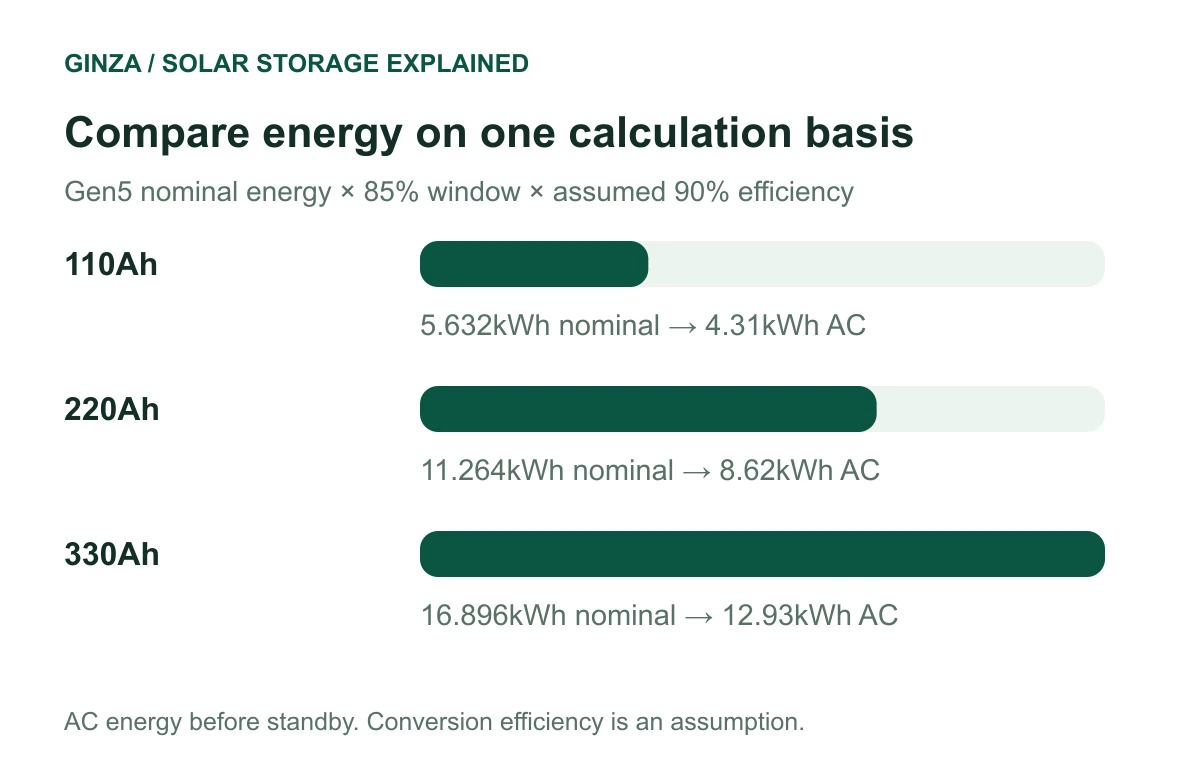
Use identical assumptions when comparing quotations. A seller’s nominal figure and another seller’s usable figure are different measures. The 90% efficiency here is an assumption, not an inverter specification; reserve, temperature, aging and standby can change the practical result.
Use unit costs without hiding the missing work
For a first screening, divide the battery-only quotation by nominal kWh. Separately divide the complete installed storage quotation by the expected usable AC energy under the same assumptions. Keep those two comparisons on different rows. Including an inverter in one numerator while excluding it from the other makes the result misleading. For a financial comparison, use the incremental battery payback worksheet to account for actual shifted energy, losses and export credit forgone.
For example, let quotation A cover 11.264kWh nominal and quotation B cover 16.896kWh nominal. Their label capacities differ by 50%. That does not mean B is automatically better value: its complete cost, supported power, available space and the household’s charging opportunity still matter. A larger battery that remains partly unused may add little practical benefit.
A useful spreadsheet has separate columns for battery, inverter work, protection, circuit changes, labour, delivery, taxes where applicable, testing and documented service. Ask the supplier to fill gaps rather than entering guessed amounts. This gives the buyer a reusable comparison when a proposal changes. For current published package and payment examples, review the Philippine installation installment page. Compare its complete package scope with the written quote rather than treating a solar-plus-storage package as a battery-only price.
Inverter and backup work can change the total
An existing solar-only inverter may not have a compatible battery connection. The proposed upgrade may retain it and add a battery inverter, or replace it with a suitable hybrid arrangement. The AC and DC coupling guide explains those routes. Neither route can be priced accurately from battery capacity alone.
Brownout backup also needs a defined operating arrangement. Ask which circuits remain powered, the supported maximum load, transfer behaviour and whether solar can recharge storage during that mode. A quote for “hybrid” equipment should not quietly imply whole-house backup.
Meralco customers can review its solar and net-metering guidance for the utility context. Export billing and battery-backed load isolation are different subjects. Other utilities should be consulted for their own connection requirements.
Read the warranty and service scope together
Request the actual warranty document for the exact product and market. Check product defects, retained-capacity conditions, throughput or cycle limits, permitted use and the claim route. Then ask who pays for diagnosis, site labour, transport and replacement installation when a claim is accepted.
The Australian Government’s warranty guide usefully distinguishes product, workmanship and battery performance terms. Its Australian legal rights and typical terms are not GINZA warranty promises or Philippine law. The relevant supplier documents govern the proposed purchase.
Service clarity can matter as much as a small difference in purchase price. Identify the local installer, the party confirming inverter compatibility and the technical escalation contact. A distributor should also confirm the documents and diagnostic evidence its customers will need.
The battery lifespan and warranty guide explains retained capacity, cycle definitions and the monitoring record behind a longer-term cost comparison.
Compare savings and backup as separate benefits
Battery savings depend on charging energy, the value of electricity avoided, export value given up, losses and how often the stored energy is used. A monthly bill amount alone does not establish those inputs. Ask for a timed load and generation assessment and a transparent calculation using the customer’s actual tariff.
Backup has a different value: which essential activities continue during an interruption, and for how long. Keep that objective visible even if the financial model focuses on energy shifting. A system can provide useful backup without achieving a claimed fixed payback period.
For homes prioritising air conditioning, use the overnight aircon examples before comparing capacities. Aircon demand can change both the battery size and inverter requirement, so it should be included early in the discussion.
When two quotes use different inclusions, ask both installers to price one common scope from the same site plan. For example, label the protected circuits, specify whether a backup distribution board is included, and ask who records the agreed functional test and delivers the settings at handover. Show optional work separately so a customer can tell whether the difference is a lower rate for the same work or a missing line item. The commissioning checklist shows what evidence an installer can record for that test.
A checklist to send with a quotation request
Keep the commercial conditions beside the equipment list
Check quotation validity, payment milestones, delivery destination, access assumptions and the point at which the final installation total is confirmed. Identify whether taxes, freight, unloading and any required site preparation are included. A remote delivery and a local installed service can have different responsibilities even for the same battery. If a supplier proposes a substitute model, repeat the capacity, compatibility and warranty comparison before accepting it; do not assume the original proposal’s performance description transfers automatically. For orders that include freight, use the UN 38.3 battery test summary guide to match the transport documents to the quoted battery model before dispatch.
- Installation country and city, building type and proposed equipment location.
- Exact existing inverter, firmware if available, PV size and photographs of the installation.
- Essential-load schedule, required backup hours and any motor or aircon loads.
- Whether the goal is backup, evening solar use or both.
- Required scope: battery only, retrofit or a complete new system.
- Requested delivery, installation, testing and warranty-service responsibilities.
If the quotation also includes new PV modules, compare their written obligations separately using the solar-panel product and power-warranty guide. A module retention promise should not be presented as the battery warranty or as a complete system savings guarantee.
Sources and interpretation
Published GINZA ratings describe products, while a current written quote defines price and scope. The usable-energy percentages are stated calculation assumptions. Utility information and the Australian warranty explanation address different subjects; Australian rights and example terms are not a GINZA warranty or Philippine legal entitlement.
Frequently asked questions
Why do two batteries with similar Ah have different prices?
Check voltage and nominal kWh first, then model-specific current capability, enclosure, communication, documentation and complete supply scope. Similar labels do not establish identical products or installation work.
Is the cheapest cost per kWh always the best choice?
No. The proposal must also meet power, compatibility, location, charging and support requirements. An inexpensive unsupported battery can create additional project work.
Can I get a fixed price without a site review?
A supplier may quote a defined product or a clearly stated standard scope. Any installation assumptions and potential extra work should be explicit. Confirm the final site conditions before accepting an installed-system total.
Use the home sizing calculator, compare the GINZA battery range, and request a model-specific quotation. Philippine homeowners can also review the existing installation options.