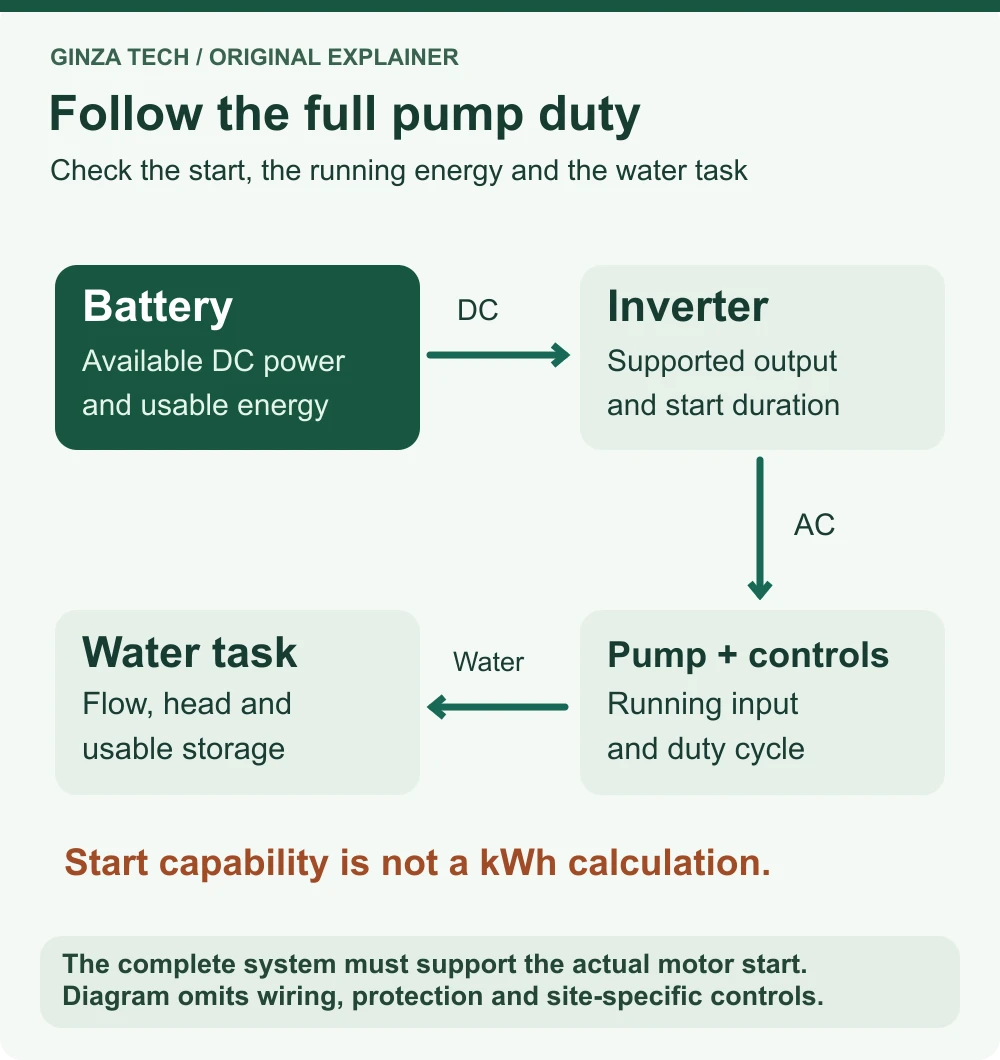
Battery backup for a water pump needs enough power to start the motor and enough energy to complete the required pumping duty. Measure electrical input, identify the motor’s starting demand and count the pumping time. Then review the inverter, battery, controls and water-storage arrangement as one application.
A pump’s rated motor output, steady electrical input and start transient are different quantities. A small daily energy requirement can still need a demanding start. This guide uses invented figures to organize a quote review. Ask a qualified installer to assess the actual pump and the supported backup arrangement.
Identify the pump and its job
Record the pump and motor model, supply voltage, phase count, controller and any variable-speed equipment. Find out whether the pump fills a tank, maintains pressure or runs as part of a continuous process. Note the required flow and head, since changing the water duty can change electrical demand.
Ask the provider to identify electrical input at the operating point. A motor’s shaft-power label does not include every electrical loss. If measurement is required, use the appropriate qualified provider and instruments. Retain the pump manual, starting information and existing controls with the electrical load schedule.
Calculate energy from the actual running time
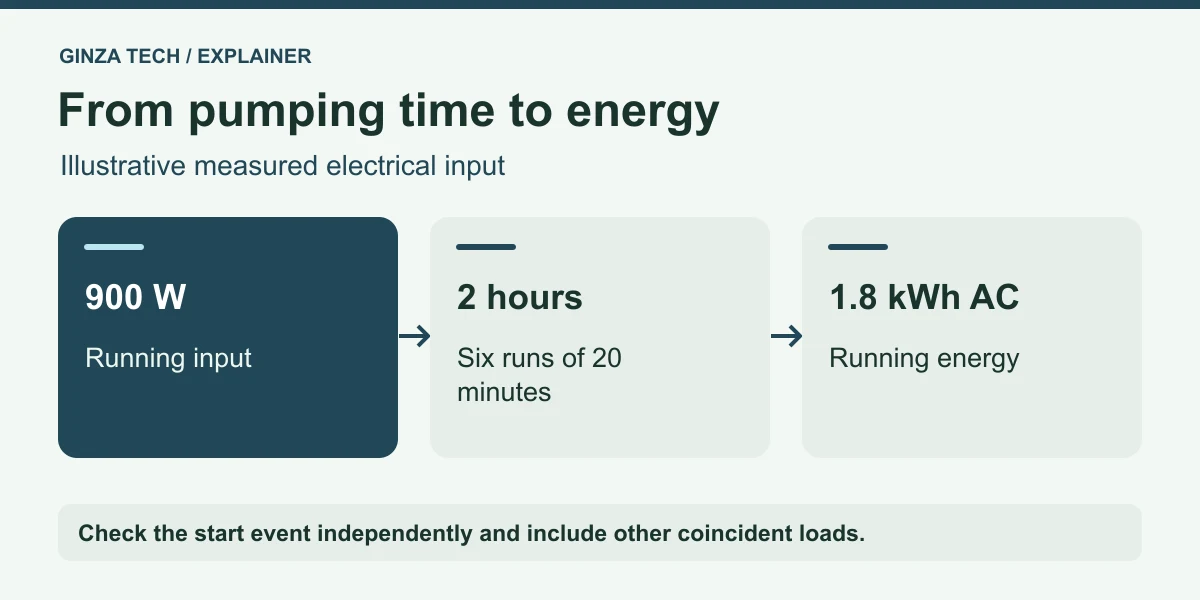
Suppose a pump draws 900 W while operating and runs for 20 minutes on each of six occasions. Total daily running time is two hours, so the electrical energy is 1.8 kWh AC. At an assumed 90 percent discharge conversion, the battery would provide 2 kWh DC for that duty before separate auxiliary use. Add other backed-up loads over the same outage period.
| Example input | Value | Why it matters |
|---|---|---|
| Measured running input | 900 W | Electrical demand during pumping |
| Six 20-minute runs | 2 hours | Total pumping time |
| Running energy | 1.8 kWh AC | Power multiplied by time |
| Illustrative battery draw | 2.0 kWh DC | AC energy divided by 90 percent conversion |
If a pressure system cycles frequently, record enough operation to capture that pattern. Starting events and control behavior can make a short test unrepresentative. A leak or altered pressure demand can also increase runtime. Have the responsible plumbing and pump provider review the water system before sizing backup around abnormal cycling.
Check the start event in magnitude and duration
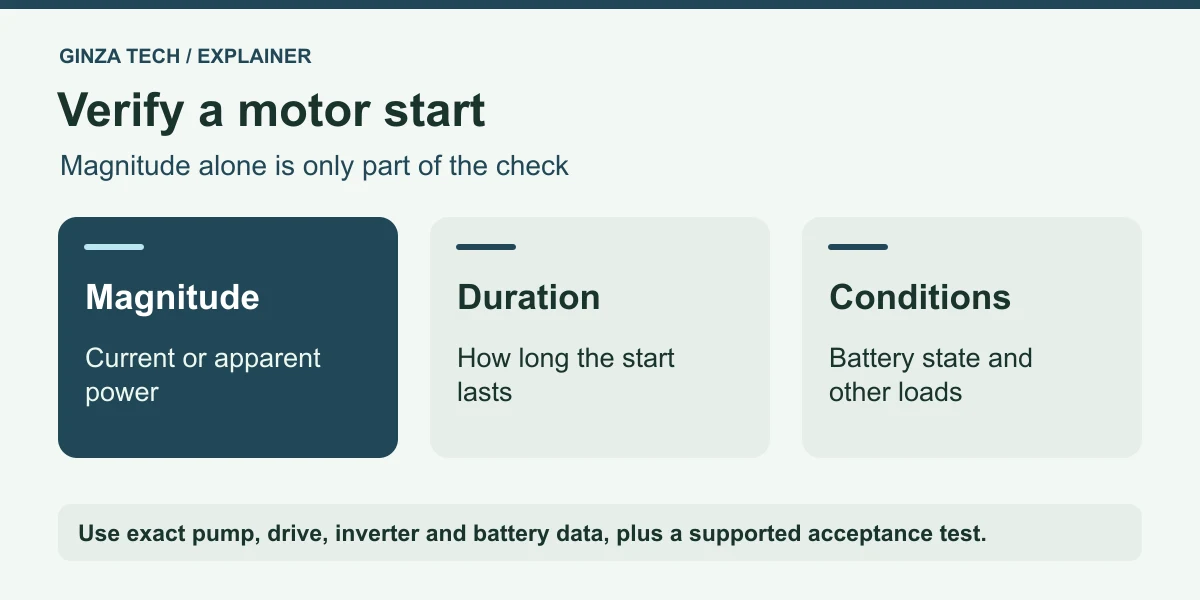
Request manufacturer starting data or an appropriate measurement. Compare it with the inverter’s supported overload capability and the battery’s available current at the expected state of charge. Account for other equipment that may be operating when the pump starts. A headline peak rating is incomplete without its permitted duration and conditions.
For a hypothetical illustration, an inverter might allow 3.2 kVA for two seconds while the proposed pump needs 3.0 kVA for three seconds. The magnitude alone looks acceptable, but the duration is not established by that rating. Ask the provider for supported evidence or a representative acceptance test. Do not use this example as a start-current multiplier for another motor.
Review the controller and supply topology
Direct starting, soft starting and a variable-speed drive can create different demands. The Grundfos motor and pump instructions illustrate how starting method and supply suitability belong in the design review. Use the manual for your actual pump and controller, including their protection and restart requirements.
For a three-phase pump, verify total output, all required phases and the supported start behavior. The three-phase backup guide also covers coincident single-phase loads. On the battery side, use the C-rate and current guide to compare demand with the complete system’s current limit.
Consider water storage alongside electrical storage
If the application permits filling an appropriately designed tank before the outage, some water demand may be served without running the pump during every interruption. Ask the pump and plumbing provider to assess usable water volume, pressure, controls and any applicable water-quality requirements. The tank arrangement must still meet the building’s actual needs.
For arithmetic only, 1,200 litres delivered at an average 20 litres per minute needs 60 minutes of pumping. At a measured 900 W input, that duty would use 0.9 kWh AC. Compare a schedule that performs that duty while solar is available with one that performs it from the battery. Flow and power depend on the real operating point, so use measured or manufacturer-supported data.
Agree the outage and recovery behavior
Ask what happens if power fails during a run. Review restart timing, dry-run or other required protection, controller memory and the response when battery reserve is reached. A pump that automatically restarts can coincide with refrigerator or compressor starts after transfer. Ask the installer to plan that sequence rather than testing each appliance in isolation.
Use the solar outage checklist to confirm the supplied circuit and transfer equipment. Define which task has priority when reserve is limited. If water pumping is essential, compare the reserve allocation with the household’s other loads in the reserve guide.
Restore the pumping reserve before the next interruption
The running example removes 2 kWh DC for the pump duty before auxiliaries. If a hypothetical charging source can sustain a net 0.5 kW at that same battery boundary, restoring that energy takes four ideal hours. Concurrent loads, source interruptions and the approved charging profile can extend the elapsed time.
Use the battery recharge-time worksheet to check that recovery against the next required pumping task. Keep the water duty, available charge window and starting-power test together; adequate battery energy does not by itself establish a repeatable water supply.
Keep a useful acceptance record
Record the equipment models, water duty, running measurements, starting evidence, load combination and observed transfer and restart. Have the provider identify what changed during the test and which conditions were verified. Keep the approved settings and service contacts with the pump’s maintenance information.
Retest the relevant duty if a pump, controller or pressure setting is changed. If the purpose is to keep water available during a long outage, also review the charging source for the following day. The PV recharge worksheet helps account for that energy alongside other daytime demand.
Compare a measured acceptance case with normal operation
Choose a test condition that represents the water duty and the other loads present during an outage. A pump tested with an empty backup panel can behave differently when refrigeration, lights and a network supply are already operating. Ask the installer to document that combination and the state of charge when the start was observed.
Include the pump’s ordinary control cycle. If its normal pressure or level controller requests another start shortly after a stop, the supported restart behavior matters as much as the first demonstration. The provider should confirm the conditions under which the pump can restart and the protection that remains active while on backup.
Record useful water delivered or the completed pumping task alongside electrical measurements. That connects the acceptance result to the owner’s purpose. If the water demand or operating head changes later, ask the pump provider to reassess the duty before assuming the previous battery-runtime estimate remains adequate.
Sources and example boundaries
The 900 W pump, starting-power comparison, flow and charging inputs are hypothetical. No installation photograph is presented as a successful pump-start test. Equipment-specific motor data and a supported acceptance case are still required.
Frequently asked questions
Can I size the battery from horsepower alone?
Use measured or documented electrical input, running time and starting demand. Horsepower describes a motor output rating and cannot provide the full backup requirement.
Will a larger battery make an undersized inverter start the pump?
Check the inverter’s output envelope as well as battery power. Additional energy capacity changes the duration calculation, while the start still has to fit every relevant limit.
What should I include in a project enquiry?
Send pump and controller models, voltage and phases, water duty, running and start data, target hours and other circuits through the project enquiry form.