

Estimate LiFePO4 battery charging time from the charge you need to add and the current the complete system can actually sustain. A first-pass amp-hour calculation is rated capacity multiplied by the change in state of charge, divided by net charging current. Allow for charging stages, changing source power, concurrent loads and manufacturer limits before treating it as a finish time.
This guide focuses on the time and current needed to reach a target. If you are choosing the PV array that will supply that energy, use the solar recharge budget. A charger with a large nameplate cannot use energy that the source does not have available.
Choose the start and target states
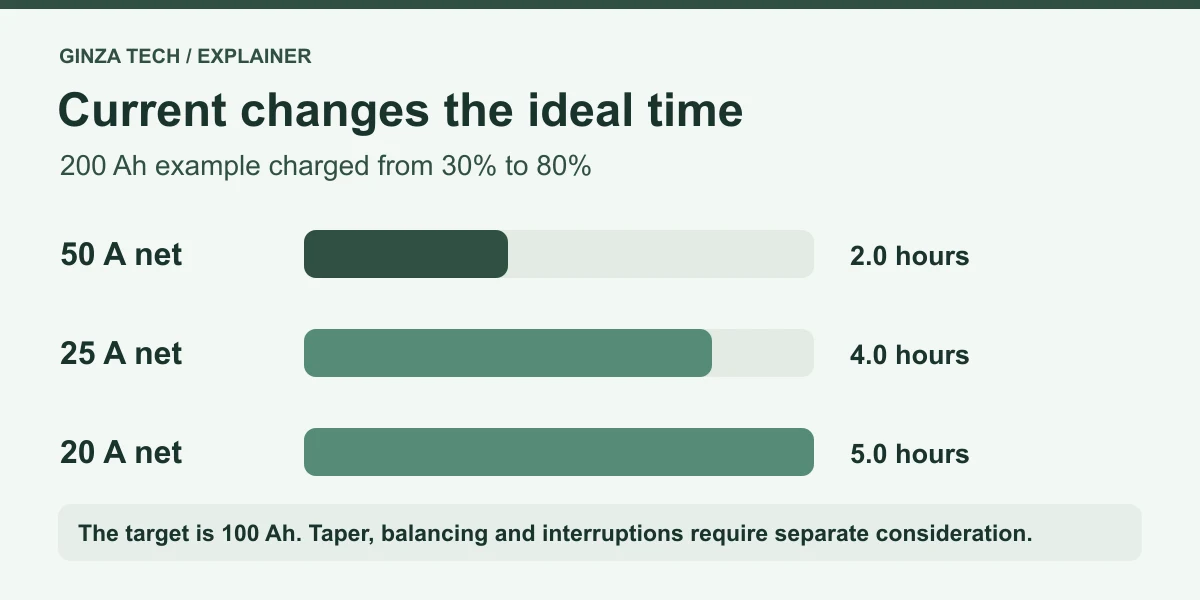
Write down the battery’s current state of charge and the intended target. On a hypothetical 200 Ah battery, moving from 30 percent to 80 percent represents a 50-percentage-point change, or about 100 Ah. At a constant net 50 A, the ideal capacity-to-current estimate is two hours. That example assumes the reported percentages represent the same usable capacity basis throughout.
Use the state-of-charge source identified in the installation record. A BMS, separate monitor and inverter dashboard can report different estimates or update at different intervals. The monitoring guide explains how to identify the relevant reading. The reserve guide helps define the window you want to recover.
Use net battery current rather than a charger label
Suppose the charging source supplies 60 A on the DC side while equipment on that same DC boundary draws 10 A. About 50 A enters the battery in this simplified balance. If the battery’s own current reading is reliable and already shows net charging current, use that value directly. Subtracting the loads again would count them twice.
For an inverter-charger supplying AC loads as well as charging storage, the accounting can be different. Ask the provider where each power value is measured. Record battery current or battery-side energy over the relevant period and compare it with the source and load readings. The source’s maximum current is only useful when the equipment and source can sustain it under the observed conditions.
| 200 Ah example | Charge to add | Net current | Ideal constant-current time |
|---|---|---|---|
| 30 to 80 percent | 100 Ah | 50 A | 2.0 hours |
| 30 to 80 percent | 100 Ah | 25 A | 4.0 hours |
| 30 to 80 percent | 100 Ah | 20 A | 5.0 hours |
Apply the formula to the actual battery capacity
Ideal hours = capacity in Ah × (target SoC − starting SoC) ÷ 100 ÷ net charging amps. This is a constant-current estimate on a consistent capacity basis. A full-charge procedure can take longer because of the documented charging profile, balancing and source interruptions.
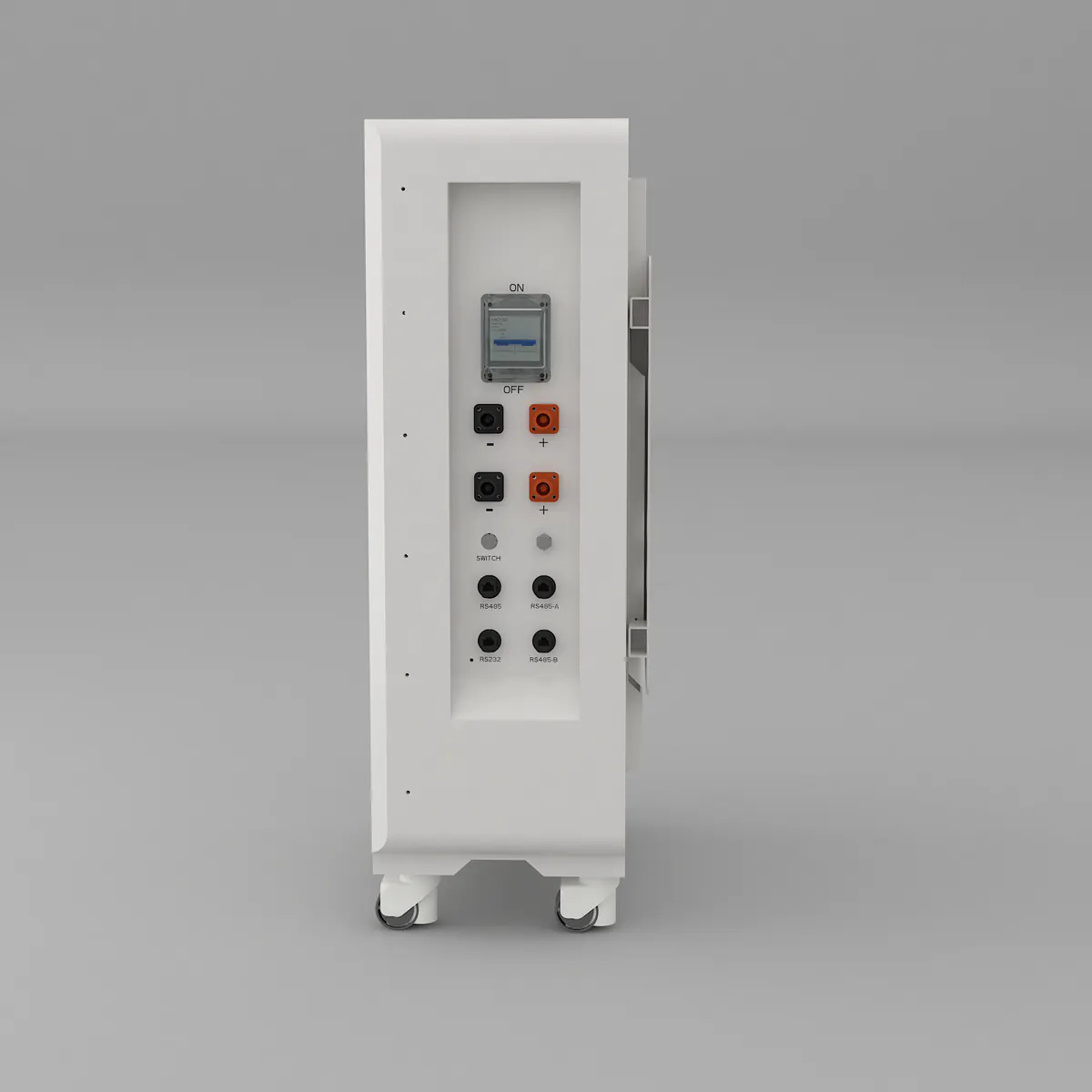
The product shown in this article is the GINZA 51.2 V 330 Ah Gen5 battery; the earlier worked table intentionally uses a generic 200 Ah battery. Substituting 330 Ah for a 30-to-80-percent window gives 165 Ah to add. At a hypothetical sustained net 50 A, that is 3.3 ideal hours. It is not a prescribed current or a measured GINZA charging-time claim; the complete system must support the operating point.
Read the permitted current and charging stages
Check the battery’s recommended and maximum charging current, the inverter or charger limit and any dynamic BMS restriction. Charging conditions can change with temperature and state of charge. Use the exact product’s profile and control requirements. The C-rate guide shows how to convert current and capacity without confusing a maximum with a continuous operating target.
Some LiFePO4 systems reduce current near the target voltage or reserve time for their approved balancing process. The Victron Lithium NG operation manual illustrates a manufacturer-defined charging profile. Its voltage and time settings belong to that battery family. Request the corresponding charging instructions for the actual battery you are installing.
Use a staged calculation when power varies
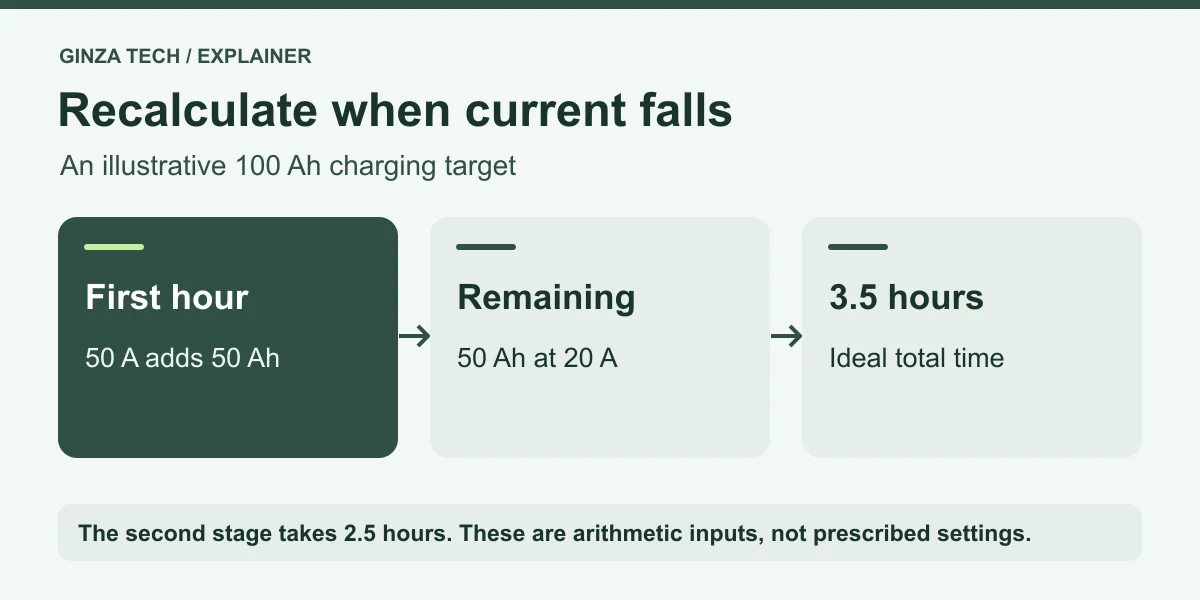
Imagine the same battery needs 100 Ah. It receives 50 A for the first hour, adding about 50 Ah in the ideal accounting. Cloud then reduces the net rate to 20 A. Adding the remaining 50 Ah would require another 2.5 hours at that rate. The estimate becomes 3.5 hours, plus any additional effects in the approved charging process.
This is more informative than keeping the initial two-hour estimate after the conditions change. For solar charging, review the available hours before sunset, daytime loads and the expected generation profile. If the target matters for an evening outage, compare a lower-generation day as well as a clear day.
Cross-check with energy and power
For a rough nominal energy check, a 51.2 V, 200 Ah battery represents 10.24 kWh. A 50-percentage-point change corresponds to 5.12 kWh on that nominal basis. Supplying a constant 2.56 kW to the battery would take two ideal hours. In practice, voltage changes through charging, so integrated energy and the manufacturer’s capacity definition provide a better basis than assuming nominal voltage at every moment.
If the source budget is measured on the AC side, account for charging-path conversion using the same boundary. For an illustrative 5.12 kWh battery-side target and 90 percent charging-path efficiency, the AC input would be about 5.69 kWh. A 2 kW available AC supply would need about 2.84 ideal hours for that input, before other time-dependent constraints. These are calculation assumptions rather than GINZA charger ratings.
Investigate slow charging with a short evidence record
Record the start and end times, state-of-charge readings, battery current, source power, concurrent loads, mode and any reported charge-current limit. Include temperature or alarms shown through the normal interface. The charging fault guide helps organize an abnormal result. A supported system can intentionally reduce current, so have the provider interpret the reason before changing settings.
After an expansion, repeat the estimate for the new bank and the available charging window. Twice the amp-hour capacity takes twice the ideal time at the same net current for the same percentage change. The expansion guide also covers compatibility and retesting.
Choose a finish-time target you can verify
Ask the installer to state the expected target charge by a particular time under a defined source and load profile. For example, a plan might require recovery of a selected backup reserve before the evening, while allowing the final part of charging to continue under the manufacturer’s profile. Record both the useful reserve target and any separate requirement for periodic complete charging or balancing in the equipment instructions.
During the trial, note any time that charging is intentionally paused. A three-hour calendar window can contain only two hours of meaningful charging if the source is unavailable or controls hold the battery. Compare charge added with active charging time before concluding that the current calculation was wrong.
For a generator source, verify available input after concurrent loads and the approved charger demand with the responsible provider. The generator comparison covers those operating responsibilities. For PV, compare the actual solar and load timeline. A useful charging-time promise names the source assumptions rather than giving one number for every day.
Sources and example boundaries
The 200 Ah and 330 Ah examples illustrate capacity-to-current arithmetic. They assume a consistent reported capacity basis and do not establish a charging profile. The manufacturer example below applies to its own battery family.
Frequently asked questions
Will a higher-current charger always make charging faster?
The battery, inverter, source, protection and approved installation must support the operating point. A battery-side current limit or a small source can remain the constraint after a charger upgrade.
Why does the last part take longer?
Check the manufacturer’s charging profile, current taper and balancing requirements. A simple amp-hour estimate assumes constant net current throughout the chosen window.
What should I include in a charging-time enquiry?
Provide the battery and charger models, starting and target percentages, measured current, available source and concurrent loads through the project enquiry form. For an existing system, add the relevant logs and time interval.