
LiFePO4 battery storage before installation needs a documented plan for the exact battery model. Identify the required state of charge, storage environment, permitted shutdown method, review interval and return-to-service procedure from the supplier’s current instructions. A generic percentage copied from another brand is not a complete stock-care plan.
This guide is intended for distributor inventory, delayed projects and batteries held outside normal operation. It focuses on receipt, residual drain and release records. An installed system continuing to serve loads needs its own operating maintenance plan.
Separate battery inventory from an operating storage system
The phrase battery storage can mean a working energy-storage installation or the act of keeping unused batteries in a warehouse. Label which condition applies. A pallet awaiting dispatch, an isolated spare and a commissioned battery left connected to equipment can have very different residual-consumption paths.
LiTime’s storage guidance gives one manufacturer’s approach to stored LiFePO4 products. Victron’s battery-care documentation illustrates why residual loads and timely recharge matter. Neither source supplies GINZA’s model-specific storage settings.
Before accepting stock, ask for a written procedure that identifies the exact hardware and document revision. Confirm who is authorized to perform checks or charging and what observations require a service hold. Keep that procedure available to the people physically responsible for the inventory.
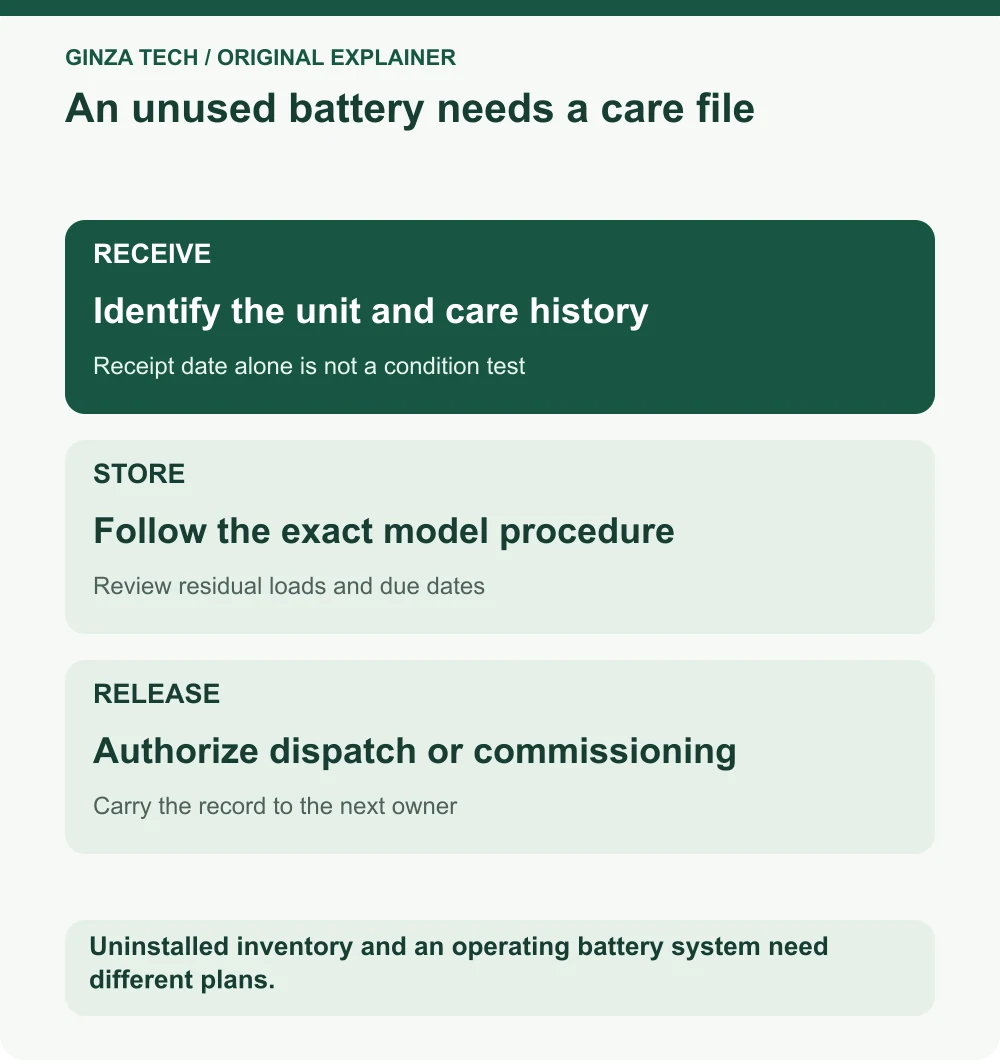
Create a receipt record before the waiting period begins
| Stock record | Information to retain |
|---|---|
| Identity | Model, serial number, batch and supplied documents |
| Receipt condition | Date, packaging observations and authorized initial checks |
| Storage state | Recorded charge state, shutdown method and connected equipment |
| Environment | Approved location and relevant condition records |
| Next review | Due date, responsible person and required action |
| Release | Final observations, authorization and receiving project |
Use an individual serial record where batteries may wait for different lengths of time. If a batch is moved between locations, carry the review history with it. A purchase date alone does not establish the current state of charge or whether the unit has remained under the intended conditions.
Record delivery damage, water exposure, unusual heat, deformation or leakage as findings for the supplier and the site’s safety process. Do not release a questionable unit merely because its display powers on. Follow the responsible provider’s instructions for handling and assessment.
Account for residual consumption during the wait
An apparently idle arrangement can still consume energy through a BMS, display, communications device or connected inverter. A shutdown switch’s documented behavior matters: it may disable one function without removing every internal or external load. Ask the supplier which state is intended for the storage period.
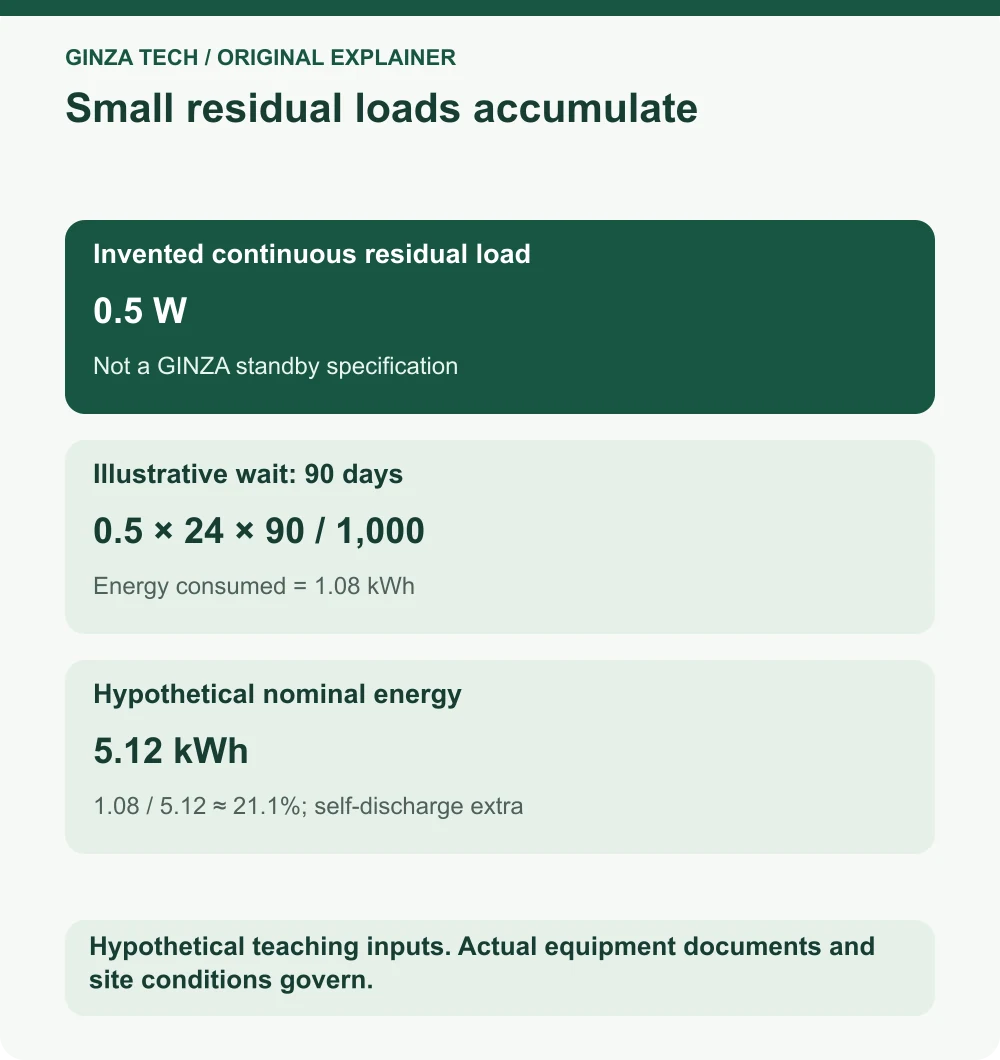
Consider a deliberately hypothetical continuous residual load of 0.5 W. Over 90 days, its energy is 0.5 × 24 × 90 ÷ 1,000 = 1.08 kWh. Against a hypothetical 5.12 kWh nominal battery, that equals about 21.1 percent of nominal energy before any self-discharge or other effects.
The example is a sensitivity check, not a GINZA standby specification. A power rating, actual duty cycle and accessible operating window must be known before predicting remaining charge. Do not subtract nominal-energy percentages directly from an uncertain dashboard reading and call the result a guaranteed safe storage duration.
The enabled hours change the residual-energy example
| Hypothetical 0.5 W auxiliary load | Enabled hours per day | Energy over 90 days |
|---|---|---|
| Continuous example | 24 | 1.08 kWh |
| Independent intermittent example | 1 | 0.045 kWh, or 45 Wh |
The intermittent case assumes zero consumption outside its stated enabled hour solely for this arithmetic. Actual off-state consumption and self-discharge need separate evidence. These values do not describe a battery’s available shutdown mode or set its review interval. Obtain the relevant duty and power measurements before estimating a real waiting period.
Use the exact model’s environmental and charge instructions
Request permitted storage temperature, humidity or condensation conditions, orientation and packaging requirements. Confirm whether the instructions distinguish short storage from an extended period and how those periods are defined. Warehouses, vehicles and unventilated rooms can experience different conditions from ordinary office temperature.
Storage, charging and discharging temperature ranges can differ. A unit that has remained within its permitted storage range is not automatically ready to charge at that same temperature. The supplier should define any conditioning and inspection needed before an authorized charging activity.
Use the location and environmental review for the eventual installation. An enclosure protection rating does not replace the warehouse instructions or prove suitability for flooding, condensation or an unreviewed storage arrangement.
Make the review date an operational responsibility
Choose the interval from the exact manual and the supplier’s assessment of the actual storage state. Assign a named role to check the record and respond before a due date passes. A reminder with no responsible person or available approved charger is not an executable care process.
If the waiting period extends beyond the original plan, request an updated assessment rather than rolling the date forward without evidence. Record any authorized checks, charging and abnormal observations. Distributor stock should leave the warehouse with a traceable history, not just a newly applied dispatch label.
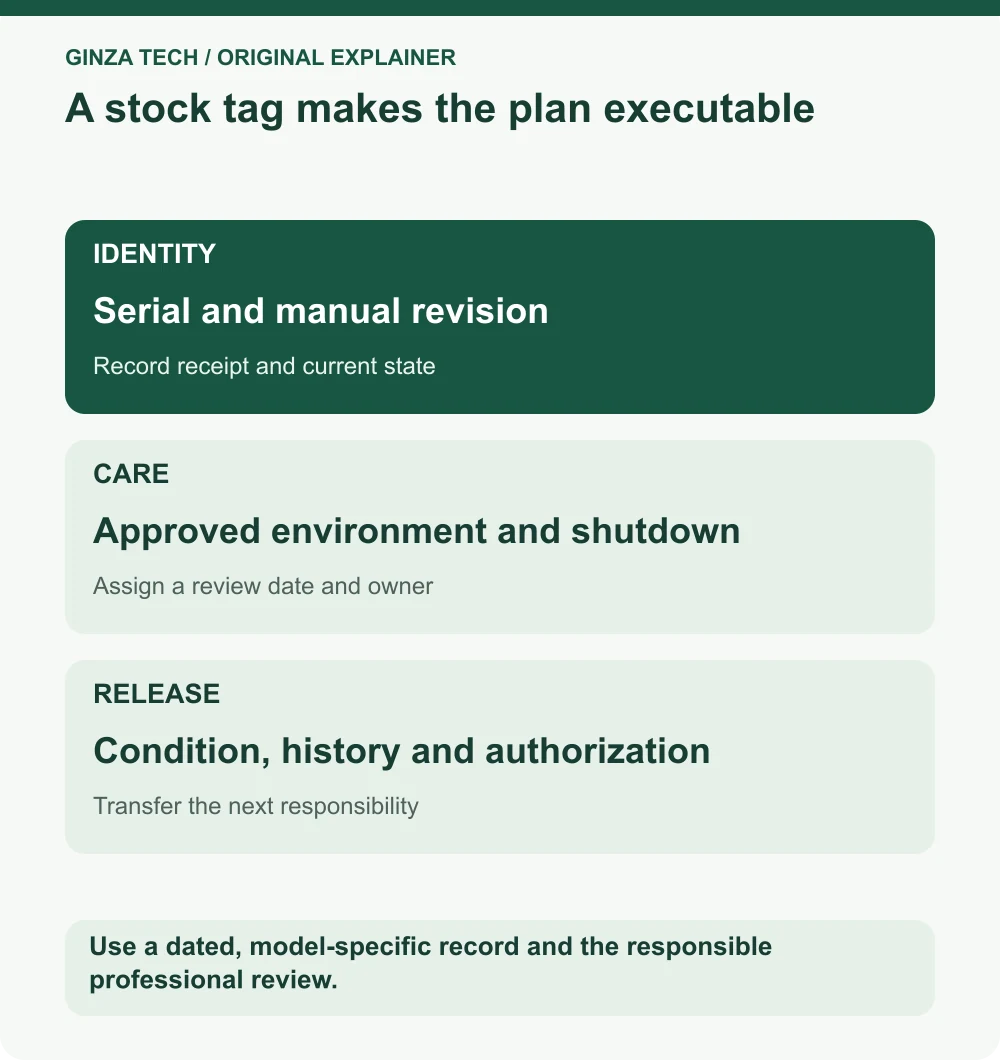
Prepare an approved release to installation
Before dispatch or commissioning, reconcile the stored unit with the order and the latest accepted configuration. Ask the provider to assess any overdue checks or uncertain history. Obtain the required initial-charge, compatibility and functional-test instructions for the project.
The commissioning checklist starts a separate installation acceptance record. Where units are being added to an existing bank, the expansion review also applies. Successful storage care does not itself establish permission to combine different batteries.
Keep shipping and storage documents distinct
A storage-care file and a transport-document file serve different purposes. Retain the appropriate model identity across both, but do not treat a test summary as a state-of-charge instruction for the warehouse. The battery documentation guide explains the distinct roles of transport and safety documents.
For damaged, returned or uncertain batteries, ask the supplier and the responsible transport provider for the appropriate assessment. Ordinary stock-release approval should not silently stand in for a transport decision about a different condition.
Base stock release on care history, not arrival order alone
Consider two illustrative stock units. One arrived recently but has an unclear transit and care history. The other arrived earlier and has complete authorized review records. The delivery sequence alone does not establish which unit is ready for the next installation. Reconcile each history with the supplier’s release criteria.
A first-in, first-out inventory rule can help organize stock, but it should operate alongside condition and review controls. Keep units awaiting assessment visibly separate in the stock system and assign their follow-up. If a customer delays installation after dispatch, transfer the applicable care instructions and the next responsibility rather than assuming the storage period has ended when the warehouse invoice closes.
Sources and interpretation
The manufacturer care references show why model identity, residual loads and storage conditions matter. Their settings must not be transferred to another battery. The residual-drain example is hypothetical; GINZA stock instructions, approved handling and the exact model documents govern actual care.
- Victron: battery care and residual discharge context
- LiTime: manufacturer-specific storage guidance example
- Victron: lithium battery handling and safety reference
Frequently asked questions
What percentage should every LiFePO4 battery be stored at?
There is no single setting established by this article for every product and storage state. Obtain the current instructions for the exact model, duration, environment and shutdown arrangement.
Is switching the display off enough?
Only the equipment documents can establish what that action disables. Check residual internal and connected loads, then use the authorized storage procedure rather than relying on appearance.
How should a distributor ask GINZA for guidance?
Send the model, serial range, receipt dates, current state, location and expected waiting period through the GINZA support enquiry. Request written stock-care and release instructions for the confirmed order.