Read a Meralco net metering bill by keeping three quantities separate. Import is electricity drawn from the utility, export is eligible electricity sent back through the approved connection, and self-consumption is solar electricity used on the property. The utility meter records flows across its connection. The inverter measures power within the solar system. Those instruments answer different questions, which explains many apparent mismatches between an app and a bill.
This guide is for a home or small business comparing its first approved net metering bills or deciding how much daytime surplus it could use. The workflow uses Meralco terminology. If another distribution utility serves the site, use its current agreement, statement format and credit method. The example values are invented for the calculation.
Start with the service dates and two meter readings
Open the detailed statement and find the billing period. Record the start and end dates, the import and export kWh, and the peso value shown for eligible exports. If the statement gives cumulative register readings, subtract the prior reading from the current reading for each direction. Use the bill’s conversion or multiplier if one is shown. A cumulative export register is a lifetime-style counter and cannot be compared directly with a single month in the inverter app.
Confirm which meter belongs to the service account. A PV production meter or renewable energy certificate meter, where applicable, measures a different boundary from the bidirectional utility meter. Ask the installer to point out the registers during handover and use the utility’s written meter information if the display cycles through unfamiliar labels. As an invented register example, an export counter moving from 4,400 to 4,550 kWh gives 150 kWh for that period, before any stated multiplier. Use the separate import register for imports; neither counter is total PV production.
Reconcile a simple solar-only example
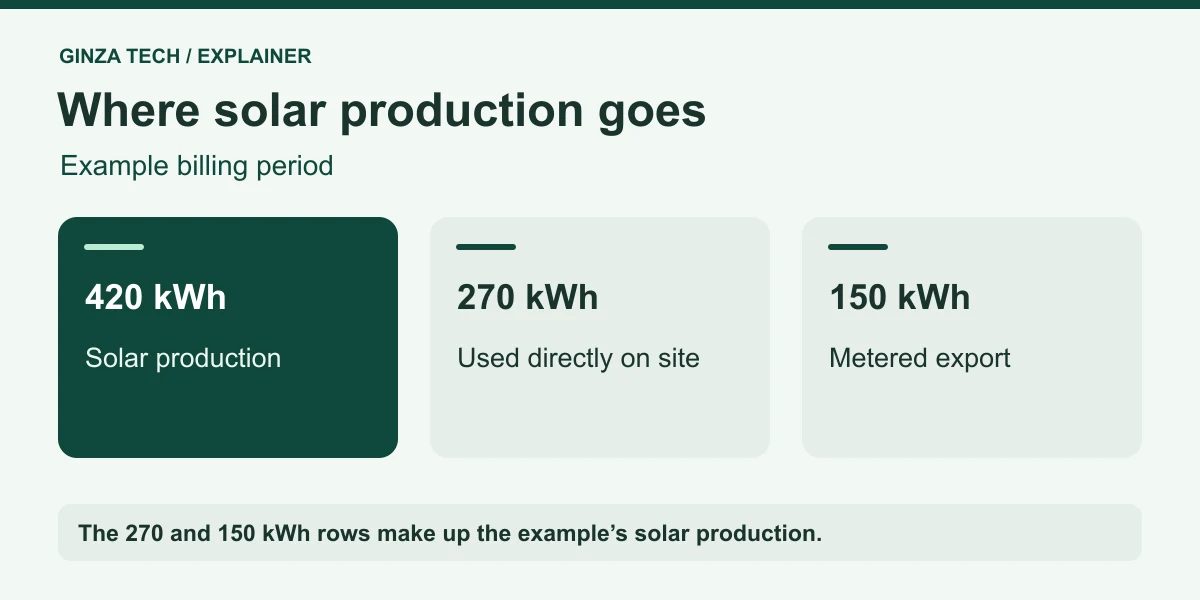
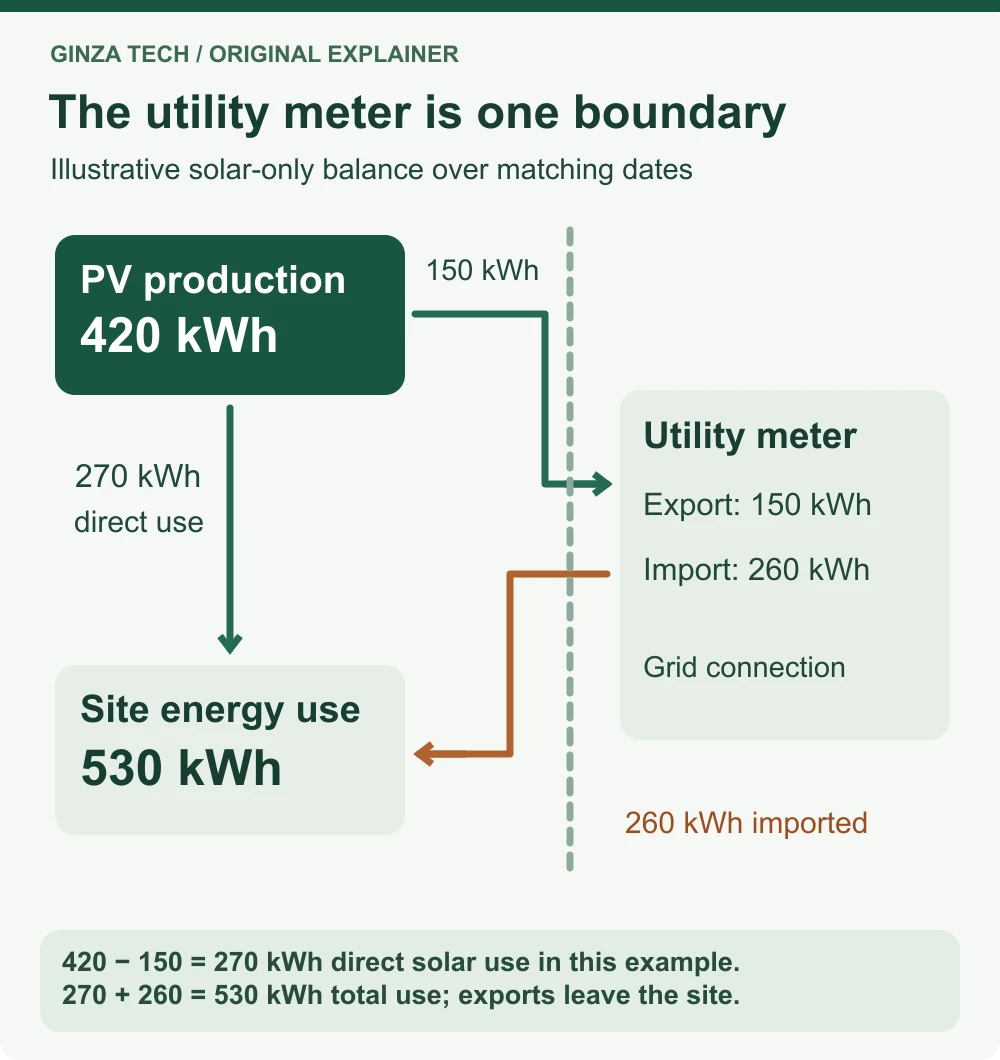
Suppose a property’s solar inverter shows 420 kWh of AC production over the same billing period. The utility records 150 kWh exported and 260 kWh imported. In a simplified solar-only setup with consistent measurement boundaries, about 270 kWh of solar was used directly on site. The property used about 530 kWh in total, because it combined those 270 kWh with 260 kWh from the grid. The 150 exported kWh left the property.
| Reading | Example | What it tells you |
|---|---|---|
| Inverter production | 420 kWh | Solar energy measured at the inverter boundary |
| Metered exports | 150 kWh | Energy sent through the utility connection |
| Metered imports | 260 kWh | Energy drawn through the utility connection |
| Estimated direct solar use | 270 kWh | Production minus exports in this simplified setup |
Only apply that subtraction to a solar-only energy balance with matching dates, meter boundaries and no other generation. Some apps report PV on the DC side, so conversion losses already make the figures differ. With storage present, the battery can charge, discharge and consume energy through conversion. Changes in battery state of charge between the start and end of the period also affect the balance. For a battery-equipped site, request synchronized PV, grid, load and battery readings.
Check peso credit separately from kWh
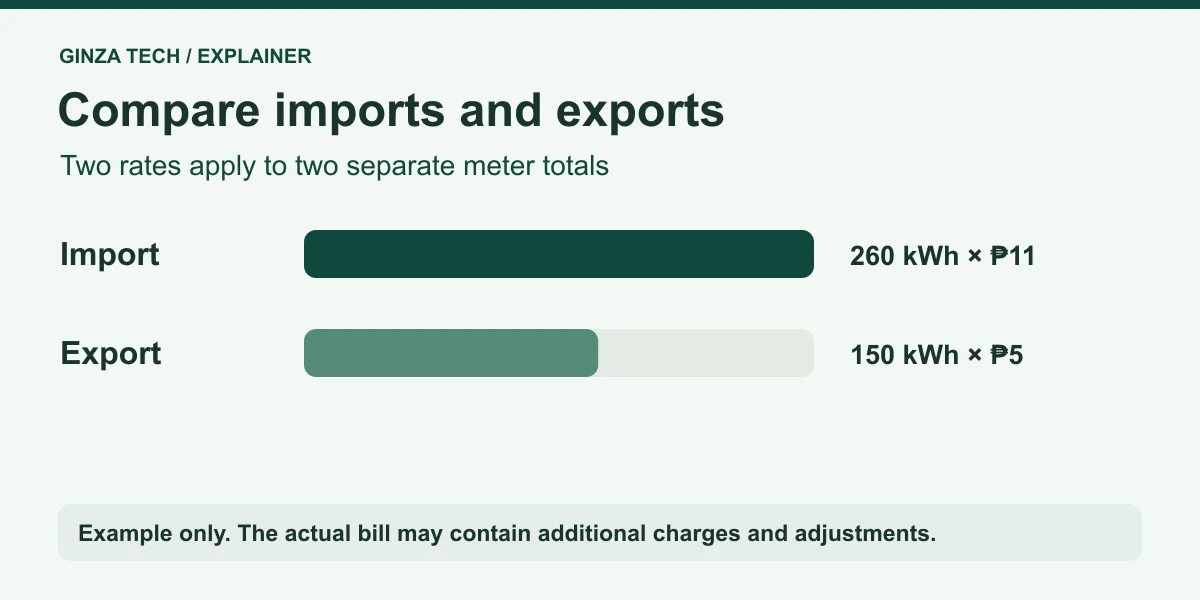
Meralco’s net metering guide explains that eligible exports earn peso credits and that imports and exports use different rate components. Multiplying exports by the retail import rate would overstate the credit whenever the applicable export rate is lower. To check the export line, multiply the credited export energy by the export rate shown for the applicable period and compare that value with the bill, allowing for rounding and any separately described adjustments.
In the example, 150 kWh at a hypothetical ₱5 per kWh would produce a ₱750 export credit. Multiplying the 260 imported kWh by a hypothetical ₱11 per kWh gives ₱2,860 for that simplified import value. The difference is ₱2,110 before any other bill items. Keep your actual charges, credits, taxes and adjustments on separate rows. Neither example rate represents Meralco’s current tariff.
Investigate a large mismatch in a useful order
- Match the app date range to the bill dates. Calendar-month charts can include days the statement excludes.
- Check whether the site entered approved net metering service partway through the statement period. Meralco describes the official service start after successful commissioning in its application process.
- Confirm the app’s units and sign convention. One dashboard can show an export as a negative grid value while another uses a positive export total.
- Check for monitoring gaps and verify which meter or current sensor the app uses. Save the readings and ask the installer to review their mapping.
- Send any unexplained billing discrepancy to the utility with the service dates, meter reading photographs and the relevant bill lines. Share redacted copies with anyone who does not need the account number.
Decide what to do with repeatable daytime surplus
Start with loads that can move safely into sunny hours. A scheduled task that can use PV directly avoids the extra conversion and standby losses of storing that energy. Check whether that change is realistic for the occupants or business operations before counting it as a saving. A useful comparison uses several actual billing periods, with different weather and occupancy patterns.
Then compare two cases for the remaining surplus. In the export case, one eligible kWh earns the current export credit. In the storage case, one kWh charging the system yields fewer than one kWh to use later and must coincide with a load that would otherwise import electricity. If an illustrative system returns 0.85 kWh and the marginal import value is ₱11, that use avoids ₱9.35 before subtracting the ₱5 export credit forgone, battery wear and equipment costs. Keep outage backup as a separate benefit. The battery efficiency guide explains how to get the right input for this calculation, and the Philippine battery quote guide helps compare installed costs. For the incremental storage purchase decision, use the payback worksheet with the actual useful energy and export alternative.
Compare a second bill before making a purchase
Put two periods next to each other and calculate average daily imports and exports using the actual number of billed days. An increase in peso credit can come from a higher credit rate, more exported energy, or both. Separate those effects before attributing a change to better solar production. Add a note if weather, business hours or appliance use changed. Keep the original statements available so the person preparing the quote can trace each input.
Sources and interpretation
All meter readings and peso rates are invented examples. The production-minus-export shortcut is restricted to the stated solar-only balance and matching dates. Meralco documents establish its terminology and process; an actual statement and agreement establish the values applicable to the account.
Frequently asked questions
Does a bidirectional meter show how much solar I produced?
It reports electricity crossing the utility connection. Direct solar use behind the meter can be absent from both the import and export totals. Use the inverter or a suitable production meter for generation and compare matching time intervals.
Can I count on export credits before approval?
Use the utility’s written approval and effective service date. Ask your installer and utility which interconnection route applies and what the system is allowed to do while an application is being processed. Meralco separately describes its own-use and DER pathways. The Philippine zero-export and SGF ZESS guide links the current DOE source and the notification questions to confirm with the host utility.
Can net metering keep a refrigerator on during a brownout?
Export approval addresses normal grid operation. Backup depends on the equipment’s ability to isolate and supply selected loads during an outage. Use the solar power outage guide to check the circuit and transfer design before buying equipment.
For a quote review, bring two representative bills and one interval export from the inverter or meter. Our project enquiry can start with the utility name, daily surplus and evening load, so the storage option can be evaluated against the existing arrangement.