
A solar battery’s simple payback period is the incremental installed cost divided by its annual net financial benefit. Compare a solar-only case with the same property plus storage. Count the electricity cost actually avoided, subtract the value of any exports given up, and include the storage losses and added operating costs.
This worksheet is for a Philippine home or small business evaluating an actual quotation. All prices, tariffs and operating days below are hypothetical. They demonstrate the calculation rather than a GINZA selling price, a current utility rate or a predicted return for your property.
Define the purchase you are evaluating
For an existing solar system, the incremental cost can include the battery, inverter work, controls, protection, installation and commissioning required to add storage. For a new system, ask the supplier for comparable solar-only and solar-plus-storage scopes. A payback figure for the whole array answers a different question from the additional return on a battery.
The Philippine battery quote guide helps compare those scopes. Keep warranty coverage and future service responsibilities beside the price. Identify any equipment replacement that is specific to the storage option, and agree how shared work is allocated between the two cases.
Measure useful shifted energy
The battery must have energy to charge and a later load that would otherwise buy electricity. Start with interval data for surplus generation and evening imports. Limit the modeled shift by usable capacity, charge and discharge power, operating schedules and the backup reserve. A nominal 10 kWh battery does not necessarily deliver 10 kWh of bill savings every day.
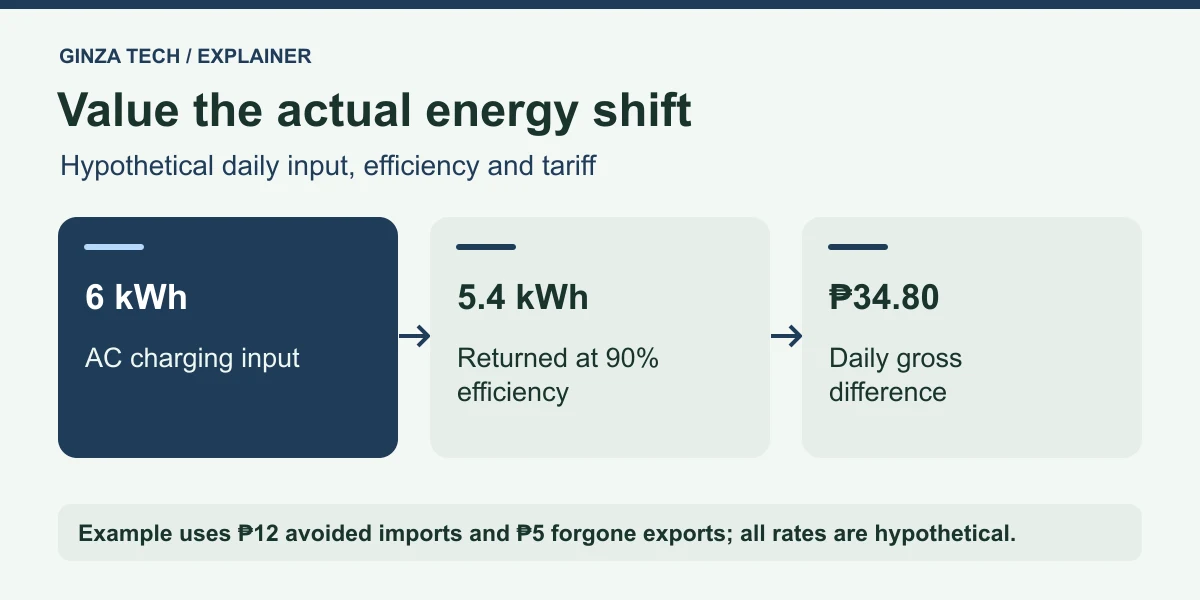
Suppose the system can accept 6 kWh AC of surplus charging energy and return 90 percent at the same AC boundary. It then delivers 5.4 kWh AC later. If only 4 kWh of avoidable load exists in that period, the useful shift is constrained by that load. Use the efficiency guide and PV recharge worksheet to define the energy inputs.
Subtract the export opportunity
On an approved export arrangement, charging the battery can use solar that would otherwise earn credit. The Meralco net metering explanation distinguishes the value of imports from export credits. Use the applicable bill and agreement. For a constrained own-use system, identify whether the alternative is curtailed generation instead.
At hypothetical rates of ₱12 per avoided import kWh and ₱5 per exported kWh, the 5.4 kWh returned avoids ₱64.80. The 6 kWh used for charging forgoes ₱30 of export credit. The daily gross difference is ₱34.80. This comparison assumes that the returned energy displaces imports to which the stated marginal rate actually applies.
| Illustrative daily line | Calculation | Value |
|---|---|---|
| Charging input | 6 kWh AC | 6.0 kWh |
| Energy returned | 6 × 90 percent | 5.4 kWh AC |
| Avoided import value | 5.4 × ₱12 | ₱64.80 |
| Export credit forgone | 6 × ₱5 | ₱30.00 |
| Gross difference | ₱64.80 − ₱30.00 | ₱34.80 |
A bill can contain fixed charges or other items that do not fall in proportion to imported kWh. Use only the charges that actually change. The bill-reading guide helps separate the energy quantities and credit lines before using them in a model.
Convert the operating pattern to an annual benefit
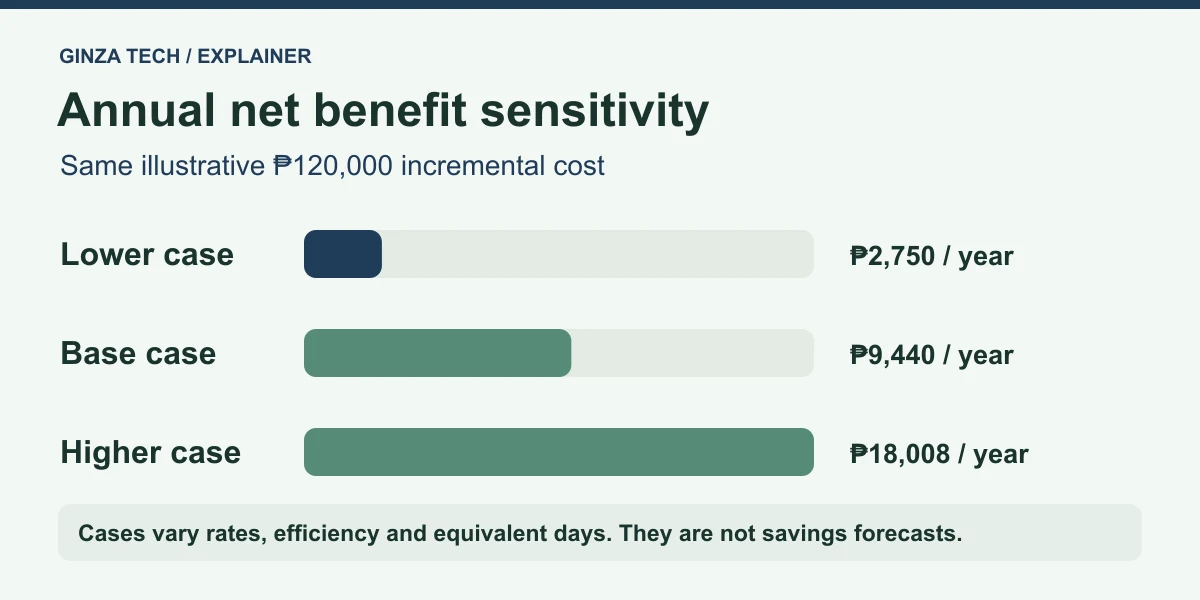
Assume 300 equivalent days achieve the modeled shift. Multiplying ₱34.80 by 300 gives ₱10,440 a year before added operating costs. If an illustrative allowance for those costs is ₱1,000 per year, the net annual benefit is ₱9,440. An incremental installed cost of ₱120,000 divided by that benefit gives about 12.7 years of simple payback.
The equivalent-day count should reflect the actual annual energy shifted, including low-generation days, travel, business closures and reserve behavior. If you have an hourly model, sum the useful value over the year instead of pretending every day has the same profile. Keep the energy totals and assumptions so the result can be reviewed.
Show how much the result can change
Using the same 6 kWh charging input, a lower case with 85 percent efficiency, a ₱10 avoided rate and ₱6 export rate has a daily gross difference of ₱15. At 250 equivalent days and the same ₱1,000 annual cost, annual net benefit is ₱2,750. The simple payback becomes about 43.6 years, which can exceed the modeled equipment life. That case needs a lifecycle review rather than a headline savings promise.
A higher case using 90 percent efficiency, a ₱14 avoided rate, ₱3 export rate and 330 equivalent days gives ₱18,008 annual net benefit after the same cost allowance. The hypothetical payback is about 6.7 years. These cases are arithmetic sensitivities. They are not forecasts that rates or usage will follow either path.
Check for a zero or negative net benefit first
Simple payback in years = incremental installed cost ÷ positive annual net benefit. If annual net benefit is zero or negative, this model has no finite simple payback. A negative result from dividing by a negative benefit must not be presented as a payback period.
For the solar-shifting case, the daily gross difference is charging-input kWh × (round-trip efficiency × avoided import rate − export rate forgone). At 90 percent efficiency and a hypothetical ₱5 export rate, the avoided import rate must exceed about ₱5.56 per kWh just to make that gross difference positive. Added annual costs, replacements and financing can still make the overall result unattractive.
If you compare the published Philippine installation installment options, retain the cash price, financed amount, interest, fees and payment schedule from the actual agreement. The payment calculator answers a cash-flow question; its monthly payment is not a measure of electricity savings.
Keep backup value and financing visible
An owner may value refrigeration, internet or business continuity even when the bill-saving payback is long. Describe that backup duty and any avoided loss separately, with evidence for the assumption. A reserve held for outages can reduce daily energy available for savings. The reserve guide shows how to account for that allocation.
Simple payback does not include every time-dependent cost. Ask for a cash-flow comparison if finance charges, degradation, replacement, changing tariffs or a shorter ownership period matter. The DOE homeowner guide identifies consumption, generation and utility compensation as important inputs to savings. Its U.S. incentives and finance examples should be treated in their own jurisdiction.
Test the effect of holding more backup reserve
In the base example, suppose the reserve policy or actual evening demand allows only 4 kWh of useful charging input per equivalent day instead of 6. With the same 90 percent round-trip efficiency and rates, 3.6 kWh returns and avoids ₱43.20. Forgone export credit is ₱20, leaving ₱23.20 per day. Across 300 equivalent days and after the same ₱1,000 annual cost, net benefit is ₱5,960. The same hypothetical investment then has a simple payback of about 20.1 years.
This is why a quotation should show the operating policy used for its savings estimate. Ask whether backup reserve, planned absence, seasonal generation and usable energy after aging are included. A more realistic annual shift can be lower than a model based on filling and emptying the full bank every day.
Keep the base case and sensitivity cases together. When a tariff, quote or operating requirement changes, update only the affected inputs and retain the prior version. That makes it possible to explain why the result changed and to compare suppliers using the same actual load and export assumptions.
Sources and example boundaries
This is an incremental-storage worksheet, not a return forecast. Every tariff, price and equivalent-day count in the examples is hypothetical. The utility source explains the import/export distinction; use the actual agreement and marginal bill charges in a proposal.
Frequently asked questions
Can I divide battery price by my current electricity bill?
Use the portion of costs the storage option can actually avoid. Existing direct solar use, fixed charges and loads outside the discharge period can make the whole bill an unsuitable denominator.
Does zero-export solar make every stored kWh a saving?
Check charging opportunity, later demand, conversion and reserve. The zero-export system guide explains why unused solar can still be constrained when the battery is full.
What should I send for a proposal review?
Provide the incremental quote, utility tariff, matching generation and import records, desired reserve and ownership period through the project enquiry form.