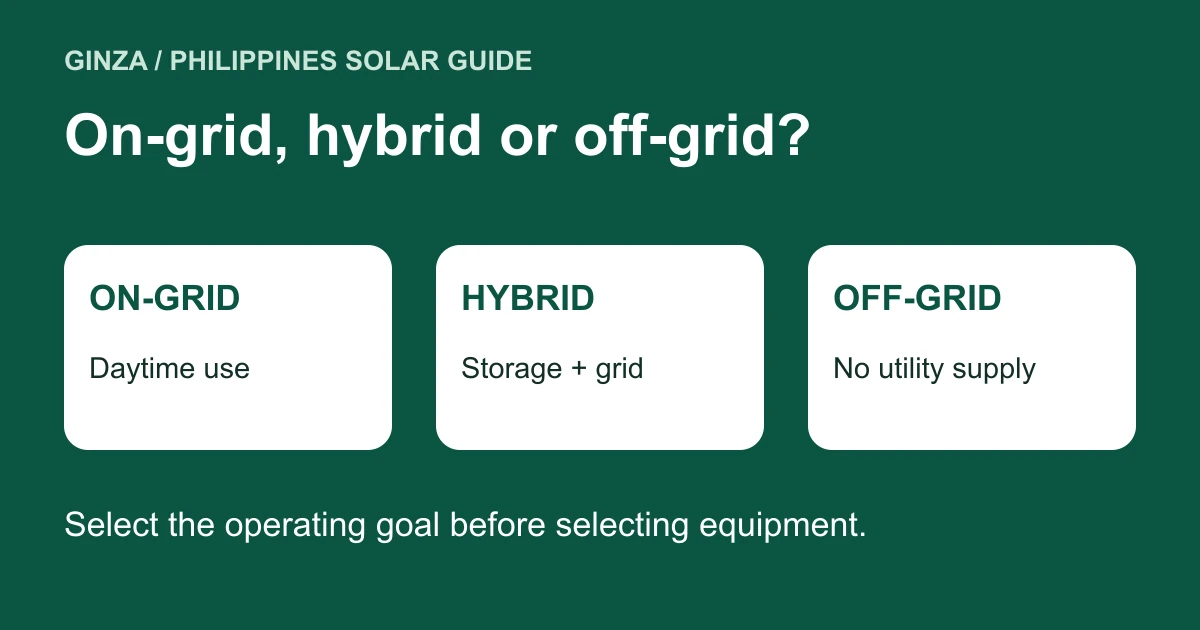
In the Philippines, a zero-export solar system is intended to serve the owner’s demand while preventing electricity from flowing into the distribution network. Under DOE Circular DC2026-08-0017, SGF ZESS means self-generating facilities zero-export solar systems; MSS means micro-solar systems. These own-use categories have different requirements. Start by identifying your connection type and obtaining the current instructions from your distribution utility.
This review was checked on 13 November 2026. It summarizes the official sources linked below and then offers a GINZA planning checklist. Confirm the current route for the actual property with the utility, local government and responsible professional before relying on a proposal’s description.
Classify the installation before comparing equipment
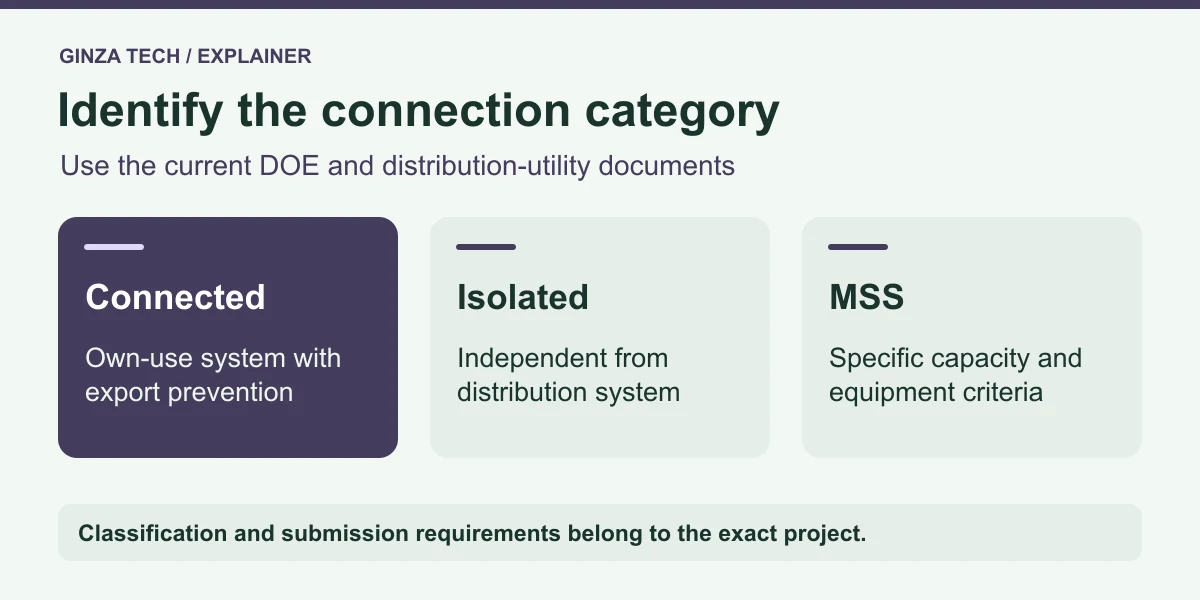
The DOE circular and its attached text distinguish connected SGF ZESS, isolated SGF ZESS and micro-solar systems. The connected category remains linked to the distribution system with equipment that prevents export. The isolated category operates independently. The micro-solar category has specific capacity, equipment and connection conditions.
Ask the supplier to name the proposed category in writing. A phrase such as “off-grid capable” can describe an inverter feature without identifying how the installed system connects to the property and utility. Use the system-type comparison for the operating objectives, then have the professional record the actual connection arrangement.
Keep notification and other requirements distinct
Section 4 of the circular provides for notifying the host utility for connected SGF ZESS and MSS. It also addresses building permits and ERC COC requirements, with category and user-specific provisions. For SGF ZESS, check the LGU’s treatment of an existing building permit and the COC exemption applicable to the named users. Read those conditions in the source rather than extending an exemption to every project.
For its customers, Meralco’s own-use solar guidance lists the notification channels and describes the relevant system types. Other utilities can have their own submission interface. Visayan Electric’s SGF guide, for example, points customers to its notification form and customer portal. Use the route for the property’s franchise area.
| Category under the circular | Notify host utility | Building permit | ERC COC |
|---|---|---|---|
| Connected SGF ZESS | Yes | Required; existing permit may suffice after LGU confirmation | Required, subject to the named-user exemption |
| Isolated SGF ZESS | No | Required; existing permit may suffice after LGU confirmation | Required, subject to the named-user exemption |
| Qualifying MSS | Yes | Not required under this circular | Not required under this circular |
The SGF ZESS COC exemption covers use by households, clinics, hospitals and other medical facilities. Section 6.3 describes post-installation notification. Other applicable laws and safety requirements remain relevant; the utility notification is distinct from the LGU permit process.
For MSS, Section 3.2 specifies no more than 1,000 W DC of PV and a factory-set micro-inverter output no greater than 800 W AC, plus automatic anti-islanding and a compliant connection. Meeting the two power limits alone does not establish eligibility.
See what zero-export control must handle
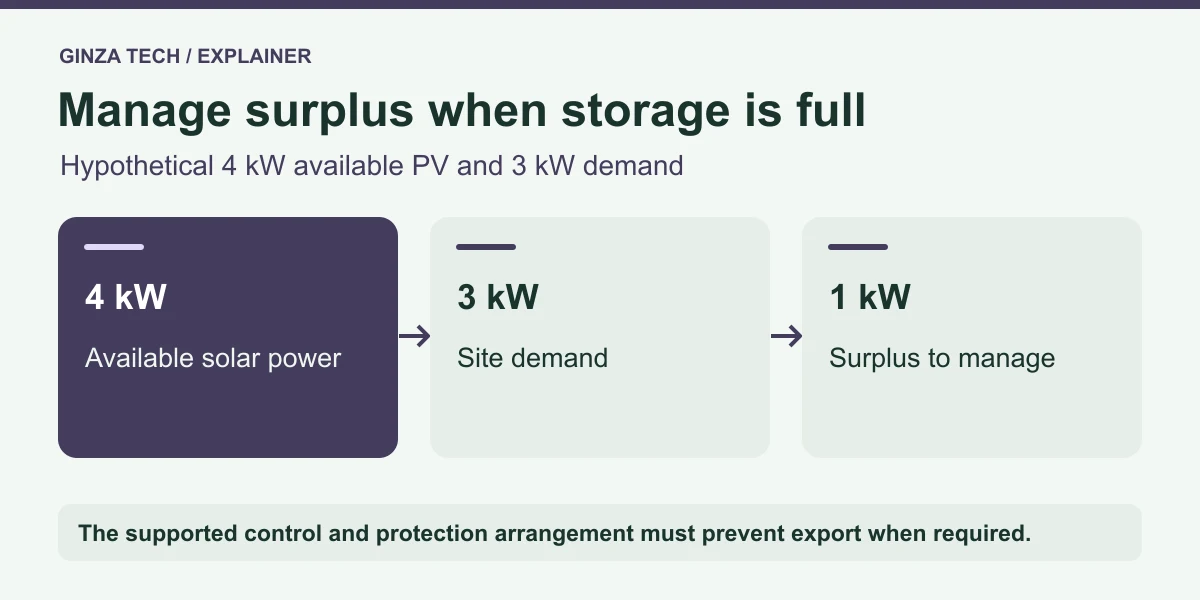
Consider an illustrative moment when 4 kW of PV power is available and the property uses 3 kW. If the battery is full and cannot accept charge, an own-use controller has to manage the surplus within its supported design. Holding actual PV output near the usable demand is one possible operating result. The availability of 4 kW does not mean the inverter should continue delivering 4 kW into that connection.
Now suppose demand falls suddenly. Ask the installer how the approved control arrangement responds, where the meter or sensor measures the site flow, and what happens if communication is lost. The source documents require effective mechanisms for the connected zero-export arrangement. The exact protection, response and test methods must come from the approved equipment and site design.
Assess the battery as an energy-use option
A battery can absorb some otherwise constrained solar and supply demand later, provided it has charge headroom and the complete system supports the operation. It may become full, reach a current limit or be held at a reserve target. The export-prevention design must still handle those conditions.
Use the solar recharge budget to compare PV generation, daytime demand and available charging opportunity. Then use the incremental payback worksheet to value the energy actually used later. Keep curtailment, export credit and avoided imports as separate lines in the comparison.
Separate own-use operation from backup and export credits
Ask which circuits stay powered during an outage and how the installation isolates from the utility. Zero-export behavior during ordinary grid operation does not itself describe the backup output or transfer time. The brownout backup checklist helps define and test that additional function.
For customers considering compensated exports, review the current net metering route separately. The circular and Meralco guidance distinguish own-use operation from eligibility for export compensation. The Meralco bill guide explains the energy and credit quantities after an approved arrangement is operating.
Build a handover package that survives a change
Retain the system category, equipment models, connection diagram, supported operating settings, applicable submissions and received records. Ask for a test record showing the relevant operating cases. These may include normal solar production, a full battery, a sudden load reduction and the documented response to loss of control data. The responsible provider should define which tests apply and how they are conducted safely.
If the property later adds panels, changes the inverter, changes ownership arrangements or seeks export credits, ask the utility and professional what must be updated. A previous notice describes the system recorded at that time. The new configuration and commercial purpose should remain traceable in the project file.
Use a short classification review for a changing property
Consider a home that initially installs solar for daytime use, then later adds a battery and wants brownout backup. The owner should ask the installer to record how the new equipment changes the connection diagram, control arrangement and supplied circuits. The utility and professional can then identify whether the existing project record needs an update. Keep the revised diagram and test evidence with the original notice.
A business can introduce another question if the solar system owner and the electricity end-user are different entities. Give that ownership and contract information to the utility when confirming the appropriate route. Avoid assigning a regulatory category solely from the inverter’s export setting or from the fact that the loads sit on one property.
The planning checklist remains useful even when the submission interface changes. Identify the utility and property, name the connection category, retain the applicable source documents and assign a person to confirm each outstanding item. Separate engineering questions from document questions so the quotation can state what has been established and what evidence still needs to be supplied.
Retain the date and version of the instructions used. When the utility updates its form or guidance, the project team can then identify which requirements need another review.
For new rooftop designs, compare roof layouts against the site's hourly demand to estimate when production can be used on site.
Sources and example boundaries
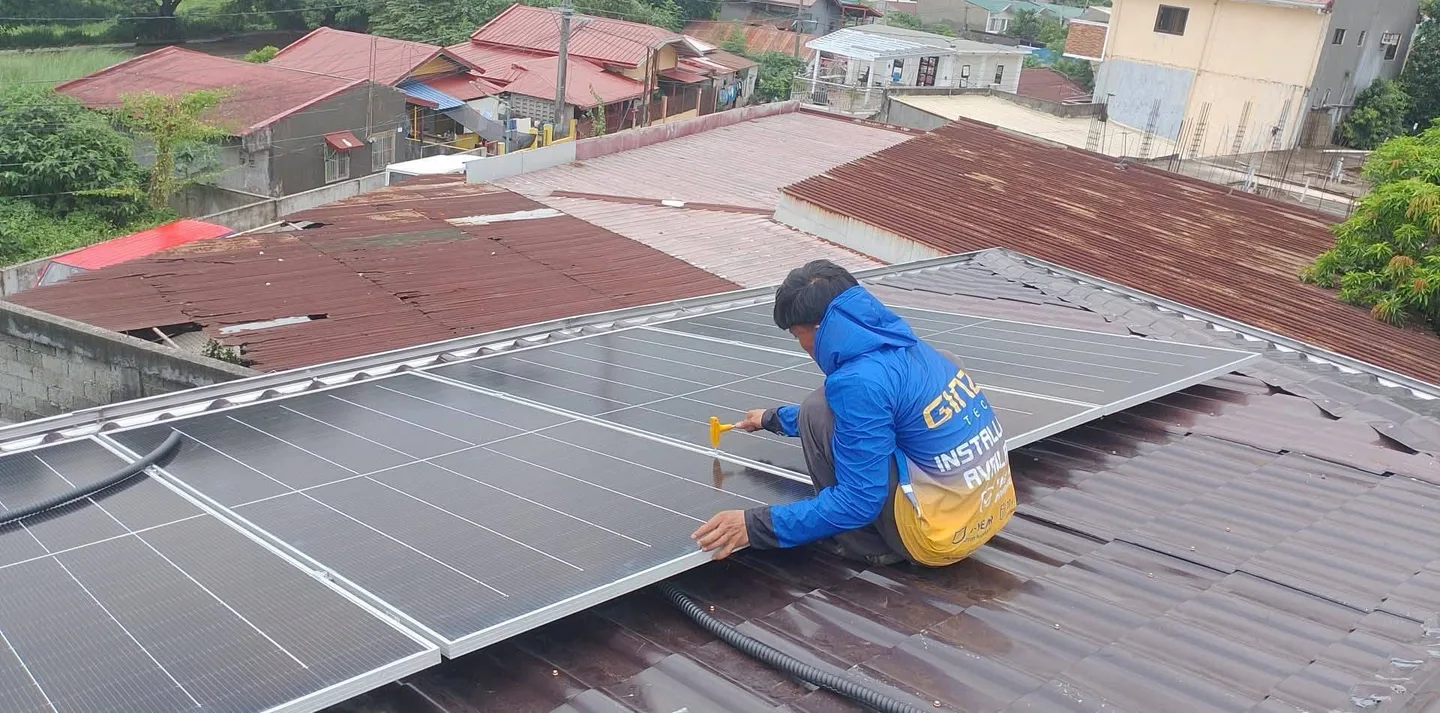
Policy sources were checked on 13 November 2026. The control diagrams are conceptual, and the rooftop photograph does not prove approval or classification. Read the cited circular alongside current utility implementation instructions and any later regulatory updates.
- Philippine DOE Circular DC2026-08-0017 and attached official text
- Meralco own-use solar implementation guidance
Frequently asked questions
Does every solar system qualify as an MSS?
Check all the technical conditions in the circular. The MSS definition includes limits on PV DC capacity and micro-inverter AC output, together with connection and safety conditions. A small system label alone is insufficient.
Can I assume a battery makes my system zero export?
Ask for the supported control and protection arrangement and its test evidence. The battery’s ability to accept charge changes during operation, so the design must manage the relevant conditions.
What should I send for a GINZA storage discussion?
Provide the utility, proposed category, inverter model, daytime load, expected surplus and backup goal through the project enquiry form. Bring the current utility requirements to the discussion.