
A home battery under Malaysia’s Solar ATAP should be assessed from surplus solar, later demand, export value, losses and the owner’s backup priorities. The existence of the programme does not make storage mandatory for every participant or prove that every battery proposal is financially attractive.
This guide focuses on the storage decision for a relevant Peninsular Malaysia household. Programme sources were reviewed on 13 November 2026. Check the current utility, account category and documents before procurement; the commercial SELCO framework and a household Solar ATAP application are different questions.
Understand the programme before adding a battery model
SEDA describes Solar ATAP as a consumer rooftop-solar programme for self-consumption and permitted surplus export, introduced on 1 January 2026. The Energy Commission’s guidelines allow BESS to form part of the installation, subject to applicable requirements.
The same guidelines distinguish domestic export credit based on the applicable Energy Charge from non-domestic credit based on Average SMP, with settlement conditions. Do not assume exported electricity offsets every component of a bill one-for-one. Use the current account and contract to establish the actual treatment.
TNB’s Solar ATAP portal provides utility information. For the wider country-policy distinctions, use the separate three-market policy guide. This article examines the next step: whether a particular home has useful storage demand.
Follow one unit of surplus solar
Solar generation can serve a load now, enter storage for later use, or be exported where the approved arrangement permits. Each route has a different value. Directly using solar avoids storage conversion losses, while export and storage depend on the applicable credit and later import costs.
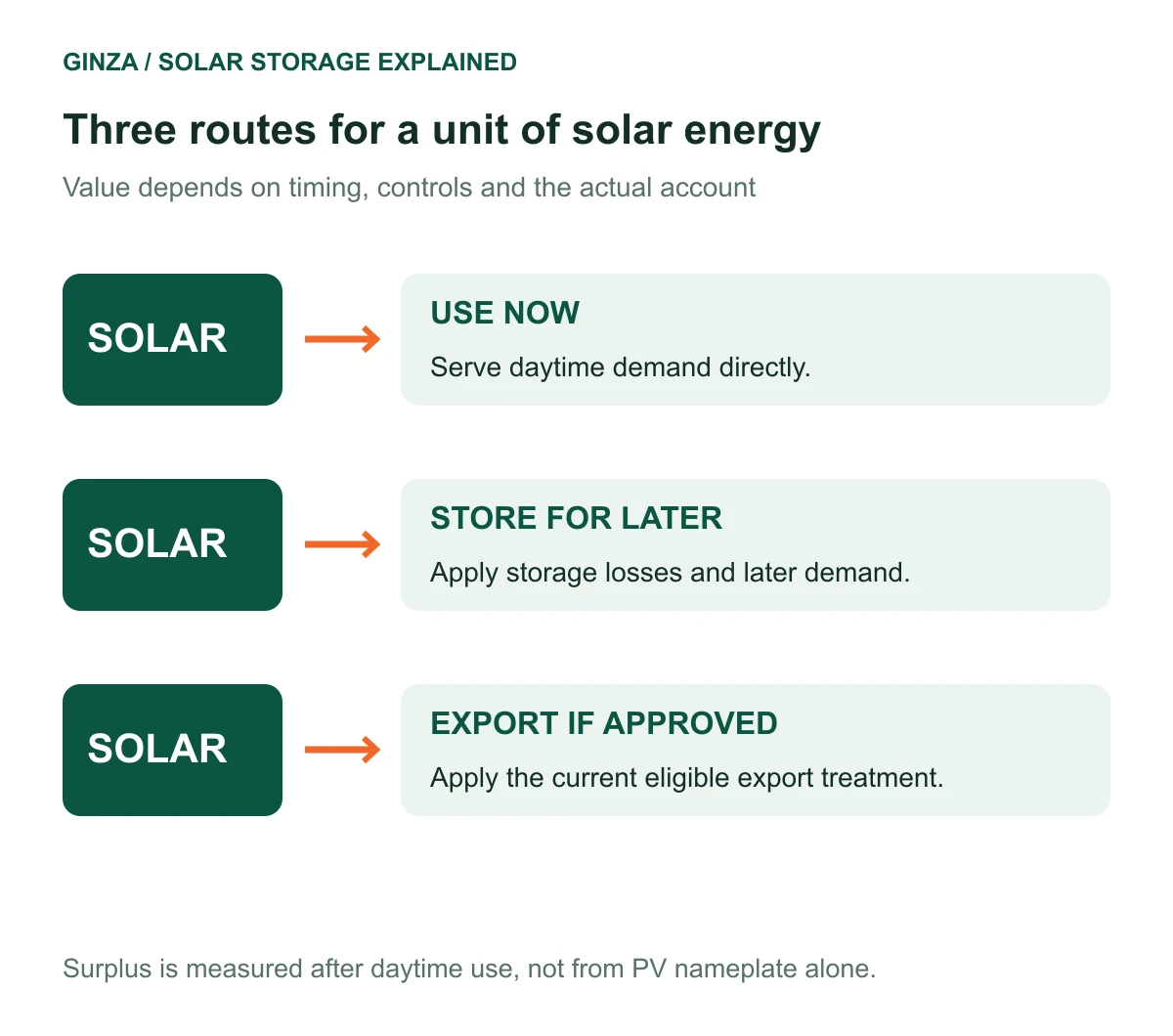
A battery cannot store energy that the household has already consumed during the day. Review a timed profile, especially for homes with daytime air conditioning, work-from-home equipment or other significant loads.
Collect the right household data
| Input | What to record |
|---|---|
| Daytime solar generation | Actual or modelled production profile, including shade and seasonal variation. |
| Daytime use | Loads that absorb generation before it becomes surplus. |
| Evening and overnight demand | kWh that could actually be supplied from storage. |
| Import and export value | Marginal avoided import cost and effective export treatment for the account. |
| Backup objective | Essential circuits, hours and protected reserve. |
A monthly bill and the PV array’s kWp are useful context, but they do not show the timing of surplus or demand. Ask the installer to identify which data are measured and which are assumptions in the proposal.
Compare storage with the export alternative
For a simplified energy-only comparison, let A be the value per kWh of later grid imports avoided, B the effective export value per kWh diverted from export, and η the relevant solar-to-later-AC storage efficiency. For one kWh entering this comparison, gross incremental value is approximately η × A − B.
This deliberately simplified formula assumes the exported energy would otherwise have qualified for the relevant value, and the stored output will be used. It is not a complete TNB bill calculator and does not model all charges, caps, incentives, taxes or changes in behaviour.
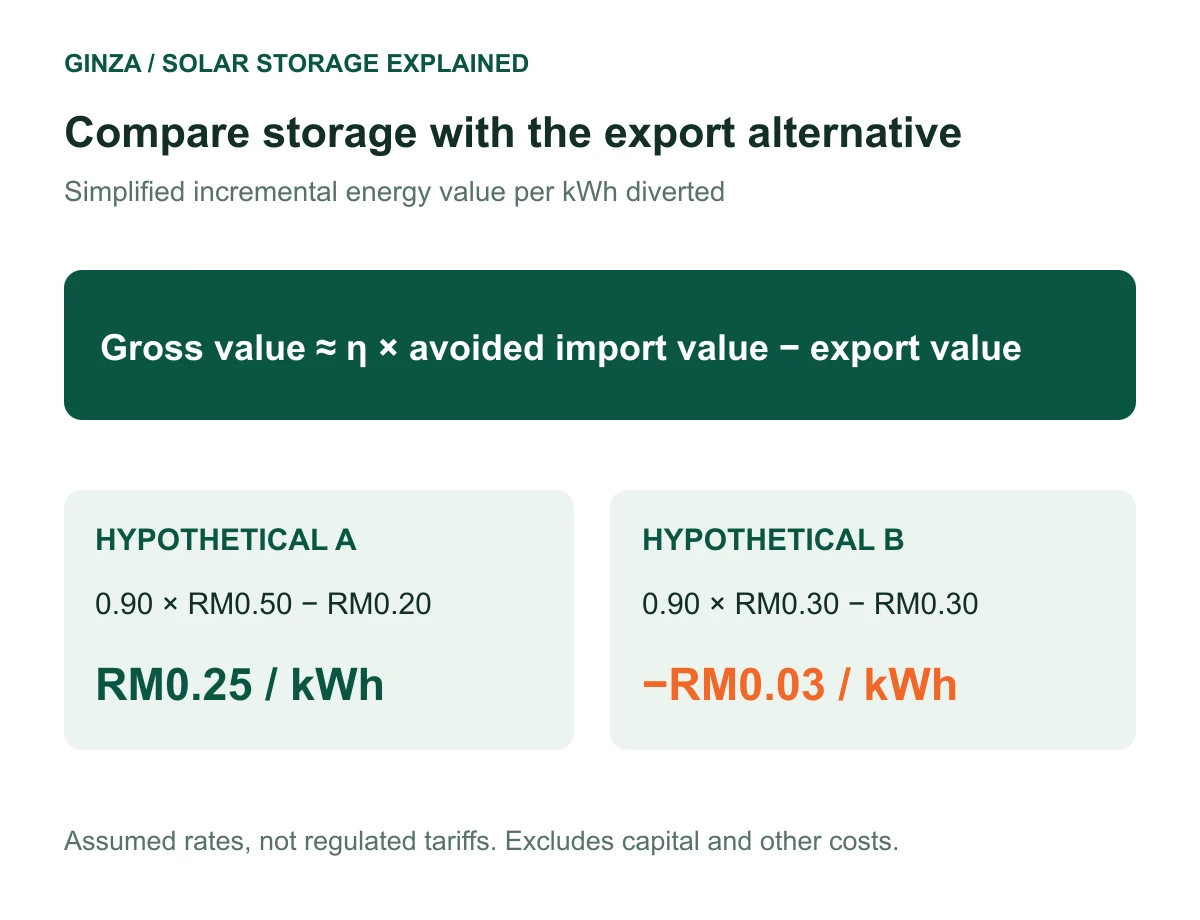
| Hypothetical input | Example A | Example B |
|---|---|---|
| Storage efficiency η | 90% | 90% |
| Avoided import value A | RM0.50/kWh | RM0.30/kWh |
| Forgone export value B | RM0.20/kWh | RM0.30/kWh |
| Gross value per kWh diverted | RM0.25 | −RM0.03 |
These rates are invented arithmetic assumptions, not current regulated tariffs or a GINZA savings claim. Example B shows why storage is not automatically an energy-saving investment merely because it increases self-consumption.
Annual use matters as much as battery capacity
Suppose the first hypothetical example can divert 10kWh of otherwise-exported solar on 240 useful charging days. The simple gross energy value is 10 × 240 × RM0.25 = RM600 a year. At 365 such days, it would be RM912.50. Neither figure includes capital, service costs, aging or financial discounting.
The difference is not produced by changing the battery label; it comes from how often the assumed energy movement actually occurs. Use realistic profiles and sensitivity cases rather than multiplying the best sunny day across an entire year.
Also check the evening demand available to consume the stored output. A larger bank may have unused capacity if the household’s later consumption is small. Increasing capacity does not necessarily increase yearly value in proportion.
Model settlement limits and the contract period
Under the cited Solar ATAP guidelines, unused exported energy is not carried into later billing periods, and export credit cannot offset the Automatic Fuel Adjustment (AFA). The programme period is no more than ten years from commencement, after which the guidelines describe strictly self-consumption operation subject to the applicable framework. Use the actual account and agreement when modelling that change.
For the worksheet, B should represent the value the particular diverted export could actually use under the settlement rules. Do not assign a headline credit to energy whose credit would be forfeited. Recalculate the cash-flow case if the contract or credit treatment changes. The incremental payback method can organize costs and useful energy, but its example peso rates are not Malaysian tariffs; substitute the actual MYR inputs. If annual net benefit after costs is zero or negative, bill savings provide no finite simple payback.
Keep backup value separate
A household may want refrigeration, lighting, communications or selected cooling during interruptions. That preference can be important even where an energy-only savings model is modest. Record the backup objective openly instead of disguising it as guaranteed bill savings.
Confirm the backup-capable inverter, isolation arrangement, designated circuits and actual transfer behaviour. The owner should know whether PV can charge during an outage and what happens when reserve is reached. A battery connection alone does not establish those functions.
Keeping a reserve for an unexpected interruption can reduce the energy available for routine evening use. Model both priorities together. The system comparison explains the technical concepts, while utility rules must be confirmed for the Malaysian installation. The reserve guide makes that energy allocation explicit.
Existing solar needs an equipment review
If the home already has solar, collect the inverter model, firmware, current contract and installation records. Do not assume that adding storage or changing a programme arrangement leaves all existing equipment and approvals unchanged.
The retrofit guide compares AC and DC coupling. For a GINZA proposal, obtain confirmation that the exact battery and inverter combination is supported. Nominal voltage, physical connectors and generic “hybrid-ready” language are insufficient.
A balanced decision checklist
Compare a solar-only case with a storage case
Request both cases using the same household profile and period. Show the extra installed storage cost, energy that moves through the battery, export value given up, later imports avoided and any protected reserve. If the home already participates in another arrangement, ask the utility or responsible provider how the existing contract affects the proposed change before assuming a new programme applies. Keep uncertain eligibility or billing inputs separate from confirmed equipment costs. That makes the decision reviewable if an account condition, tariff input or installation scope changes.
- There is measured or credibly modelled surplus after daytime use.
- The household has later demand that can consume the stored energy.
- The comparison includes losses and forgone export value.
- The complete installed cost and service responsibilities are documented.
- The backup objective and protected reserve are separately stated.
- The equipment and current programme conditions have been reviewed.
If these inputs are missing, improve the assessment before committing to a capacity. Some households may reasonably begin with solar-only use; others may value a supported storage arrangement. The appropriate result comes from the household’s evidence.
Sources and interpretation
Official Solar ATAP sources were rechecked on 13 November 2026. The RM prices, energy movements and equivalent days are hypothetical. Apply the actual account, usable export credits and contract period in a financial model. These calculations neither establish programme eligibility nor forecast a household's savings.
Frequently asked questions
Is a battery compulsory under Solar ATAP?
The cited ATAP framework allows storage rather than imposing a universal household battery requirement. Check the actual programme and account; do not import a different SELCO project’s conditions.
Is every exported kWh worth the full import bill rate?
Do not assume that. Domestic and non-domestic credit bases and settlement conditions differ, and bills can contain other components. Confirm the actual account treatment with the utility.
Should the battery match the daily solar generation?
Size it from useful surplus, later demand, reserve and equipment limits. Total solar generation alone can substantially overstate what needs to be stored.
Use the energy sizing guide, review GINZA low-voltage storage, and share your location, account context and inverter model for a product discussion.