A LiFePO4 battery’s useful life depends on calendar age, cycling, operating conditions and the energy it must still deliver. A headline cycle figure is not a guaranteed number of years, and a warranty term is not a promise that a battery will suddenly stop on its final day.
For broad context, the Australian Government’s component-lifespan guidance gives lithium-ion batteries a general average of 10–15 years. That is an external category-level reference, not a GINZA model forecast, Philippine field result or warranty. A real purchase needs the exact model documentation and the intended duty.
Separate four different life questions
| Measure | What it tells you | What else to check |
|---|---|---|
| Calendar age | Elapsed time since manufacture, installation or another stated start point. | Storage conditions and the warranty’s actual commencement date. |
| Cycle performance | Capacity behaviour under a defined repeated test. | Discharge window, current, temperature and remaining-capacity criterion. |
| Energy throughput | Total energy processed on a stated measurement basis. | Whether the figure uses DC discharge, AC delivery or another definition. |
| Useful backup life | Whether remaining usable energy meets the owner’s requirement. | Actual loads, reserve, losses and inverter capability. |
These measures can lead to different conclusions. A lightly used bank can still age with time. A battery that remains operational can eventually fall short of a long overnight objective. Conversely, a smaller remaining capacity may still serve a reduced essential-load schedule.
Understand a cycle before comparing cycle counts
Ask how the manufacturer defines a cycle. A laboratory cycle may involve a specified charge and discharge window at a controlled temperature and rate. A real system may perform several partial charge and discharge movements in a day. Counting each movement as one full cycle can make two records incomparable.
Equivalent full cycles can provide a useful analysis measure when their basis is explicit. In a simplified discharge-throughput calculation, a 10kWh nominal battery delivering 5kWh on the DC side each day processes 0.5 equivalent full cycles per day. It reaches about 182.5 such cycles over 365 days, not 365 simply because it was used daily.
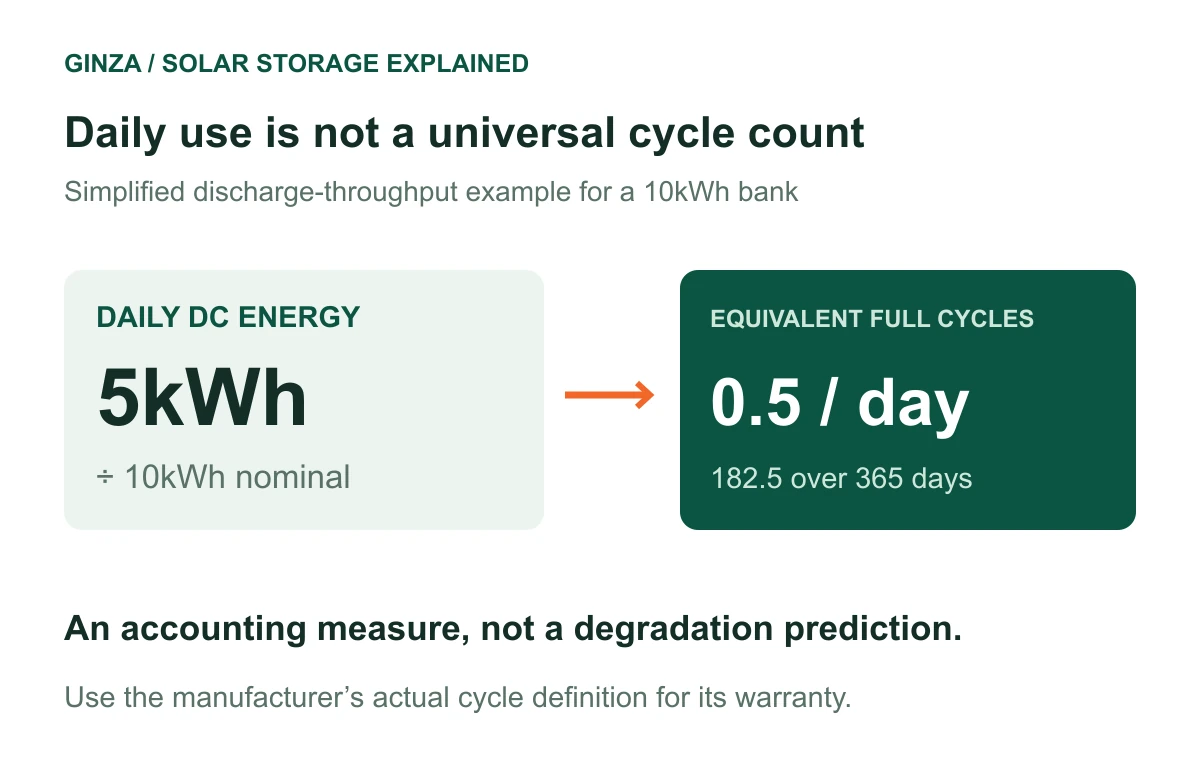
This accounting example does not predict degradation or define a warranty cycle. Charging throughput, discharge window, operating temperature and measurement method can change the interpretation. Use the supplier’s definition for a contract or performance comparison.
Do not divide the cycle claim into a guaranteed lifespan
GINZA’s published Gen5 information includes a cycle-life statement under stated test conditions. Before relying on it for procurement, request those conditions and the current documents. The number should not be divided by an assumed daily cycle count to create guaranteed decades of service.
A cycle test does not remove calendar aging, installation exposure or variation in actual use. Nor does it establish the duration of an associated inverter, communications equipment or other system component. Review the complete service and replacement plan rather than treating the bank as the only item with a useful life.
Remaining capacity matters to the backup promise
Consider an illustrative 10kWh nominal bank operated over an 85% window with 90% conversion efficiency. At its starting capacity, the calculated AC energy is 7.65kWh before standby. At an assumed 80% retained capacity, the same method gives 6.12kWh.
| Illustrative retained capacity | Available AC energy | Hours at a constant 1kW |
|---|---|---|
| 100% | 7.65kWh | 7.65 |
| 90% | 6.89kWh | 6.89 |
| 80% | 6.12kWh | 6.12 |
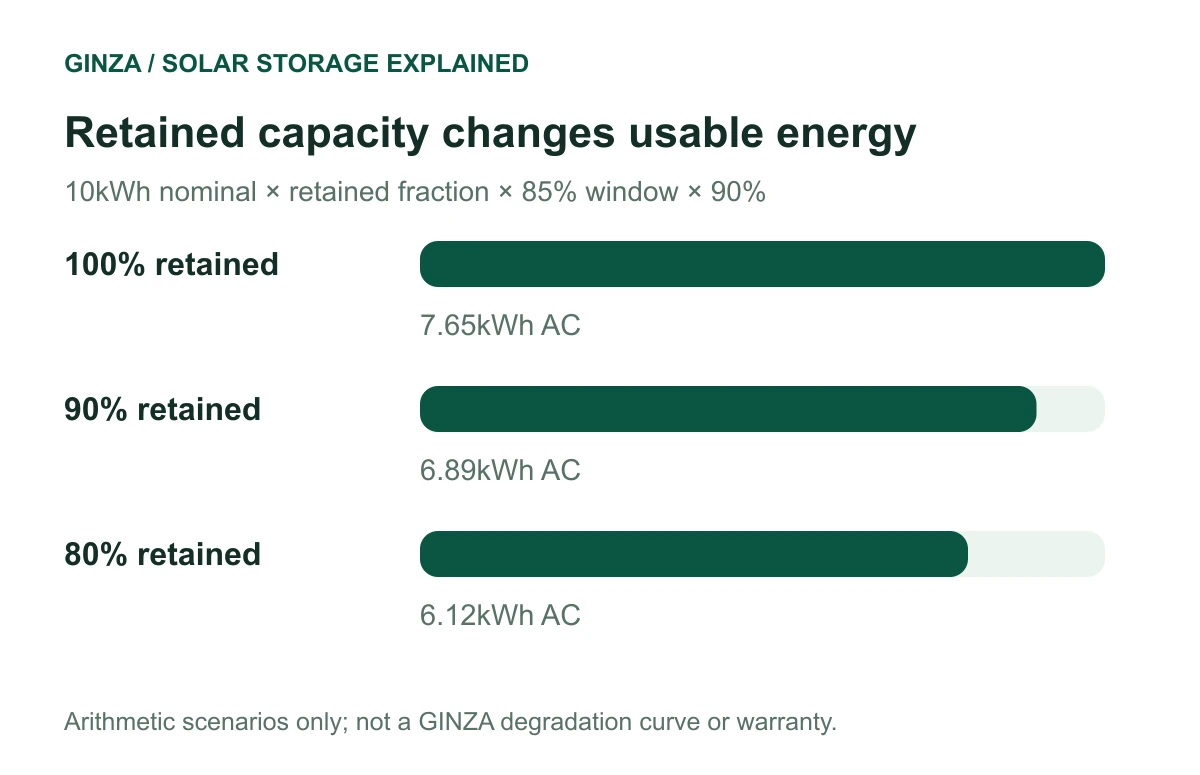
The percentages are arithmetic scenarios, not a degradation curve, warranty threshold or forecast for a GINZA product. If the owner needs 7kWh AC every night, the requirement would already exceed the 80% scenario. A 4kWh essential-load objective has a different capacity margin.
This is why initial sizing should include a clear service objective. The home sizing guide explains reserve and losses; the aircon examples show how comfort loads can consume much of the available energy.
Review the actual warranty, not only the headline years
Request the document for the supplied model, country and seller. Identify the warranty start, product-defect terms, retained-capacity definition, throughput or cycle limits, operating conditions and any registration requirements. Ask how a claim is assessed and what evidence must be retained.
The Australian Government’s warranty explanation distinguishes time, throughput and end-of-warranty capacity approaches. Its examples describe the subject, not GINZA terms. Confirm whether the proposal also covers diagnostic labour, transport, removal and reinstallation.
A distributor should agree on the support route before selling. The installation record, model identification, firmware versions and operating history make a later question easier to investigate. A missing document can create more uncertainty than a small difference between headline cycle figures.
Heat, charging and installation conditions deserve attention
Operate the system within the exact product’s conditions and retain the approved charging profile and current limits. A technical maximum is not a recommended permanent target. Avoid using the battery’s enclosure rating as permission to install it in a location that traps heat or prevents service access.
Ask the installer how the system manages normal operation, reserves, alarms and any planned periods out of service. Follow the supplied maintenance and storage guidance; do not adopt generic voltage or state-of-charge instructions from a different brand to extend life. The battery maintenance checklist organizes ordinary observations, qualified inspection and the records needed after a change.
The location guide explains heat, exposure and access. The charging diagnostic guide explains why an operating limit can stop charging without proving the battery is worn out.
Build a monitoring baseline at handover
- Keep the exact model, serial and installation date in the owner’s private records.
- Retain approved settings, firmware and the commissioning results.
- Record the initial backup objective and the loads included.
- Review energy use, alarms and charging opportunity over comparable periods.
- Ask support to assess persistent changes before assuming capacity failure.
A change in observed runtime can result from hotter nights, new appliances, a different reserve or less charging before the outage. Compare like-for-like conditions. A qualified provider may need an equipment-specific capacity assessment; a single SOC screenshot is not that assessment.
If the decision is still between chemistries, use the LiFePO4-versus-lead-acid comparison. This page instead follows service life, capacity and documentation within the selected lithium system.
Plan replacement or expansion deliberately
If the required energy no longer fits, review the load plan, charging availability and system condition before ordering more batteries. Expansion has model, firmware, current-sharing and installation constraints. It is not automatically a remedy for a fault or a substitute for a service diagnosis.
For end-of-life handling, use an appropriate local provider and the manufacturer’s instructions. Do not place a stationary lithium battery in ordinary household waste or attempt to dismantle its cells. Keep the recycling and transport arrangements with the service plan.
For batteries held as distributor stock before installation, keep a separate inventory storage and release record. Receipt history, residual loads and the exact supplier care instructions matter alongside the operating-life and warranty comparison.
Before interpreting a warranty threshold, check how a stationary battery state of health comparison is measured and which reference and test boundary apply.
Sources and interpretation
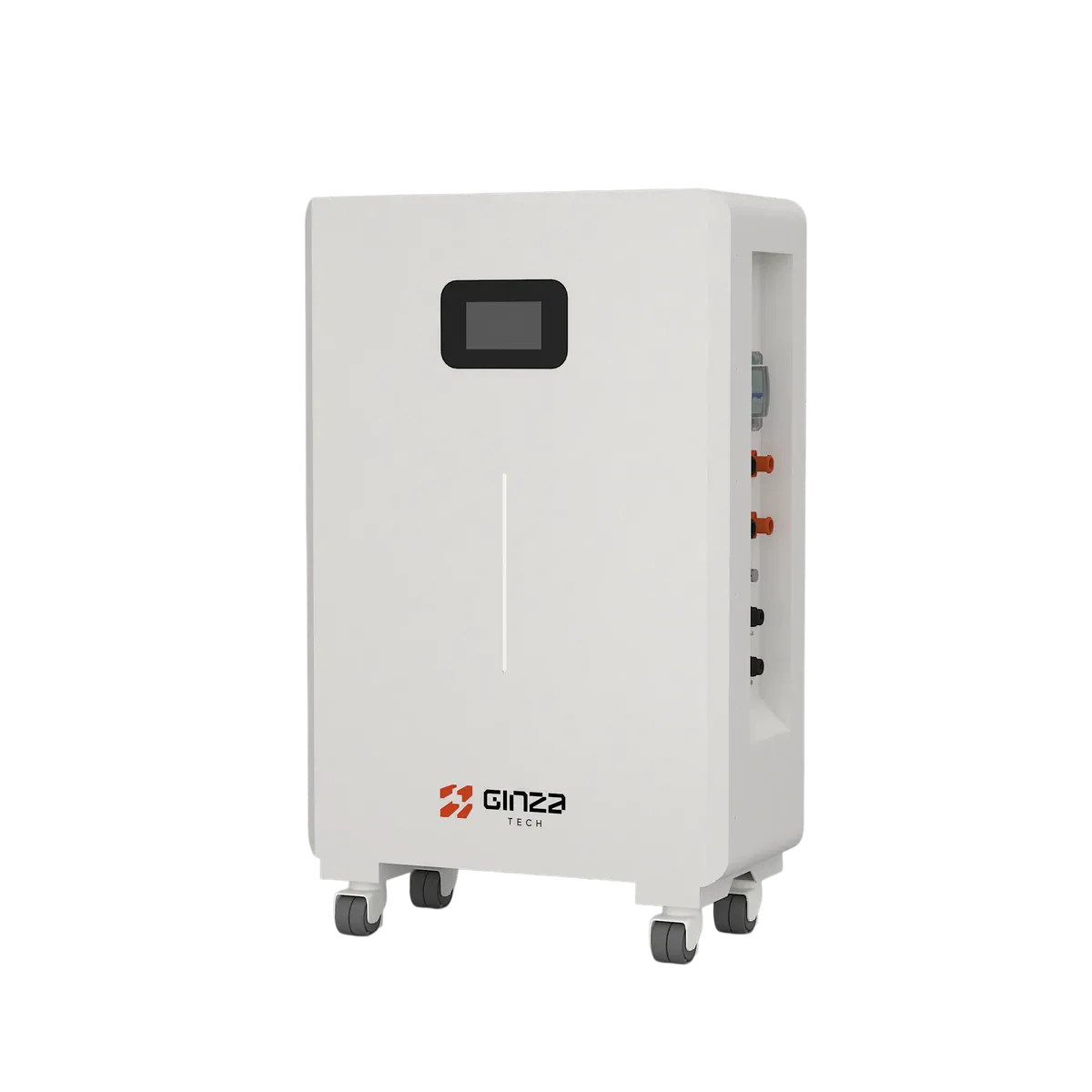
The Australian lifespan range is category-level context, not a forecast for the pictured model. Throughput and retained-capacity scenarios are accounting examples. Contractual cycle counting, capacity thresholds and claim conditions come from the supplied warranty; ordinary dashboard data does not replace an approved capacity assessment.
Frequently asked questions
Does a 10-year warranty mean ten years of unchanged capacity?
Only the actual warranty can establish what is guaranteed. It may specify a retained-capacity level, usage limits and conditions. Read those alongside the product-defect terms.
Is a daily partial discharge always one full cycle?
No universal counting rule applies to every product. Use the stated manufacturer definition; disclose the basis when calculating equivalent full cycles.
Should an older battery be replaced because it charged slowly once?
Not on that observation alone. Source availability, load, schedule, battery limits and faults can all affect charging. Document the behaviour and obtain a model-specific assessment.
Ask GINZA for current model and warranty documents, including your application and country. For an existing installation, provide its commissioning and operating records through the appropriate support channel.