A solar battery is worth comparing with a generator when you know the essential loads, likely outage length and how either system will be replenished. A battery gives you stored energy with an inverter power limit. A generator provides power while it has suitable fuel, operating conditions and maintenance. For repeated short outages and long interruptions, the better arrangement can be different.
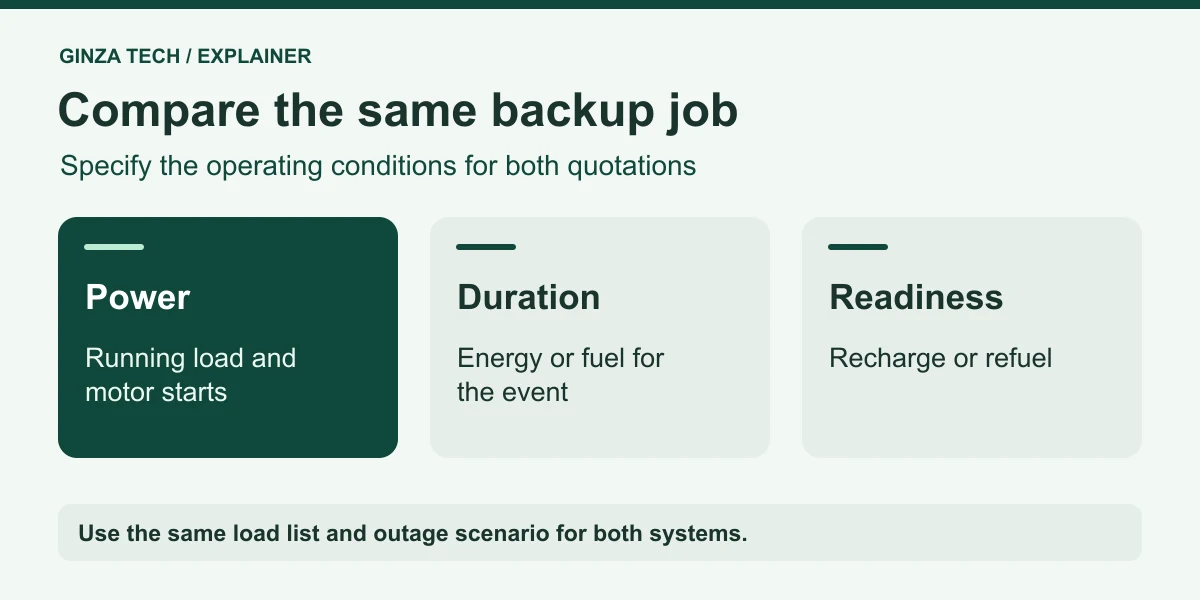
Start with the same backup job on both quotations. Ask each supplier to identify the circuits served, the continuous and starting loads, transfer behavior and the time or fuel needed to restore readiness. This guide uses hypothetical numbers for planning. It does not quote a fuel price, generator rating or measured GINZA backup performance.
Which backup option fits the job?
Use the outage pattern to shortlist an arrangement before comparing headline prices. The table is a decision aid; it does not establish that a particular product can supply your circuits.
| Your priority | Arrangement worth comparing | Condition that can change the decision |
|---|---|---|
| Short interruptions with a modest overnight load | Battery backup with a demonstrated transfer and reserve | The starting state of charge and the available recharge window |
| Long interruptions with accessible fuel and an appropriate operating site | A suitably rated generator | Fuel availability, site constraints, servicing and the actual light-load duty |
| Long interruptions plus continuity for sensitive loads | A supported generator-and-battery system, with local UPS where needed | Approved source integration, combined charging demand and a tested operating sequence |
For a storage quotation, the GINZA low-voltage battery range supplies product-level capacity information. Match it with the proposed inverter and outage load; a battery listing alone does not establish generator compatibility or whole-house backup.
Describe one outage before comparing equipment
List the appliances that actually need power. For a home this may mean refrigeration, lights, fans and internet. For a shop it may include payment equipment and selected refrigeration. Record the expected hours and which appliances cycle. Ask a qualified provider to check motor starts separately from average demand. The home battery sizing guide provides the energy worksheet.
Then state the conditions when the outage begins. A battery may have already supplied evening loads. A generator may be away for service or have limited fuel on site. Consider an ordinary interruption and one longer event. A comparison based on a full battery and unlimited fuel leaves out the operating decisions the owner must make.
Compare power first and duration second
| Requirement | Battery proposal | Generator proposal |
|---|---|---|
| Continuous load | Inverter output and available battery power | Continuous rated output under stated conditions |
| Motor start | Surge magnitude, duration and battery current | Starting capability and voltage response |
| Duration | Usable energy at the starting charge | Fuel available and consumption at the duty |
| Transfer | Installed backup output and transfer equipment | Starting sequence and approved transfer arrangement |
| Restore readiness | Supported recharge source and time | Refueling and any service requirement |
An average 800 W load for five hours uses 4 kWh AC. A battery system with 5 kWh of usable energy measured at the load connection would cover that energy budget under the same conditions. At a constant 800 W it represents 6.25 ideal hours. Confirm whether the quoted usable energy includes the equipment’s own consumption. A brief pump or compressor start still needs its own power check.
Ask the generator supplier for fuel use at a load close to that 800 W duty. Rated kVA alone does not provide a fuel estimate. A unit chosen for a large motor start might spend most of the outage at a light load, and its operating cost at that point can matter. The water-pump backup guide helps define that motor duty.
Check where the equipment can operate
Battery siting needs the supplied environmental limits, structural support and service access. Use the tropical battery location guide for the site review. Have the installer identify noise from cooling equipment as well as the proposed access route. A cabinet location also needs to work for future inspection and replacement.
A combustion generator needs an appropriate outdoor operating location and fuel arrangements. The CDC generator safety guidance addresses carbon monoxide and outdoor placement. Give the supplier a site plan showing nearby doors, windows and vents. The qualified installer should design the transfer and protection so the backup source supplies the intended circuits safely.
Compare the cost of an outage you might actually have
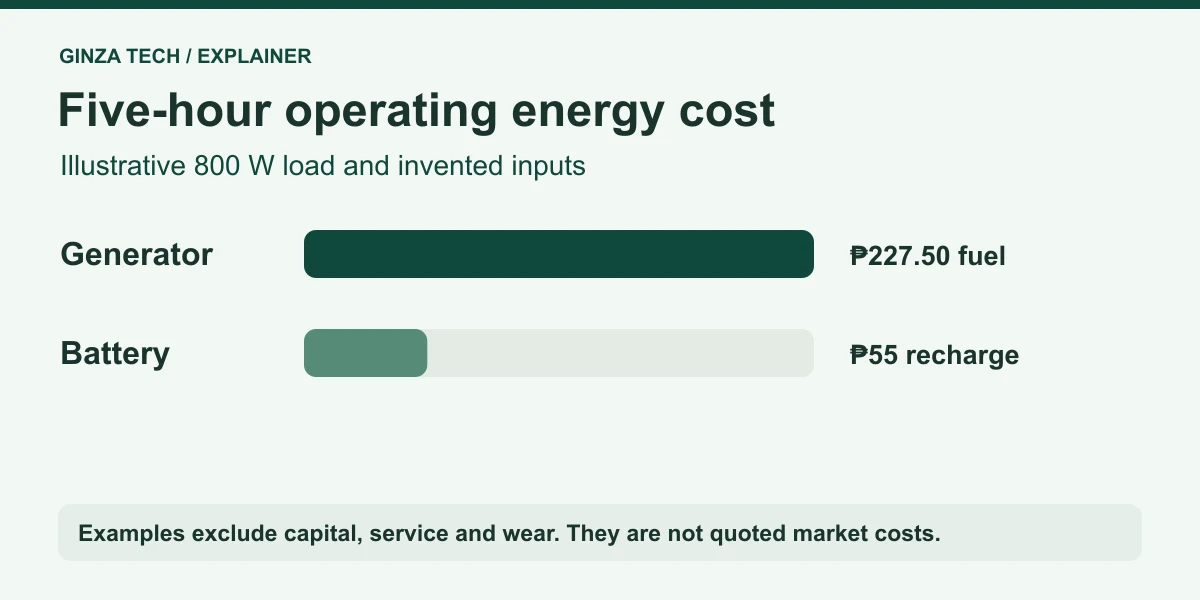
For arithmetic only, suppose a generator uses 0.7 litres per hour at the chosen duty and fuel costs ₱65 per litre. Five hours would use 3.5 litres and cost ₱227.50 in fuel. Add the service, consumables and operating tasks required by that generator. Both inputs are invented, so replace them with the supplier’s duty data and the fuel cost for your location.
For a battery, suppose replacing the 4 kWh AC delivered requires 5 kWh of charging energy at the relevant complete-system boundary. At an illustrative ₱11 per charging kWh, that energy costs ₱55. If the source is excess solar that could earn an export credit, include the credit forgone instead. The battery payback worksheet explains the incremental-cost comparison.
Plan for a second interruption
After a five-hour event, ask how quickly the battery can recover its intended reserve using the source actually available. A sunny-day PV estimate is less useful if interruptions occur during prolonged cloud or overnight. The charging-time guide separates the energy target from charger and source limits.
For the generator, record who checks fuel and service readiness. Include access during a storm or outside business hours. A responsible operating plan assigns these tasks to a person and keeps the manufacturer’s service schedule available. If the house may be unattended, ask which operations are automatic and which need someone on site.
Some sites use a supported generator and battery arrangement. A qualified provider must confirm source selection, input limits and charging demand for the exact equipment. The Victron generator integration FAQ illustrates why charging demand and the generator’s continuous capability need a joint review. Its product-specific settings apply to its documented equipment.
Compare a short event with a longer one
Use at least two scenarios when asking for proposals. In the five-hour, 800 W case, the load uses 4 kWh. If the same demand continues for twelve hours, it uses 9.6 kWh. A battery with 5 kWh of usable output needs additional available generation, a larger energy budget or reduced loads to cover the second case. A generator proposal must show enough fuel, supported operating duration and a suitable site arrangement for that same event.
Then include a second outage after only a short recovery window. Record how much energy the battery can regain, or how the generator’s readiness will be checked. A quote can be adequate for one event but inconvenient for repeated operation. Ask the supplier which assumption changes the equipment selection and which can be addressed through an agreed operating plan.
Keep the comparison focused on the household’s actual priorities. A small quiet overnight load and a daytime workshop motor can call for different arrangements. The final decision sheet should show the cost and responsibilities for each scenario, including the tasks someone must perform when the normal electricity supply is unavailable.
If the system will use both sources, review approved generator input and charging before commissioning to understand the transfer options.
Sources and example boundaries
The cost bars compare invented operating-energy inputs for one 800 W outage load. They exclude purchase cost, service and wear. The two sources below address generator safety and one manufacturer's integration requirements, rather than proving GINZA system performance.
Frequently asked questions
Can a solar battery keep working through a multi-day outage?
It needs sufficient replenishment during that event. Ask for an energy balance using essential loads, realistic solar input and the supported minimum charge. The reserve guide shows why the initial percentage changes the available duration.
Will either system keep a router online without a reset?
Test the actual transfer behavior with the router and network terminal. A compatible local UPS may be useful for continuity while the larger source starts or transfers. See the Wi-Fi router backup guide.
What should I ask for on the final quotation?
Request the named circuits, equipment models, continuous and start limits, transfer arrangement, replenishment plan and support responsibilities. Send the same load list and outage scenario through the project enquiry form when comparing a GINZA storage proposal.