LiFePO4 and lead-acid solar batteries should be compared by the energy they can deliver under the intended operating conditions. The amp-hour label and initial battery quotation are only starting points. The permitted discharge window, charger compatibility, discharge rate, maintenance and replacement plan can change the complete comparison.
LiFePO4 is a specific lithium-ion chemistry, often shortened to LFP. Lead-acid includes flooded, AGM and gel products, which should not all be given the same maintenance instructions. This guide helps homeowners, installers and project buyers compare actual models without assigning one lifespan or operating limit to every battery in a chemistry category.
LiFePO4 vs lead-acid: the practical comparison
| What to compare | LiFePO4 | Lead-acid |
|---|---|---|
| Usable energy | Apply the exact permitted discharge window, reserve and system losses. | Apply the exact discharge allowance, reserve, discharge rate and losses. |
| Charging | Requires an approved lithium profile and appropriate BMS integration. | Requires the profile for the actual flooded, AGM or gel model. |
| Maintenance | No routine electrolyte watering; inspection and monitoring remain necessary. | Flooded types require electrolyte care; sealed types have different requirements. |
| High-load operation | Check battery current limits, BMS and inverter capability. | Check discharge-rate performance as well as current and inverter limits. |
| Life claims | Compare test conditions, calendar use and actual warranty terms. | Compare the same factors, including the intended charging and maintenance regime. |
| Upgrade work | May require changes to an existing lead-acid-based system. | A replacement must also suit the existing system and intended duty. |
Start with kWh at the actual battery voltage
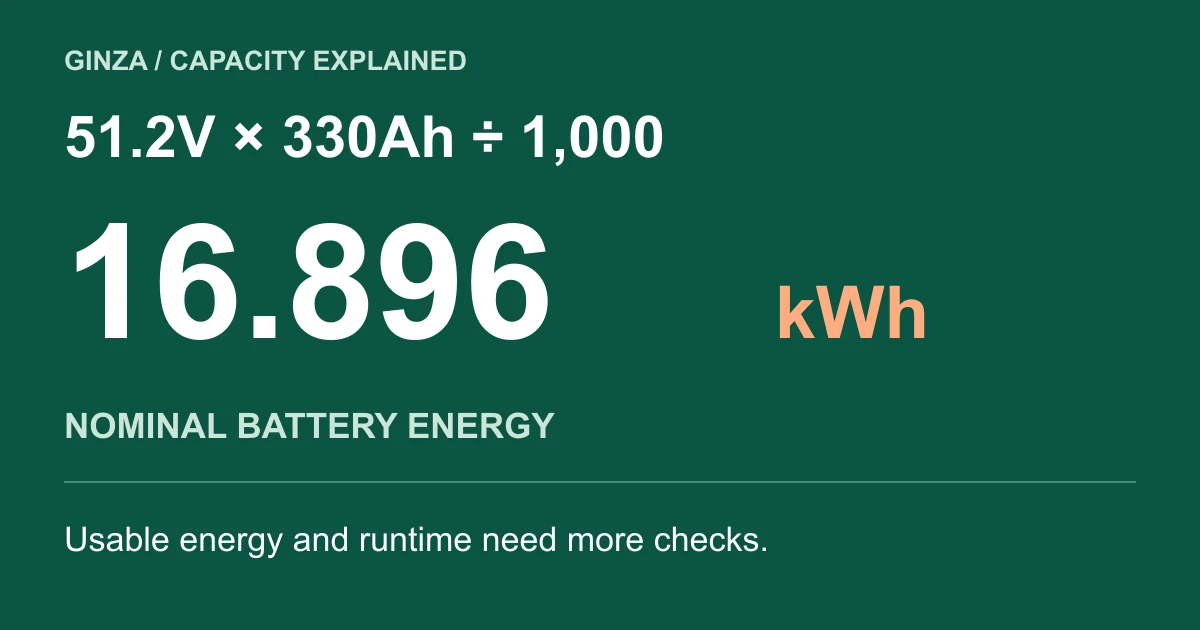
Amp-hours alone do not provide an energy comparison. A 12V 100Ah battery represents approximately 1.2kWh nominal, while 51.2V 100Ah represents approximately 5.12kWh. Identical Ah numbers can therefore describe very different quantities of stored energy.
For a bank of batteries, compare the complete bank at its actual voltage. Series and parallel arrangements affect voltage and capacity differently; the system designer must confirm an approved arrangement. Do not count each battery’s Ah as though every bank were configured the same way.
After calculating nominal energy, ask how much is intended to be used. That depends on the exact model and the required operating objective, not just the words “lithium” or “deep cycle.”
Usable-capacity example: two nominally equal banks
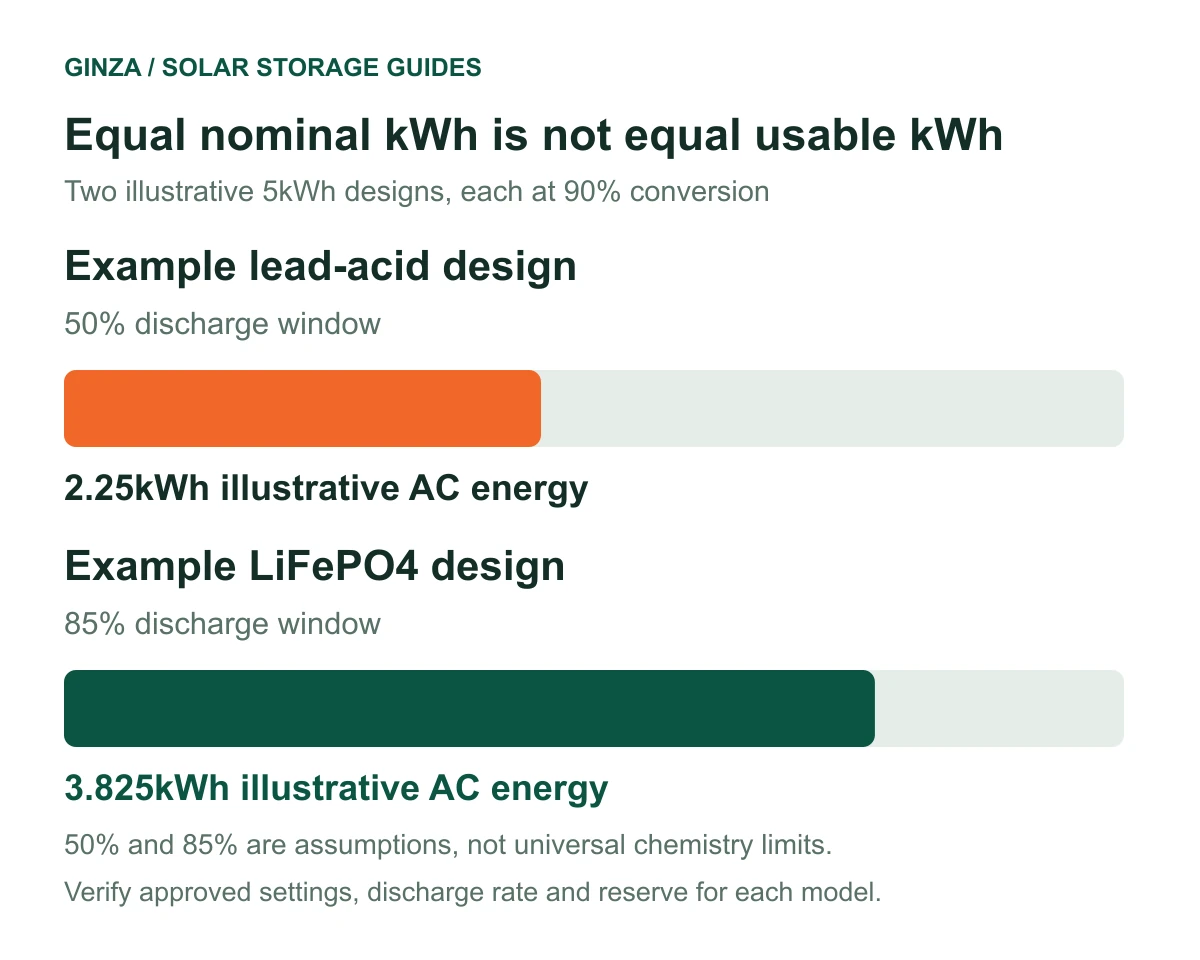
Consider two hypothetical banks, each rated at 5kWh nominal. For comparison only, assume a 50% discharge window for the first design and 85% for the second, with 90% conversion efficiency for both.
| Illustrative proposal | Calculation | AC energy before other losses |
|---|---|---|
| 5kWh bank, 50% window | 5 × 0.50 × 0.90 | 2.25kWh |
| 5kWh bank, 85% window | 5 × 0.85 × 0.90 | 3.825kWh |
The 50% and 85% windows are example design assumptions, not universal chemistry limits. Some products support different conditions. Ask for the permitted window and the performance data for the exact model rather than copying a percentage from a general comparison.
Reversing the calculation shows why equal Ah or equal nominal kWh can be misleading. Under the same illustrative assumptions, delivering 4kWh AC would require about 8.89kWh nominal at a 50% window, or 5.23kWh at an 85% window. These are mathematical examples, not a specification for a new GINZA model.
Victron’s lithium and AGM comparison explains how discharge conditions affect usable capacity. Its particular product examples are not evidence of GINZA performance.
Check discharge rate and peak demand as well as energy
A bank selected for several hours of modest demand may behave differently when a large load is applied. For lead-acid, the rated capacity needs to be understood alongside the stated discharge rate. For LiFePO4, permitted current and BMS behaviour are still essential checks.
The inverter can also become the limiting component. A battery bank with enough nominal energy may not be able to support a pump’s starting demand or several large appliances at once. Compare the same load profile, operating temperature and reserve objective when evaluating the two proposals.
For a worked load schedule, use the home solar battery sizing guide. For a higher-capacity reference, see the 51.2V 330Ah energy and runtime calculator.
Charging compatibility is a separate purchasing decision
A lithium battery should not be treated as an automatic drop-in replacement merely because the nominal voltage looks familiar. Confirm the inverter’s supported range, charging profile, current control, communication and any manufacturer-approved operating mode without closed-loop communication.
Lead-acid-oriented features and settings may be inappropriate for a lithium model. A qualified installer should review them against the actual equipment documentation. The Victron lithium operating manual, for example, calls for a suitable chemistry-specific or correctly configured custom charging profile. Its numerical settings are not universal settings for other batteries.
Also distinguish a physical interface from an approved protocol. A cable that fits an RJ45 socket does not prove CAN or RS485 compatibility. Ask the battery and inverter suppliers to confirm the exact pairing and required cable assignment.
Flooded, AGM and gel maintenance are not interchangeable
Flooded lead-acid equipment needs the care programme specified by its manufacturer, including electrolyte maintenance. AGM and gel products should not be described as if they require the same watering procedure. Trojan’s maintenance guidance differentiates these designs and identifies how sizing, temperature, charging and use affect service life.
LiFePO4 avoids routine electrolyte watering, but that does not remove the need for inspection, monitoring, secure installation and an accessible service route. The responsible provider should explain what is checked periodically, what alarm information is retained and when technical support should be contacted. Use the owner and provider maintenance checklist to assign observations, service and records after installation.
For either chemistry, consider who will actually carry out maintenance. A plan that relies on checks no one is prepared to perform is a weakness in the complete proposal, even if the battery’s datasheet is attractive.
Understand cycle life, calendar age and warranty separately
For either chemistry, compare the stated cycle-test conditions, calendar duty and actual warranty terms. A cycle figure alone is not a promise of equivalent years at every site.
The LiFePO4 lifespan, retained-capacity and warranty guide works through those measures in detail. Use the same duty and required useful energy when comparing a lead-acid and a LiFePO4 proposal.
Compare lifetime cost with a worksheet, not a slogan
Compare quotations that deliver the same useful outcome: for example, the same essential-load energy and backup period. Include the equipment needed to achieve that result, not just the battery purchase.
| Worksheet item | Information to obtain |
|---|---|
| Initial installed cost | Battery bank, compatible charging equipment, protection, installation and testing. |
| Maintenance | Required work, provider and the assumptions used for its cost. |
| Replacement plan | Expected operating conditions, service criteria and what a replacement would involve. |
| Useful energy | AC energy delivered under the chosen window, losses and load profile. |
| Comparison period | The same time horizon and usage assumptions for both proposals. |
A simple screening measure is total ownership cost divided by estimated lifetime AC energy delivered. It is only as useful as its assumptions. Do not turn a favourable cycle-test result into a guaranteed payback, and do not add unverified prices to make one proposal appear cheaper.
A compatible lead-acid design may remain worth evaluating for a particular duty and budget. A LiFePO4 proposal may offer advantages for a different cycling requirement. The decision should follow the actual models, installation and use, rather than a claim that one chemistry wins every possible application.
Before replacing an existing lead-acid bank
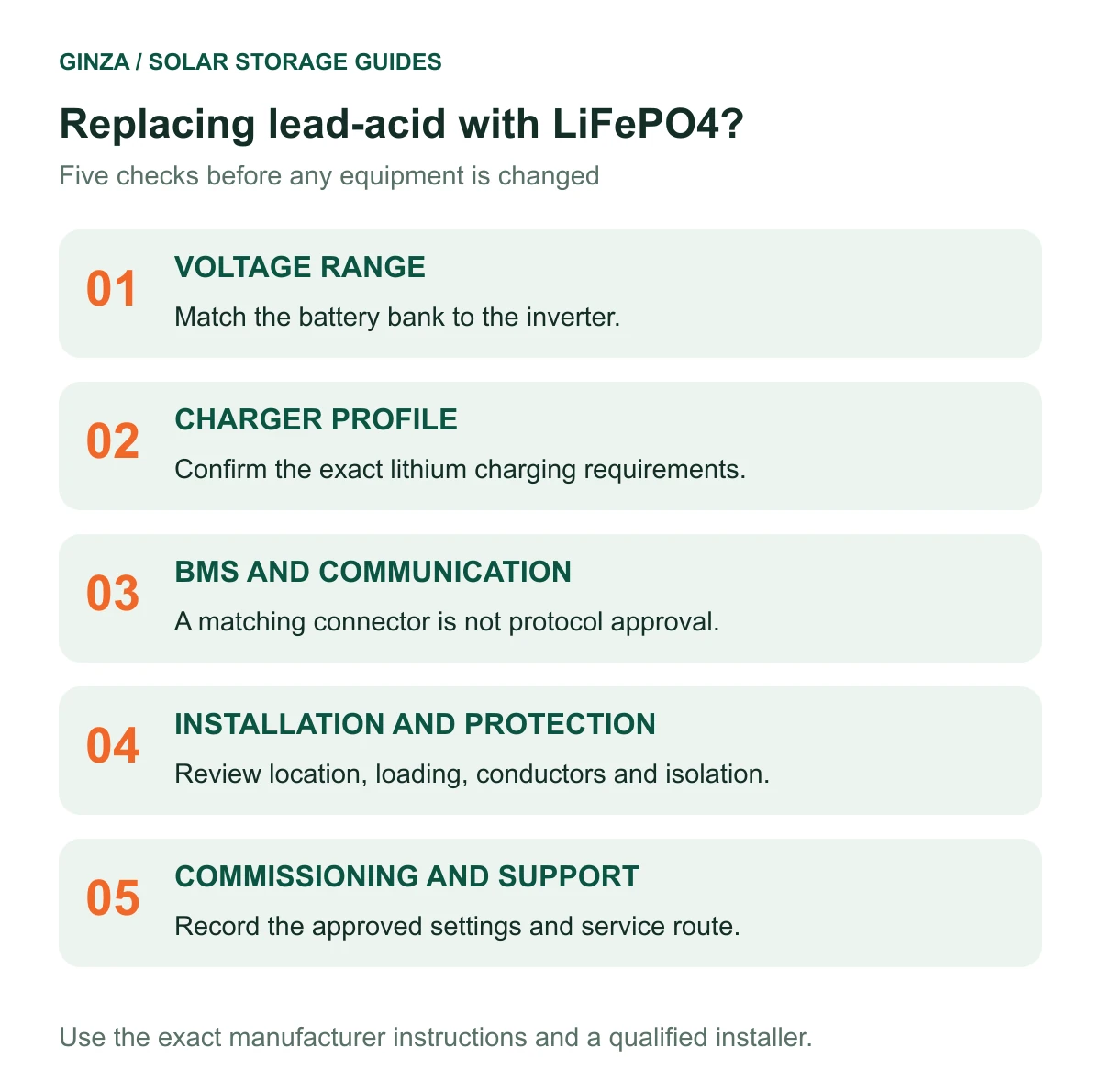
Use this as a review workflow with the installer, not a procedure for altering an energised system. Record the existing bank voltage, exact inverter and charger, firmware, current settings, physical location and load requirement. Then obtain confirmation of the proposed battery/inverter combination and any changes required to protection or conductors.
Do not assume different chemistries or existing banks can be directly mixed. Obtain manufacturer and system-designer approval for the complete architecture. At handover, retain the final settings and commissioning record.
If the proposal adds capacity to an existing lithium bank, the parallel-bank expansion review is separate from choosing a chemistry. Confirm the exact equipment combination rather than assuming nominal voltage makes products interchangeable.
What should Philippine buyers check at the site?
Review heat exposure, water exposure, clearances, service access and the equipment’s permitted installation conditions. An enclosure’s IP rating does not replace the installation manual or establish permission for immersion, unrestricted rain exposure or an enclosed heat trap.
Also decide whether the goal is everyday energy shifting, brownout backup or an off-grid supply. The battery chemistry does not itself provide safe outage operation. Use the hybrid, on-grid and off-grid comparison to establish the system objective before comparing batteries.
The location and IP-rating guide expands the heat, water and access checks for an actual installation.
Sources and interpretation
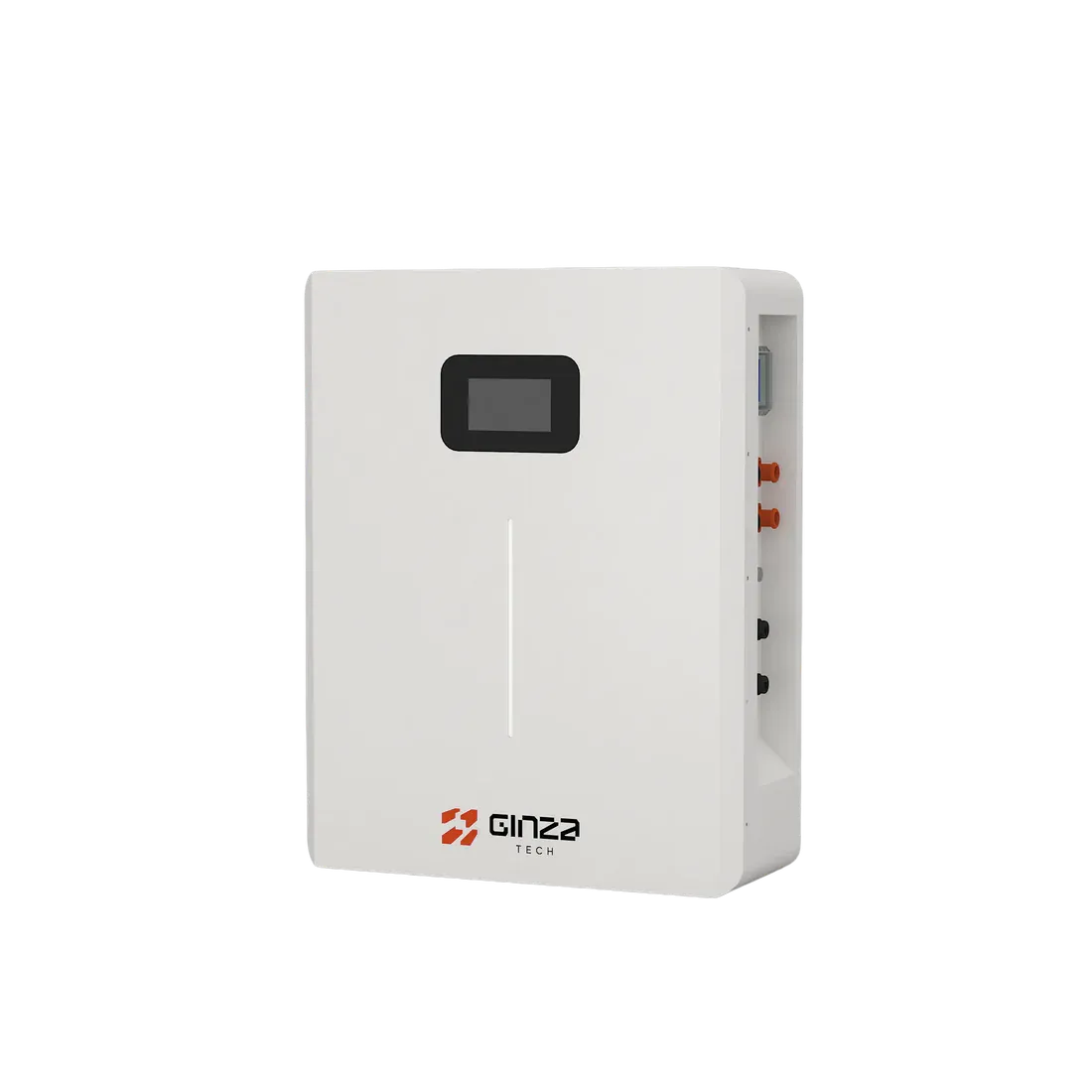
The two 5 kWh banks and their discharge windows are hypothetical comparisons. Manufacturer references discuss their own battery designs and care requirements. The pictured GINZA product is a model reference, not a test of the illustrative banks. Compare complete supported systems under the same duty before treating a chemistry label as a performance claim.
Frequently asked questions
Which is better for solar: lead-acid or LiFePO4?
Compare the exact models under the intended duty. Usable energy, current capability, charging compatibility, maintenance and complete installed cost are more useful than the chemistry name alone.
Do LiFePO4 batteries need a special solar charger?
The charger must support the exact battery’s requirements. Some existing equipment has a suitable configurable profile; other systems need changes or replacement. Have the complete setup reviewed before purchasing.
What are the disadvantages of switching to LiFePO4?
The existing installation may need compatibility work, different charging control, BMS integration or other equipment changes. Include that work and the support arrangements in the quotation.
Is LiFePO4 fireproof or maintenance-free?
No battery installation should be described as risk-free. LiFePO4 still requires correct equipment selection, protection, installation conditions and the specified inspection programme.
Explore the GINZA 51.2V LiFePO4 range, or send the team your inverter model, country and load requirement. Philippine homeowners can request an assessment through the existing installation page.